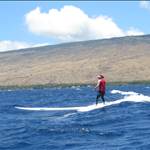
Out of the first 12 competors home in Sat 12 Towers about 8 of them were riding dugout sups.
Can I get some technical detail why these dugouts are performing better than the more traditional DW boards?
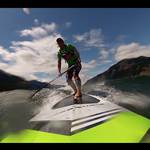
They have less drag because there are fewer edges to catch. They are smooth and rounded like torpedoes up front, and have high sides to prevent the side rails from "digging into" the water, and water getting onto the deck. They also tend to have narrow tails which present a smaller surface to catch when the board pitches (i.e. the nose of the board goes up) and so have less drag there also. The paddler stands close to the waterline so the boards can be more stable for a given width. The big boofy noses can also mean that in mild conditions you don't have to move your feet much, so is easier to maintain a high average speed.
The downside of dugouts is that they can be hard to control in strong winds and big conditions, and if you fall you will lose a lot of time because they are hard to get back in. They can also fill up like a paddling pool in big conditions. They don't surf well either, and are horrible for beach starts.
So dugouts are quite a specialised racing design. But they are very effective in the right conditions and with the right paddler on board because, simply, they are low drag. In big conditions drag can be your friend, allowing you to control the board. So big conditions (e.g. over 30 knots and waist-high or over bumps) on dugouts needs really good skills from the paddler.
mmmmm from an engineering perspective it is an ability to drop the centre of gravity and the width whilst giving the ability to the rider to increase the paddle cadence through using a shorter paddle. In real terms, they look really badassed and everyone is on them and that means that just through sheer numbers they will be finishing higher up the winners tree a lot more often.
Footage on the net of beau paddling the ace in WA is some of the best around for how to control and use a dug out to its full potential. Matty nottage also.
I like a flat flat deck myself but a flat deck pin tail like the falcon. An easier 1 board quicker all round everyday board to paddle in the ocean.
Select to expand quoteArea10 said..
They have less drag because there are fewer edges to catch. They are smooth and rounded like torpedoes up front, and have high sides to prevent the side rails from "digging into" the water, and water getting onto the deck. They also tend to have narrow tails which present a smaller surface to catch when the board pitches (i.e. the nose of the board goes up) and so have less drag there also. The paddler stands close to the waterline so the boards can be more stable for a given width. The big boofy noses can also mean that in mild conditions you don't have to move your feet much, so is easier to maintain a high average speed.
The downside of dugouts is that they can be hard to control in strong winds and big conditions, and if you fall you will lose a lot of time because they are hard to get back in. They can also fill up like a paddling pool in big conditions. They don't surf well either, and are horrible for beach starts.
So dugouts are quite a specialised racing design. But they are very effective in the right conditions and with the right paddler on board because, simply, they are low drag. In big conditions drag can be your friend, allowing you to control the board. So big conditions (e.g. over 30 knots and waist-high or over bumps) on dugouts needs really good skills from the paddler.
Area10, thanks for a great summary, as often.
I am currently testing a Starboard Ace-GT 17'4" x 27" from a friend in order to decide a buy or not. This summarise very clearly the pros and cons. Our mild conditions and the intended use for me as a distance touring board seems to resonate with the pros.
Luc
Dugouts are awesome. No other board to have if it's Downwind Upwind Choppy waters yout can't beat them.
They are stable cos of low gravity points and pretty much roll over the bumps themselves.
As for hard to get back in if you fall off. No way. Just as easy as flat deck board once you work it out.
Really the only thing dugouts don't like or are not good at is Surfing in or out.
Watch Jake and T2 on the Video from 12 towers and make it look like it should.
Get on ONE and you will love it. It will change the way you downwind for ever.
Xx angie
Select to expand quoteangie pangi said..
Get on ONE and you will love it.
Get on "any" one and you will love it ? :-)
I am friend with the new distributor in Canada/Americas so don't shoot at me....
Select to expand quotegregc said..
mmmmm from an engineering perspective it is an ability to drop the centre of gravity and the width whilst giving the ability to the rider to increase the paddle cadence through using a shorter paddle. In real terms, they look really badassed and everyone is on them and that means that just through sheer numbers they will be finishing higher up the winners tree a lot more often.
Regarding the bolded section above, having paddled these designs since the very early iterations (Starboard K15, New, Ace, Sprint), it's gratifying to know that they have finally reached a critical mass, or in other words, at last I feel like I am in with the cool kids. 
It is funny though, because for a very long time, many people considered dugouts to be an abomination, not in the spirit of the surfing roots of the sport, etc etc. Yet some of the most vocal critics of the past have now become converts. And that's because the design just works! Whether or not you think they look "badass" is of course, subjective. Personally, I do think that a skilled rider such as Beau, Matt, Jake or the Tardrew brothers make dugout down winding look awesome.
Select to expand quotePTWoody said..
Personally, I do think that a skilled rider such as Beau, Matt, Jake or the Tardrew brothers make dugout down winding look awesome.
Regretfully, having just acquired an Ace-GT, I will tip the balance on the other side.....
The boards are also stiffer in a dugout vs flatdeck.
I personally can paddle a dugout easier Dw than a flat deck. At low speeds I find them easier to steer off the nose or paddle steer them. At higher speeds they're actually easy to steer once you move your feet a little. The only place a flat deck is easier is through the surf at the finish in my opinion. They do take time to get to know how they work but it worth it. The most common mistake I see people make is get a board they can survive on down wind, not be Comfortable on. You need to be comfortable walking round and putting the board on its side etc because you need to be doing these things to steer it properly.