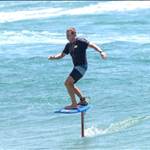
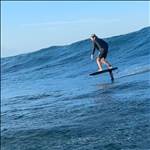
Front angle of what JB previously posted , we actually shot this the same day. Great minds think alike. This is the extended version of what I put on instagram and slowed down the last 40 secs so you can watch the foil work. I also show where I stuck the Gopro session 5 under the board in the start of the video , if you want to try it (blue board on top of the boat) The Gopro stick on's are the bomb.
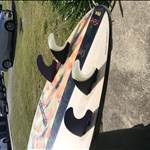
The more you watch this you can see the foil work when I pump , plus when I get too high it starts to cavitate and hum like hell the higher I get it up. This is a GoFoil thing not all foils do this. The mast mount on this Sup board is 7-6 x 28 board is at 23" from the tail and even at this short distance you still get tail tap when you pump causing drag. So the further forward you mount the mast the more the tail will hit in a pump. Since this board we have gone back to 21" or less. (the white board on the boat) it lifts just as easily and is more stable at high speed plus heaps easier to pump.
Select to expand quoteDavidJohn said..
Do those foils come with a volume knob.. 
Yes, it is a piece of sandpaper :-)
Seriously, if you want to reduce the humming you must sand the trailing edges (mast and wings), ideally in a asymmetric way to lock the trailing vortex on one side of the thick trailing edge. See my post with schemas at www.seabreeze.com.au/forums/Stand-Up-Paddle/Review/Fin-Whistle
You should aim for the case #7 of Fig 6.35, but without getting an edge that can cut the skin.
Myself, I prefer the humming than taking the risk for me and others. Plus you get used to humming, the auditive feedback is welcome to know what is happening (On my foil, the humming seems proportional to the length of mast in the water). And it makes the prone surfers think twice before thinking dropping on you, it save you the trouble of whacking them on the head with the paddle :-)
Seriously, I nearly never shout on people dropping on me (never on small kids / girls / women anyways), as I consider that I can get so much waves that it doesn't matter, but I had to shout to a guy and threaten him with my paddle as he was trying to drop on me nearly on my trajectory as I was foiling... there are some suicidal types. I try to go foil on peaks where I am alone, but of course seeing me taking wave after wave attracts always some prone bozo who think he can thus take also waves... of course he catches nothing and leave disgusted, but this was the first time saw one trying to drop me, with of course not a chance to actually catch the wave.
Select to expand quotecolas said..
Seriously, if you want to reduce the humming you must sand the trailing edges (mast and wings), ideally in a asymmetric way to lock the trailing vortex on one side of the thick trailing edge. See my post with schemas at www.seabreeze.com.au/forums/Stand-Up-Paddle/Review/Fin-Whistle
You should aim for the case #7 of Fig 6.35, but without getting an edge that can cut the skin.
This was explained to me the other day when I was talking about my Neil Pryde windfoil humming loudly. I want to get a bit more information about how do sand the trailing edge correctly before attacking my wings. Any more advice on that?...
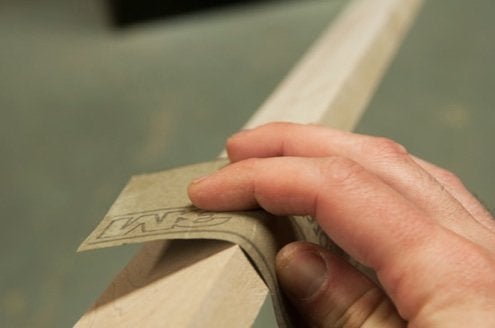

This is GoFoils reply to my video on how to stop the hum:-
Usually it is the back wing but also can be the front wing. The back one inch should be sanded to almost a concave. Look for trailing edge going to a rounded shape towards the middle of edge either top or bottom surface. Think of it releasing the other way like a concave. Usually last 1/4" of rounding is the culprit so try and see if you can see it. Put sideways in light as it is very hard to see or put straight edge on it to help see it.
I think in your latest video here Colas really puts to bed any advantage of the forward mount mast as I stated above in my video about tail tap causing drag. Good to see you up and riding but when you pump & ride that tail just keeps hitting the water and pulling you down. Yes it's a pretty weak wave but we are flying on those and able to pump through. Just letting the vision tell the story.
Ah ah ah... I don't believe it.
This was the first of my foiling video I didn't upload to seabreeze, thinking "Why bother, the usual band of fools will just nitpick on irrelevant details, ". I am so sad to be right... 
And to think some are accusing me of always speaking of these mast positions...
Let's focus more on the important parts: technique: I do not pump vertically (a la "Huntington hop") on takeoff because I do not have yet the balance needed to start the flight without being destabilized in the first meters (you can see an example of this at 1:25). Instead (but I do not do it in the takeoffs in the video) I just pump longitudinally, pushing back & forth my feet to give forward acceleration to the wing and raise the lifting speed. I find it easier to enter the flight fully prepared, plus it is stabler in hot situations (late take offs, take offs in the foam) Note that I can paddle feet in the straps, so my feet are actually quite forward, and thus the mast quite backwards compared to them.
On the rest of pumping, you can see that the waves were very, very slow (5s period), so I am in near-stall mode (The wing, hence the board, is pointing upwards). This is the main problem, I should have focused more on getting more speed rather than lift.
And I also do not use my arms and upper body enough. And my feet are too contracted (toes are flexed). BTW, this is what an expert foiler told me when he saw the video: actual issues with my technique, not some imaginary drivel.
Seriously the tail dragging is not very important, as Finn Spencer shows us here (he starts at the center of the board): the technique is 10 times more important. One could even think he actually uses the tail to push on the water for leverage.
www.facebook.com/Gofoils/videos/658305287705088/
Colas it looks like you are having to use quite a lot of effort to keep the foil down, if there is a way you can shim the hole foil set up so the front of the front foil point up a fraction more I think it would be well worth trying. I know it is a Tuttle but if it were a plate design I would add a 1 or 2mm spacer under the rear, you want to try and bring the leading edge of the front wing down by 10mm or so which is probably about between 0.6-1deg and see how that feels. Until you experiment with this you wont realize the difference it can make! a few mm can make a board go from shocking to amazing and back to shocking so there is a real sweet spot you have to find.
Waves look perfect in that vid!
Colas said:- This was the first of my foiling video I didn't upload to Seabreeze, thinking "Why bother, the usual band of fools will just nitpick on irrelevant details, ". I am so sad to be right...
Guess that makes me the fool 
Colas said:- I should have focused more on getting more speed rather than lift.
You won't get any speed without lift. That's what a foil does giving you speed from your lift , without it you are dead in the water.
Colas said:- Seriously the tail dragging is not very important, as Finn Spencer shows us here (he starts at the center of the board): the technique is 10 times more important. One could even think he actually uses the tail to push on the water for leverage. (no way)
Seriously it's a kid on a flat water start on a micro board and you want to compare that technique to your video. The whole point about my rebuttal, is just maybe you are wrong but for some reason, you won't entertain the idea or consider other expierenced advice. I'll leave you with this.

Select to expand quotecharlieuk said..
Colas it looks like you are having to use quite a lot of effort to keep the foil down, if there is a way you can shim the hole foil set up so the front of the front foil point up a fraction more I think it would be well worth trying.[...]
Waves look perfect in that vid!
Yes, I can add washers to the screws holding the wing / stab / fuselage or even to the tuttle head. And I have also a thin-foiled high aspect stabilizer to use for less stability but more forward/aft looseness for better pumping for when I will be better at it.
However, the foil is currently well balanced at speed: racing at full (scary) speed on some punchy hossegor freight trains showed me that the balance is perfect in this extreme case with my current straps position, so I am not eager to deviate from this neutral handling yet. I really feel that once you know your gear works (I had to adjust my straps positions to find this neutral balance at speed), the pilot technique is what makes the difference. Plus you can see in the video that I have no problem keeping the foil down (I am even often too low) when the wave has some face.
I really think that my raised position is due to my lack of technique: I react to the lack of speed just like a (bad) plane pilot would pull on the controls to raise the nose if he feels that his speed is dropping, instead of diving to get speed. If you look at the vids of good foilers, they keep their speed by choosing carefully their trajectories on the wave... just like good surfers in fact. I often get stuck on the flats like a beginner surfer. It is not that the foil raises by itself, it is me, the pilot, that raise it unconsciously.
The waves were very nice for foiling, but were much better a tad earlier. By looking at the buoy afterwards the difference was the period: at 6s for my weight and gear and technique I have enough speed to fly, at 5s it becomes harder.
Select to expand quotePiros said..
This is GoFoils reply to my video on how to stop the hum:-
Usually it is the back wing but also can be the front wing. The back one inch should be sanded to almost a concave. Look for trailing edge going to a rounded shape towards the middle of edge either top or bottom surface. Think of it releasing the other way like a concave. Usually last 1/4" of rounding is the culprit so try and see if you can see it. Put sideways in light as it is very hard to see or put straight edge on it to help see it.
Interesting. It looks like the wing trailing edge is somewhat near the case #3 of the figure above, and he advises to "remove the bump" to get to case #5. Or going from #6 to #8. Makes sense.
This is how the rear front wing looks on a Kai Go Foil , it's quite square from the factory.

Same view rear wing , some dings and bruises from bottom strikes.

Select to expand quotePiros said..
This is how the rear front wing looks on a Kai Go Foil , it's quite square from the factory.
Ah, it looks more like case #1 then.
To continue with videos that show how a foil works, this one is quite interesting as it mixes two types of pumping:
The vertical one, and the "roller coaster" classical surf action (or gulls in upwards winds on the face of a dune).
Or even three types, if you separate the simple vertical hungtinton hop from the more "circular" pumping where the legs push the foil forward at the descent.
www.facebook.com/patrice.guenole/videos/10214013237147332/
Select to expand quotecolas said..
To continue with videos that show how a foil works, this one is quite interesting as it mixes two types of pumping:
The vertical one, and the "roller coaster" classical surf action (or gulls in upwards winds on the face of a dune).
Or even three types, if you separate the simple vertical hungtinton hop from the more "circular" pumping where the legs push the foil forward at the descent.
www.facebook.com/patrice.guenole/videos/10214013237147332/
If it is flat try this way more fun :)
Select to expand quotecolas said..charlieuk said..
Colas it looks like you are having to use quite a lot of effort to keep the foil down, if there is a way you can shim the hole foil set up so the front of the front foil point up a fraction more I think it would be well worth trying.[...]
Waves look perfect in that vid!
Yes, I can add washers to the screws holding the wing / stab / fuselage or even to the tuttle head. And I have also a thin-foiled high aspect stabilizer to use for less stability but more forward/aft looseness for better pumping for when I will be better at it.
However, the foil is currently well balanced at speed: racing at full (scary) speed on some punchy hossegor freight trains showed me that the balance is perfect in this extreme case with my current straps position, so I am not eager to deviate from this neutral handling yet. I really feel that once you know your gear works (I had to adjust my straps positions to find this neutral balance at speed), the pilot technique is what makes the difference. Plus you can see in the video that I have no problem keeping the foil down (I am even often too low) when the wave has some face.
I really think that my raised position is due to my lack of technique: I react to the lack of speed just like a (bad) plane pilot would pull on the controls to raise the nose if he feels that his speed is dropping, instead of diving to get speed. If you look at the vids of good foilers, they keep their speed by choosing carefully their trajectories on the wave... just like good surfers in fact. I often get stuck on the flats like a beginner surfer. It is not that the foil raises by itself, it is me, the pilot, that raise it unconsciously.
The waves were very nice for foiling, but were much better a tad earlier. By looking at the buoy afterwards the difference was the period: at 6s for my weight and gear and technique I have enough speed to fly, at 5s it becomes harder.
That doesn't really make sense to me, at speed if anything it would be worse and you will have to fight it even more. I cant see why you would want it different for the two conditions personally.
Select to expand quotecharlieuk said..
That doesn't really make sense to me, at speed if anything it would be worse and you will have to fight it even more. I cant see why you would want it different for the two conditions personally.
What I said is I have been at very high speeds already, and the foil is perfectly balanced at speed. Note that at these high speed, 1" difference on the placement of the front foot (space between straps insert positions) had very noticeable effects, the proper front foot position was quite obvious when tested at high speed. Back foot position is not really important.
So, your proposition being true(*): "if the foil lifts too much in the slow waves of the video, then it will be worse at speed",
simple logic thus dictates that the foil does not lift too much in the slow waves of the video.
If we have "B is false" and "A ==> B", then A is false.
Thus my analysis is that since the foil doesn't lift too much, the stalling is a pilot error, not a gear problem.
(*) actually, it could be false, maybe if the wing / stabilizer balance was changing with the speed. This is why I said that I'd rather have my foil tweaked for the high speeds (which is the case) because I cannot imagine struggling against the huge forces in play at high speed, whereas compensating for some inbalance at low speed seems doable. Hossegor waves can switch from mellow to hollow quickly with the tide.
Select to expand quotehilly said..
If it is flat try this way more fun :)
But much, much more dangerous. :-) A wheelchair is not my idea of fun ...
I never skated again after falling off a ramp on the concrete. As Gerry Lopez said, "The best surfer is the one that can still surf the day after."
Interestingly, on the video the rider is Patrice Guenole whose son was doing BMX competitively but had him stop and spend more time foiling because of the high probability of ultra-serious, crippling injuries in BMX.
Select to expand quotecolas said..hilly said..
If it is flat try this way more fun :)
But much, much more dangerous. :-) A wheelchair is not my idea of fun ...
I never skated again after falling off a ramp on the concrete. As Gerry Lopez said, "The best surfer is the one that can still surf the day after."
Interestingly, on the video the rider is Patrice Guenole whose son was doing BMX competitively but had him stop and spend more time foiling because of the high probability of ultra-serious, crippling injuries in BMX.
Yes foiling is the rollerblading of surfing