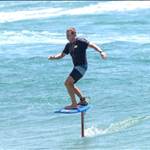
Patrice Guenole has made a 1h17mn video where he details all the differences between all the foil wings in the (huge) Gong line.
It is in the form of Question and Answers (Q&A) or "Ask Me Anything" (AMA) session. People asked their questions on the Facebook Group, and Patrice then made a video of his answers.
French audio with English subtitles.
Enjoy!
PS: I think the insights of a designer on his motivations behind each design feature is always interesting, even if you do not plan to buy his creations, nor agree with his choices.
I'm curious to see when Gong finally produces a high aspect foil wing. They highest they do is barely middle of the road.
Otherwise their foils are pretty awesome.
I think Patrice said that he was not yet convinced by the extreme aspect ratio foils. He has prototypes, but do not feel they are worth it (in the sense advantages/ drawbacks) in the current state the Gong market (i.e it will be useful for not enough people to justify the price of a production line mold)
But the current line perform. Beryl Besseau won the "Exterme Cordouan" contest this month in the Wingfoil category with a Gong foil Veloce extremecordouan.fr/
He had so much lead on all the other contestants that he just did the downwind return leg without the Wing (floating in the wind).
I don't say Gong foils are better than the others. Just that they wont handicap you ;-)
Select to expand quoteGrantmac said..
I'm curious to see when Gong finally produces a high aspect foil wing. They highest they do is barely middle of the road.
Otherwise their foils are pretty awesome.
Yes & no Grant . The Veloce L&T 90 isn't far off the mark at all , it's similar to design and spec of the new Axis BSC range 890 & 970 , plus along the lines of the new UNI 190 Vyper & Signature Game Changer 1260 . Yes these all aren't HA foils but that's where the market is going to high performing mid to higher aspect foils. I've been riding the Axis 890 BSC and it is the easiest / higher performace foil I ever ridden , it's only mid to high at best. I'm over the super high aspect foils , yes they have monents of brillance but Dam they are hard work.
Gong seem to quote a lower AR then I calculate off of the projected area, perhaps they use the developed area in their calculation. That puts the Veloce around 5.5-6:1 using the projected area which is definitely in the ream of mid-high aspect.
I'm tempted by one as a faster wing that will still mount on my Starboard fuselage (it's been done before). Especially if they retain an easy and secure carve which in my experience isn't always possible without some sort of winglet.
Select to expand quoteGrantmac said..
Especially if they retain an easy and secure carve which in my experience isn't always possible without some sort of winglet.
You may want to try to glue/clip/screw a small vertical fin (1"to 2") on top of the fuz of your foil(s). It makes wonders for carving as it prevents the small yaw parasitic movements that can happen in turns (and kill your speed) if your foil wings are not directional enough. You can play with the position on the fuz to dose the effect.
The advantages are that unlike winglets, they do not run the risk of breaching in turns and making the foil more unpredictable, and in a straight line their effect is lessened a bit by the wake of the mast, loosening a bit the foil to start a turn.
The drawback is that you will not be able to "dishpan" turns, only carve.
For example I used this on an early Going foil with totally flat wings and a round section fux:
But I did not need one with the Rise or Curve wings (and stabs) that are curved, and the square section alu fuz
Not sure about that one Colas pretty old school if anything should be on top of the wing not in front .
Select to expand quotePiros said..
Not sure about that one Colas pretty old school if anything should be on top of the wing not in front .
Not really.
You want it on top of the stab if you are looking for the maximum efficiency of its effect. But in this case putting it forward has two benefits:
- less leverage, so it does not stiffen too much the foil at high speeds. Plus you have more leverage on it to make it stall to allow quick yaw motions at slow speed (positioning for the wave while paddling), especially if you keep it somewhat high aspect (i.e. do not use a keel/nubster template)
- more in the wake (turbulent flow) of the mast in a straight line. This is important to have some looseness when initiating a turn, otherwise you run the risk of tracking, as if the foil was on a rail. A bit like wings on a surfboard tail keeps the tail loose.
- plus a safety bonus, as this fin is small, it is thin, and putting it away from body parts is better.
Basically, I started with it on the stab, but I found it was better surf-wise to have a bigger fin closer to the mast than a smaller fin on the stab. The fin on the stab, or better yet, under the stab (to avoid the mast & front wing wake) would be more hydro dynamically efficient... but too efficient, and limit the rider to foil in a straight line (like most Wind foilers do, hence they often have the fin on the stab)
Note that this is quite an efficient solution, as it is the one that is used on most planes, not just "old school" ones :-). Managing stability on planes with only the curve on wings is tricky: a rudder is the simplest way to do it. Plus with foils in water, if you rely on the shape of the tips for stability, breaching a tip in a turn tend to be catastrophic.
I'm (mis) using SUP/winging for wings for windfoiling and I will admit that I don't get along well with really flat tails. Good thing my preferred fuselage (Starboard) has a few tails with flipped tips available that work nicely. They also adjust really effectively without shim.
Also I make my own fuselages so I can easily adapt to whatever wings I want, Gong is tempting (I've had one for winging).
Yesterday after reading this post I tried swapping my usual go-to 'flat' 250 Starboard stab for the older 270 'mustache' style with turned down tips and found it way easier to to stay on a downwind wave with wing fully de-powered. I was really blown away at the difference. Just shows how worthwhile it is to not get complacent but change and experiment with the gear.
Yeah I agree tails are so important , that's why I'm such a chop shop freak . The tail is basically drag for stability , you want to try to ride as small as possible . It comes at a cost for stability and pump . Thicker rear/wider wings plane up with speed causing front wing breach so you want to get them as thin and short as possible . I like flat but thin but turned up or down tips can give you that bit extra stability in your pump. Less is always best on the tail , if you bolt on a large rear to help with pump and start , yes you might get going easier but it planes up very quickly with minimal speed causing a front wing breach. It also extends and slows down your pump arc.