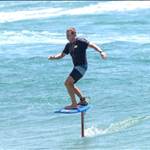
Small video showing the Gong shaper - Patrice - (farther from the drone in the first image), and a guy new to SUPfoing - Antoine - (it was his second session), but already a very good kitefoiler (closer to the cam).
Both on the new Gong SUPfoil (big flat front wing, 2' mast). I ordered one, and will report my adventures!
Boards are in the 8' range. Antoine didn't had time to put straps on it, but will install them as he says it is so much easier with straps. Note also the positions of the straps of Patrice: they are set for the specifics of foiling, very different from surfing/windsurfing/towing/kiting straps : much more centered on the board: this way the board is more balanced "in flight" rather than being on the rear like for surfing with the nose adding a lot of swing weight and catching the wind. Plus you can paddle while in the straps, a major plus. Of course the foil box is also more forward.Gong SUP foils and boards are being produced now (with this centered straps & foilbox placement) and should be available in April. Note that the foils are produced in France, in a new shaping facility at the Gong headquarters themselves, hence the 30% higher price than the china-produced kite foils.
Another video, with the whole rides, so you can see the takeoff phases. Note that:
- Although the Gong shaper in the video, Patrice Guenole advises "Tomo" compact shapes for people wanting hybrid boards that can be used with or without the foil, he says pointed shapes - like in this video - are better for foil use.
- Straps are mandatory for control and safety, and ease up the learning phase immensely. But they require a centered placement of the foil - and the straps - , so that you can paddle with the feet in the straps, moving your feet while flying is impossible.
- This centered position of the straps+foil is much more natural than trying to put the foil in the rear and riding like one would while turning a foil-less SUP (rear foot on the tail). It helps paddling and not disrupting the ride on touching the water
- You should take the board size you feel stable, and step up at least a bit (let's say 4-6" in length, 15/25 liters, 1" width) for the foil board to gain stability for your first foil board.
That is a great video as it shows the take off and also the kick out at the end of the wave and the use of footstraps which seem to make a BIG difference.
The take off is interesting in straps as he gets foiling very early. I saw another video and these dudes are advising to take the drop normally and then get the foil up in the flats. The Gong dude is foiling straight away in the straps which is much better.
The kick out at the end in a small beach break is interesting as I was thinking that it would be easy to hit the bottom and rip out the foil box!? But seeing him kick out before hitting the bottom is the way to go.
Also he's actually surfing the wave rather than just going in a straight line along the wave on the foil - which defeats the purpose of surfing.
Why are 'pointed' board better for foil surfing than a Tomo style?...
PS: I have ordered a foil for windsurfing as I thought I'd start with that as a few hours wind foiling would be the equivalent of weeks/months of trying to get the hang of foiling a SUP. I might cross over into SUP foiling when I have got the hang of wind foiling...
Some more waves, one full ride in each video.
Note how he can paddle feet in the straps before and after the ride.
He also tries to ride low, close to the water for a more "surfy" feel, so it is important to design the gear so that touching the water in turns is not a problem.
Select to expand quotesupSURFmachines said..
Colas,
What does Patrice weigh?
86kg now, I think. He is on a Curve 8'4" 120l. He normally rides SUPs in the 95/105l range.
For my 95/100kg, he advised me a Curve 8'9" 135l, as my normal Curve SUP is the 8'4" 120l.