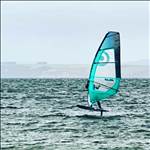
Hi all , I'm a long time kite and wing Foiler but would like to get into SUP foiling ( not DW ) .
where I live , quite often for a few days after we've had some strong winds we get some good rideable shoreline waves .
I was just wandering which board and paddle set up people would advise for a 85kg rider .
also how do you paddle correctly as the quick go that I had on my 5'3" board I ended up going in circles.
thanks I'm advance .
You don't mention your SUP experience but I think one of the solid skills for SUP foil is a good single side J stroke technique. This allows you to accelerate the board in surf stance. Starting in SUP stance can be done on a bigger board but is harder to do. A 5'3" board will have very little directional stability so unless your paddle skills are good you will go round in circles.
Gong say 30 litres over body weight is a good starting point. I am 93kg without wetsuit etc and am using an 8' 130 litre Starboard Hypernut with an Armstrong CF2400v2 Foil on a 60cm mast and fuselage.
progress has been good and I have had some long rides when conditions have been OK.
But for sure the board is too long when I am on the foil and the foil is positioned quite a long way back in the board.
Here in the North of Scotland there is no one else SUP foiling so I am having to sort it all out without much feedback but am looking for another board that will be a little easier than the Hypernut. Think this should be about 7' and plus 40 litres on my weight with wetsuit etc. So about 140 litres. Also with good tracks for foil adjustment.
So at 83kgs based on my experience you would want something about 6'9" and 130 litres.
The surf you are talking about is likely to be short period storm swell, this tends to be messy and having had a few less than perfect days falling off the Hypernut I am thinking of going plus 40 or even 50 litres to make things more relaxed out back and also paddling out so that sessions last longer.
One of the things I have found is that it's possible to make long rides on the foil then pull out and look back with dismay at how far you have to paddle back out!
Hope that helps, a hot shot will be along shortly with different advice :)
Thanks for the advice FarNorthSurfer.
I've had only limited sup hours and only tried my wing foil board out of curiosity.
I'll take on board what you say about volume although my vehicle restricts me to something no more than 6'"4 long .
I've noticed that there's a lot of videos with boards having more of a deep Hull shape rather than flat .
is that the growing trend for sup foil boards ? ps I'll be working on my J Stroke for sure .
thanks again .
Board shape seems to be falling in to SUP foil/Downwind and SUP Foil/Wing but of course you can wing them all if you want.
The deep V hulls like Kalama E3 also tend to be very narrow and I think would need some good skills to SUP in a choppy windy line up. I have never tried one though. There is a wide E3 but finding one would be hard.
my Hypernut is 31" wide and my gut feeling is that this slows it down but I think the rocker is what really slows it down.
I am looking at boards like the Fanatic SUP foil, Gong Zuma and Sunova Aviator but haven't decided yet which would make progress easiest. Also in the mix is FOne and AFS Fly.
The current version of the Sunova Aviator Pro is a board I have seen people learn to SUP DW foil on and have success. The Sunova Aviator Elite is narrower and is better for people that have SUP paddled before.
Select to expand quoteBritfoil360 said..
I've had only limited sup hours and only tried my wing foil board out of curiosity.
Forget it. SUP-paddling a 5'3" needs an advanced paddling technique that takes time to learn.
We are not speaking of just being able to gently paddle somewhat straight.
We are speaking of paddling with all your might, while being comfortable enough to handle the balance on the board.
Once you progress in SUP foiling, it is easy to get very short in board length. But for the first steps, basically, you need to be able to SUP-paddle a board of the same length.
PS: more than the hull design, being able to add a front fin to the board helps a lot mastering the row.
Select to expand quotecolas said..Britfoil360 said..
I've had only limited sup hours and only tried my wing foil board out of curiosity.
Forget it. SUP-paddling a 5'3" needs an advanced paddling technique that takes time to learn.
We are not speaking of just being able to gently paddle somewhat straight.
We are speaking of paddling with all your might, while being comfortable enough to handle the balance on the board.
Once you progress in SUP foiling, it is easy to get very short in board length. But for the first steps, basically, you need to be able to SUP-paddle a board of the same length.
PS: more than the hull design, being able to add a front fin to the board helps a lot mastering the row.
Hi @colas on topic but slightly different question you might be able to answer. The Gong Zuma 140litre and 160 litre boards are both the same width and I am wondering if the lateral stability is much the same ?
I am 93kg (winter wetsuit adds a lot more) and using an 8' 130l Hypernut for SUP foil.
It's fine when conditions are ideal but challenging when it's choppy and messy which is common at my locals. Not sure how much is down to the Hypernut board shape with a foil, I have to stand well forward on it. And think I will be fine on the 140l Zuma but there might not be much compromise in performance on the 160l which would be super comfortable and allow me to focus on getting the foiling right.
For the OP the Zuma has the forward fin that colas mentions in his post
For a 85kg rider, a larger SUP foil board would likely be a good choice. Look for a board that is at least 8-9 feet long and has enough volume to float you and your foil comfortably. Some popular models include the Slingshot Wizard and the Fanatic Fly Air.When it comes to paddling, it's important to keep your body and the board in a straight line and to use your core muscles to generate power. A proper paddling technique will help you to maintain control and stay on course. When you're ready to catch a wave, start paddling early and accelerate into the wave to build speed. Once you're up on the foil, use your upper body and your back hand to steer the board and keep it on the wave.
Select to expand quoteFarNorthSurfer said..
It's fine when conditions are ideal but challenging when it's choppy and messy which is common at my locals.
Mmm, I am afraid I have no relevant advice for you. I hate chop, so I'd rather not get out than have to cope with heavy chop (yes, it means I can stay weeks out of the water), so I do not have first hand experience on what would work best. And I never tried the Zuma nor the Hypernut...
On the paper, the 160l Zuma should be a tad stabler...
Also, square noses like the Hypernut tend to plow into the chop, and rounded noses like the Zuma may be more comfortable as the rider do not feel the urge to keep the nose as high above the water... compromising balance by sinking the tail. But this is just a guess.
Also, in my experience, a lot of the stability in chop in SUP foiling is given by your technique, by always moving a bit relative to the water so as to use the foil mast and wing as a stabilizer, a kind of huge fin, a balancing help that disappear at rest. Keeping your feet away from the rails also help balance by avoiding over-compensating correcting movement...
In a nutshell: advice from "chopmeisters" are welcome :-)
What advice / drills / tips for someone in a similar position?
I thought to spend some time on a normal SUP, but from my experience with a surfboard / foilboard where the balance is so incredibly different that any time spent without a foil is not at all beneficial to learning to paddle a foil board. I wonder if this applies equally to standing?
Flat water then offshore surf then onshore surf, then downwind?
Purely focus on J-stroke?
Select to expand quotecornwallis said..
I thought to spend some time on a normal SUP, but from my experience with a surfboard / foilboard where the balance is so incredibly different that any time spent without a foil is not at all beneficial to learning to paddle a foil board. I wonder if this applies equally to standing?
On the wave, SUP surfing is quite different from SUP foiling, just as for prone surfing.
BUT...
Paddling for the takeoff is the same, and that's what makes SUP foiling easier to learn than surf foiling: if the board is set up right (i.e. the mast not too far back), the feet are in the same place while paddling for takeoff and in flight.
So, definitively, practicing hyper-powerful "give it all you got" mock take off sprints on the flat with the SUP will help A LOT your SUP foil takeoff.
Here is a good explanation on how to train for the takeoff on the flat: you want to give the foil the maximum peak speed:
Since my original response to the OP I have in fact bought a Gong Zuma 6'9" 140l and have got some time on it in about 4 sessions. It's easier to balance in sup stance than the Hypernut despite being the same width and is easier in chop. I am still getting my foil set up dialled in with it but the big difference is not having to move feet on take off to control the foil.
I have taken it out in very small waves to get paddle practice and am sure that having a solid single side J stroke is the key skill. It also helps to have good support/brace strokes which is the same for smaller sup boards.
Worst part is the foil addiction generated by scoring a few waves leaving me gazing out of the window desperate for surf 
Select to expand quotecolas said..
Paddling for the takeoff is the same, and that's what makes SUP foiling easier to learn than surf foiling: if the board is set up right (i.e. the mast not too far back), the feet are in the same place while paddling for takeoff and in flight.
So did not have SUP foil background, but while winging with board and foil from different brands, it's often that you cannot pump on foil where your board float the best, you need to move on take off because you are full front in the foil box but you would need an extra 5-10cm. So I drilled holes in my mast plate, but still..for example with cabrinha macro board and axis foil...I could not use the straps, and the take off spot and the foil spot wasn't the same on the board. So make sure you buy a board that match your foil.
Select to expand quoteNordRoi said..
So did not have SUP foil background, but while winging with board and foil from different brands, it's often that you cannot pump on foil where your board float the best
This is the sign that the board is badly designed.
The foil should be placed so that your feet - at least the front foot - are exactly in the same position paddling and flying.
Otherwise you lose all the advantages of SUP foiling.
Look at where the mast is on the new sleek "downwind" SUPfoils board.
This topic spawned epic flame wars at the time, a lot of people did not believe this simple physical fact, I was surprised by the hate of people foaming at the mouth that the foil was not to be placed where fins are on a surfboard.
Select to expand quoteFarNorthSurfer said..
am sure that having a solid single side J stroke is the key skill.
Beware, the J Stroke lessen a lot the paddling efficiency and can quickly hurt your joints if you are not used to it.
Just paddling with the paddle shaft staying in a vertical plane is both the most efficient way to lessen the row effect, and the way to avoid tendinitis.
Select to expand quotecolas said..FarNorthSurfer said..
am sure that having a solid single side J stroke is the key skill.
Beware, the J Stroke lessen a lot the paddling efficiency and can quickly hurt your joints if you are not used to it.
Just paddling with the paddle shaft staying in a vertical plane is both the most efficient way to lessen the row effect, and the way to avoid tendinitis.
You are right that is good advice. And I use a large Quickblade paddle which makes the loads even higher.
When I used the Hypernut I had to paddle in surf stance when it was choppy conditions, this put a very high load on my rear knee which is bad because I have no right ACL after a kitesurf accident years ago.
The Zuma let's me paddle more in SUP stance and also is easier to direct, maybe the effect of the small front fin. So my knee is more protected and there is less load on my paddle stroke.
As I said in another thread though, it's still not a touring SUP ! :)
Select to expand quotecolas said..cornwallis said..
I thought to spend some time on a normal SUP, but from my experience with a surfboard / foilboard where the balance is so incredibly different that any time spent without a foil is not at all beneficial to learning to paddle a foil board. I wonder if this applies equally to standing?
Paddling for the takeoff is the same, and that's what makes SUP foiling easier to learn than surf foiling: if the board is set up right (i.e. the mast not too far back), the feet are in the same place while paddling for takeoff and in flight.
Thanks Colas, useful tips. Surprising there is so little other than Riggs around foil paddling? I noticed what you mean with the old SUP foil boards, the foil box at the tail means you need 3-4 steps backwards between paddling and takeoff. Looks ridiculous.
Another question: board angle while paddling? 6'4x24 110L Axis board with chines, is this any use to try and counter the stroke induced turn with angling the board like a canoe or paddle board?