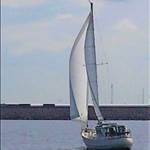
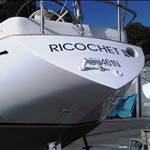
Lucky all safe.
www.smh.com.au/national/nsw/yacht-stranded-on-wanda-beach-after-crew-loses-control-in-wild-winds-20181222-p50num.html

According to Seabreeze it was 20-25 kts from the south. Not too bad you would think. Maybe an engine/prop and rig problem at the same time.
Select to expand quotetwodogs1969 said..
Noticed that they are towing a dinghy one of the biggest no go's I can think of
The dinghy was on the back.

It's hard to see how a long-keel ketch could end up in that situation, apart from poor seamanship.
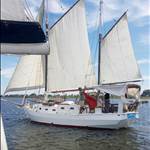
The main and headsail are both on furlers and furled.
This indicates they were motoring so it seems highly likely they had engine problems.
The older guy looks a bit frail to be engaging in this sort of activity.
No wish to add to the poor chap's hassles, but one must ask: why not drop anchor and buy some time?
Morning Wongaga
I don't know Wanda beach, so maybe someone will fire up their Navionics and prove me wrong, but quickly shoaling beaches are especially difficult and dangerous places to anchor.
You often have 100 to 50 metres of depth that rises rapidly to a good anchoring depth of 15 or so metres.
At that depth the shorebreak waves are starting to form and you are trying to anchor in the surf line.
Very hard for the anchor to bite when it is getting dragged about that much.
If you have the gear to anchor in 50 metres of rough water it is doable, but not easy.
Gary
www.9news.com.au/national/nsw-sailors-jump-for-lives-after-yacht-crashes/999ddbcc-53b9-4616-9c81-c57cc40e3b7c
Straight from the horses mouth, might stop speculation from all the ex-spurts
Here is a question for the experienced coastal sailors
If strong winds blow up and assuming the boat and crew are up to it do you head towards land and shelter or go out to sea to give yourself some room and ride it out
Regards Don
Select to expand quoteDonk107 said..
Here is a question for the experienced coastal sailors
If strong winds blow up and assuming the boat and crew are up to it do you head towards land and shelter or go out to sea to give yourself some room and ride it out
Regards Don
It depends.
Around Port Hacking I'd probably head in. Jibbon offers fair shelter from most winds and the entrance is very wide and quite deep. But that's assuming a boat that sails well, is well handled, and has at least two decent anchors.
Select to expand quoteDonk107 said..
Here is a question for the experienced coastal sailors
If strong winds blow up and assuming the boat and crew are up to it do you head towards land and shelter or go out to sea to give yourself some room and ride it out
Regards Don
That's a good question Donk.
As Chris says it really does depend, each time.
For me....it would be wrong to say I'm always nervous near a leeshore? Maybe uncomfortable/unsettled are better words? So for moi, head offshore as a default position without any specific details.
The why would be I've had enough snafus on boats to treat open water , especially to leeward, as a big plus. I've reviewing a bunch of plots off the PC, and reviewing my tracks its striking how much distance to leeward you can make when things are going wrong and the boat is slow.
I think I'm a bit obsessive on a clean bum for that reason, the filthier the hull is the greater the degradation in sailing performance. That poor soul that died recently (off Wanda beach?), with the condition of that hull I wouldn't have sailed it anywhere, it must have handled like a pig with the amount of growth it had on it.
No knowledge of the area mentioned in the topic, so I defer good sir. Interesting question.
Cheers!
SB
My home turf and spoke to a few mates.
Photos show prop fouled by sheets from deck swept / blown overboard and also fouled rudder.
40 kts is a nasty blow,being a heavy displacement, big windage and possibly not overpowered, I can see how you could get into that sort of strife. One pic shows the anchor must of held for o bit ( boat bow up to the sea )
if your running into port hacking without prior knowledge it can be Tricky.
Select to expand quoteDonk107 said..
Here is a question for the experienced coastal sailors
If strong winds blow up and assuming the boat and crew are up to it do you head towards land and shelter or go out to sea to give yourself some room and ride it out
Regards Don
Every situation would need to be assessed based on local knowledge and weather / sea state.
I've seen "all weather ports" breaking in close outs from head to head.
Sad as it is, at least this time it is not a tragedy.
Most of the above posts are pointing at different aspects which are proving that the sailors were anything but experienced. 
This is a stuff up - the reason these things happen is always because of a stuff up. When things go wrong on my boat it is because I stuffed up. It is never the conditions.
As many posters have said the boat seemed badly prepared. Behind the mast furlers are not going to help you going to windward in bad weather. That leaves you with the motor.
So you had better made sure that motor is beautifully cared for, multiple fuel filters, super servicing, and you had better prepared for multiple anchors being lost.
Then there is the forecast - anyone going up and down the coast will have fabulous weather from Meteye and Windyty. Like when navigating, don't push your margins - leave a bit extra time before the wind comes up in your nav plan, don't think that you once had a 40 knot gust and can handle 40 knots consistent offshore.
When I crossed Bass Strait last year I had a window that could have gotten me to St Helens but I had very little time before a nasty southerly hit. If the southerly was early, or we were slowed down then we could get something nasty. So we waited and four days later had a much larger window. I hope to do the same bringing the boat back in January. I like to have some spare up my sleeve at all times. Pushing the limits leaves you with fewer options.
Then go over the charts, again and again. If things are blowing up as you are heading north from Wollongong work out a safe course to Port Hacking. Leave the bommie safely to port and then close the headland and head to Jibbon. There are moorings there that are shown on Maritime maps and Zulu waterways. If something then goes wrong, gybe onto starboard and head out across Bate Bay to Sydney Harbour. You should know this well before you even head out for the trip - it is just safe passage planning.
No safe offshore boat should be getting in trouble because of a motor going down, or one anchor failing. You should be able to sail upwind, or at least reach in gale conditions and you need two and hopefully three anchors if you are going to cruise.
Lessons are here to be learned. I will stuff up in the future, just hopefully not to this extent. Things like this are to remind me to be meek when offshore, as careful as possible and to do the preparation so that we have lots and lots of options when things start to go south.
cheers
Phil
Select to expand quotewoko said..
40 kts is a nasty blow,being a heavy displacement, big windage and possibly not overpowered, I can see how you could get into that sort of strife. One pic shows the anchor must of held for o bit ( boat bow up to the sea )
if your running into port hacking without prior knowledge it can be Tricky.
I agree, that boat has a lot of body above the waterline, and a lot of windage at the stern. If it raises reefed sails and bounces around in a lumpy sea, maybe it would not make way to windward. In which case, if the engine quits, you're on the beach.
Select to expand quotesaltiest1 said..Donk107 said..
Here is a question for the experienced coastal sailors
If strong winds blow up and assuming the boat and crew are up to it do you head towards land and shelter or go out to sea to give yourself some room and ride it out
Regards Don
Every situation would need to be assessed based on local knowledge and weather / sea state.
I've seen "all weather ports" breaking in close outs from head to head.
Now that would scare me.
80 km/hr, just over 40kts. None of the live feeds I saw had anywhere near that at 7-8.00am. Maybe at 6.00 am. At the time they went ashore 80km/hr would have been very temporary gusts at the most and it was from astern which makes life easier in most cases.
A few stuff ups in boat preparation, crew selection (a 60 year old ?xperienced' skipper and one 75 year old apparently non sailor mate) and trying to sail too close inshore with an onshore wind. They didn't have to go to windward all they had to do was reach too seaward, especially if they had maintained a reasonable distance offshore.
We are fortunate from these incidents to be able to learn some lessons, or relearn them because as offshore sailors we should already know them.
But I don't believe in making excuses for what is clearly a case of very poor seamanship that could have been a tragedy.
On whether to head for shelter or go to sea, unless I was absolutely positive that there was safely accessible shelter inshore I would always head to sea and get sea room. Along the NSW coast that would be Sydney Harbour and Broken Bay/Pittwater, maybe Newcastle but Stockton Beach is a trap if the unexpected happens.
Select to expand quoteshaggybaxter said..saltiest1 said..Donk107 said..
Here is a question for the experienced coastal sailors
If strong winds blow up and assuming the boat and crew are up to it do you head towards land and shelter or go out to sea to give yourself some room and ride it out
Regards Don
Every situation would need to be assessed based on local knowledge and weather / sea state.
I've seen "all weather ports" breaking in close outs from head to head.
Now that would scare me.
I have seen Port Stephens, Coffs Harbour and Camden Haven closed out (from ashore), and Broken Bay near West Head on a strong ebb tide (when I was trying to get back to my mooring in Pittwater).
Even the entrance to Broken Bay can be intimidating at night in poor weather. Havefun and I had significant pucker coming in one dark night on return from Lord Howe. Barrenjoey light wasn't visible until a couple of miles out so thank heavens for multiple chartplotters and a paper chart.
It might be a scary option for a bay-sailor to head out to gain searoom.
I remember sailing in a race on Pittwater, a "Lion Island Race" - in near gale force SE winds and lumpy N/NE seas - where the next can was out towards Box Head, my captain who admittedly was terrified from the conditions forfeited the race turning homeward.
Even a thoroughly experienced sailor in some cases, if there is pressure from non sailing friends or God forbid family screaming at you scared witless, you might be persuaded to head to shore when all your innards say "don't do it" just because of peer pressure.
One must have a rock solid will and strong character to stand the psychological pressure from seasick, hysterical passengers, wives, children or mates.
Select to expand quotesirgallivant said..
It might be a scary option for a bay-sailor to head out to gain searoom.
I remember sailing in a race on Pittwater, a "Lion Island Race" - in near gale force SE winds and lumpy N/NE seas - where the next can was out towards Box Head, my captain who admittedly was terrified from the conditions forfeited the race turning homeward.
Even a thoroughly experienced sailor in some cases, if there is pressure from non sailing friends or God forbid family screaming at you scared witless, you might be persuaded to head to shore when all your innards say "don't do it" just because of peer pressure.
One must have a rock solid will and strong character to stand the psychological pressure from seasick, hysterical passengers, wives, children or mates.
I had similar thoughts when posting above.
I believe that the boat has now continued it's northerly journey, if only to the georges river behind a maritime boat.
Select to expand quotewoko said..
40 kts is a nasty blow,being a heavy displacement, big windage and possibly not overpowered, I can see how you could get into that sort of strife. One pic shows the anchor must of held for o bit ( boat bow up to the sea )
if your running into port hacking without prior knowledge it can be Tricky.
It's not much further to head to botany bay very safe entrance.
Select to expand quotetwodogs1969 said..woko said..
40 kts is a nasty blow,being a heavy displacement, big windage and possibly not overpowered, I can see how you could get into that sort of strife. One pic shows the anchor must of held for o bit ( boat bow up to the sea )
if your running into port hacking without prior knowledge it can be Tricky.
It's not much further to head to botany bay very safe entrance.
I agree, and not trying to make excuses, I would have gone for sea room and taken chances with shipping.
Shaggy pointed out if the hull is not clean it will handle like a pig, and I can tell you, 1st hand with that hull shape never a truer statement was made.
Or maybe as kankama said it might of been a stuff up ! (Or more likely as series of )
best senario,as skippers, we all keep these sort of incidents in mind and not fall into the same pitfalls
ps. Why is it SVs are the ones that have a habit of washing up ?
This last question to be answered by a "power equation" of a sort. I am saying it all with "tongue in cheek" without any scientific value.
A motor boat has a strong engine 50-200hp+, or whatever, and a hull built for it, all the power ready to be used at a fingertip just push the throttle. Period.
A SV has similar power ready to be used - and l see your faces screw up reading this - but the fact is, the power is there.
The difference is that the throttle on a sailing boat is only controlling 10-50hp and the rest is in the sails and the keel. There is awesome power packed in the sails and the hull of a sailing boat and if someone is not willing or able to use that power, well...one gets blown on a lee shore.
Most modern vessels are built and rigged the way that they are more than capable to sail off a possible lee shore without the help of an engine. The days of the traditionally rigged sailing vessels sans engine are over, when the "horrors of a leeward shore" was an every day nightmare. If worst comes to worse they can turn on the " iron genny" for extra power to pull them out of trouble but only as a last resource. Not getting into a situation like that is proof good seamanship!
Relying only on the relatively weak motor and hoping for the best is a mistake can turn lethal and definitely bad seamanship.
The boat with the 'behind the mast furler' which is really an abomination in my eyes, did not use the power stored in his vessel's sails and hull. The power was there, he just did not use it. It is like a motor boat with an auxiliary motor trying to get off the rocks with the small motor while the large powerful engine sits next to it idle.
Not getting there is the real solution.
People have very strange ideas of what an "experienced sailor" or "good seamanship" is.
In the ideal world we would all do the right thing all the time.
However, if have a choice to make i.e. lee shore, lifejacket offshore, rush, not reef, etc, my goal is alway to do the right thing.
I believe each time I make that right decision, I put 'money in the bank' and hope it will be there when I need it.
The question that should be asked is why were they at sea at all on this particular day. The forecast wind for the South coast was for 30 knots on both BOM and Seabreeze. How often do you ever see 30 knots forecast on Seabreeze? In the early hours of that morning we had quite a vicious squall pass through on top of the 30 knots of wind and heavy sea and there was damage around the town. This was really just bad planning that placed other people in danger.