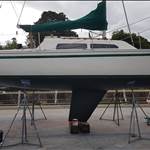
When I bought our boat (28 ft Santana } it had a 150% headsail sheeted to a track on the gunnels, but it
was too big for Missus and me to handle so I changed it to a 110% sheeted to the tracks on the deck.
However the sheets are always overriding on the winches. The cars are as far back on the track as they will
go ( closest to the winch ) and it sort of "looks" OK to me, but is this the problem ??.
I had a similar problem, but I have only a single track. What worked for me was to attach a turning block (just an ordinary Riley S/S block) on the toe rail just in front of the winch. The sheet runs from the sail to the car to the block to the winch, but comes in low on the winch.
Possibly you could run move your cars on the gunnel track (if you still have some there) right back and run the sheet from the front car to the back car then to the winch
Only time we have overrides now is when someone lets off the sheet when it is still around a cleat instead of holding the sheet up level with the top of the winch.
Thanks EC. I didn't know whether the angle of the sheet coming on to the winch was too 'steep' although
as I've said it looks OK, but this override happens every time so I've got something wrong.
I aim to have the sheet pointing to about halfway up the luff and it's almost like the winches need to be
tilted forward a bit so the sheet comes on a bit more 'square', but the boats design should negate that
as a problem.
Select to expand quotesamsturdy said..
Thanks EC. I didn't know whether the angle of the sheet coming on to the winch was too 'steep' although
as I've said it looks OK, but this override happens every time so I've got something wrong.
I aim to have the sheet pointing to about halfway up the luff and it's almost like the winches need to be
tilted forward a bit so the sheet comes on a bit more 'square', but the boats design should negate that
as a problem.
While not scientific, a better starting point for the track position is for the sheet to be at an angle perpendicular to the forestay.
And I would have thought that (if it was a matter of altering the winch angle - just by way of illustration) you normally want the top of the winch angled back from the jib, not more towards it. In other words, the solution is to have the sheet coming more from the bottom of the winch.
Sam, the angle on the bottom shoulder of the winch drum is pretty much the optimum entry angle of the winch, so you maybe able to rig a fair lead or mount your winch on a tapered block to help get you to the sweet spot
So I'm trying to refine my description of how the sheet comes on to the winch. It seems to me that the
sheet is coming on below the shoulder which is why I'm saying to tilt the winch forward more to bring it on square.
Do I rectify this by moving the car further forward or will the design of the boat always make the sheet
appear to come on too low. Even if I winch on slowly it still wants to override.
Select to expand quotewoko said..
Sam, the angle on the bottom shoulder of the winch drum is pretty much the optimum entry angle of the winch, so you maybe able to rig a fair lead or mount your winch on a tapered block to help get you to the sweet spot
Just re read your response Woko. The shoulder angle sounds like a good place to start. I didn't know about that.
I'll fiddle around and see what I can do.
Nice looking boats Sam.
Is this what your sheeting is like or are you running off a track on the coach roof?


Yes BB, that's what my set up looks like. The previous owner set the boat up for racing and put a
track along the gunnel, probably for a spinnaker, but he also put his big foresail on this track too.
I've got a smaller foresail and am using the proper track. So I reckon it's me that's doing something
wrong.
Looking closer, it looks like the car is right at the end of the track too, like mine. Hmmmm.
I would be taking the block back only as far as necessary the tighten the foot when necessary . Are you sure the sail is cut ok? Sometimes trying to get the optimum per the book doesn't work.
however if you were keen to do so I'd be looking at a' Taller' block to reduce the angle of the sheet to the winch.
Yeah, very odd. Normally to get an override from in front of the winch the rope is coming in too high. On the Farr 40 the easiest way for an override to happen is someone in front of the winch tries to pull the sheet in but lifts it a bit.
That or dropping the tail into the oncoming rope and winching it through! 
From looking at the photos, how about putting your splicing skills to good use and making a short dynex strop with a low friction ring attached somewhere between the winch and the car, as a deflector. It won't have a huge load if done right.
This might be helpful: www.bartonmarine.com/tech-info-Nautilus-Winch-fitting-instructions.asp

Select to expand quoteBananabender said..
Nice looking boats Sam.
Is this what your sheeting is like or are you running off a track on the coach roof?
Maybe it's just the angle of that photo BB, but to me it looks like that genoa block is positioned way too far forward on the track still, which would be pulling the leech down more than the foot in. If that headsail was fully unfurled though, and the car shifted right back on the track, having the winch being situated as it is on the combing, there's no way the lead angle would be anywhere near as low as 5-10 degrees as Gravy's diagram suggests.
If you do end up needing to use the turning block in that position (or further astern as suggested), the I'd be inclined to look at getting the block itself up higher, closer to the height of the winch base. A simple dyneema stop on the turning block or a few shackles might let you have a play around.
Some good photos next time you are out might help everyone see the problem in your case.
Select to expand quotecrustysailor said..Bananabender said..
Nice looking boats Sam.
Is this what your sheeting is like or are you running off a track on the coach roof?
Maybe it's just the angle of that photo BB, but to me it looks like that genoa block is positioned way too far forward on the track still, which would be pulling the leech down more than the foot in. If that headsail was fully unfurled though, and the car shifted right back on the track, having the winch being situated as it is on the combing, there's no way the lead angle would be anywhere near as low as 5-10 degrees as Gravy's diagram suggests.
If you do end up needing to use the turning block in that position (or further astern as suggested), the I'd be inclined to look at getting the block itself up higher, closer to the height of the winch base. A simple dyneema stop on the turning block or a few shackles might let you have a play around.
Some good photos next time you are out might help everyone see the problem in your case.
I agree .
A picture Sam of what the guys are talking about.
You use the car and track still to anchor the low friction ring. Just tie a short strop around the ring (snug so the ring doesn't fall out) and tie it to the car at about the right height .
Use you eye to roughly set the length of the strop, anything will be better than having the sheet go down to the car itself.

Yes I understand fellas, thanks for the input. I agree with you that it looks like the block is too low so that's
the obvious thing to tackle. I'll see if a shackle or two will do the trick and I'll follow Woko's idea of using the
angle of the shoulder as a guide. Thanks everybody.
Sam, you are on the right track. It's the angle of the sheet relative to the winch that is critical to stop it overriding on the winch. A lot of the discussion above has been about the correct sheeting angle from the moveable block to the clew to ensure that the jib is set efficiently which is also important but a different topic.
So, back to the original topic, if you look at the profile of most winches, the 'shoulder' angle is about 30 degrees which is much too steep. I would go with the Nautilus winch recommendation of a lead angle of less than 10 degrees below horizontal - unless you find a better one to suit your specific winches.
Yep Gravy is right. Two angles to consider . One forward of the block - correct sheeting angle and aft of the block which is your issue, the sheet leading onto the winch.
What I have in mind is to raise the block by degrees until I get a satisfactory result. I have the time to
do it so that's not a problem. It helps knowing what I need to achieve so I'm not wasting time.
Sam, I have had similar deliberations for the genoa sheet on my Tophat. The sheet car is well aft for close-hauled sailing, and I have solved the problem by leading the sheet well aft, past the winch, to a turning block which is mounted by a loose dyneema loop to the main aft mooring cleat. The sheet pull is then forward, and almost level, to the winch. This also gives me the option of leading the sheet across the cockpit to use the windward winch. This makes for an ugly cockpit, but if sailing alone, as usual, it can be useful, especially in heavy weather when the lee rail is well down.
Sorry, but no photos.
same here, we have a turning block for the sheets behind the winches, so the lead angle is always the same, no matter where the cars are...
So, SP and Fishy you've got me thinking, if the previous owner raced this boat there is no way he would put up
with overriding winches and I'm wondering if the gunnel mounted cars that he used, being mounted on the toe
rail, are the right height for the winches. Me, of course, having gone back to the deck mounted cars have negated
his efforts. Mind you, the problem with the gunnel mounted track is that the headsail is always on the outside
of the stanchions. So if I raise the deck mounted cars to the same height as the gunnel ones, I should be in
business.
Sam ,I am having trouble understanding why the designer would create such an issue. How many turns do you put on the winch ? What size sheet ? Is it self tailing or do you cleat off . Is the overriding caused from block to winch or winch to cleat. For a 28 footer I would guess one full max with an extra turn in a strong breeze if you wanted to adjust.
I thought bigger angles aren't really a problem except for increased friction, until the angle is too big and the sheet then wraps around the base. Too little an angle is where you get most problems with overlaps. As long as the sheet angle clears the flange to the base of the winch, it shouldn't be an issue
I agree with the above, what is your technique, too fast, too many wraps? Sheet size?
OK, sheet size is 10mm and I put 3 turns on the winch. the problem is block to winch which is not a self tailer so
I cleat off.
Hey Sam , this may help you ....maybe ............ we sometimes / rare ... get an O /R ..... I think it happens to us when we put three turns on the winch then try to quickly trim it up while its loose , then it loads up and it has been flipped screwed up while it was loose . They way we solve the problem is to only put one or two turns on the winch then after the load comes on , quickly put one or two more on depending on the pressure. then quickly put the handle on and trim it up . To sum it up , the problem seems to happen when unloaded with too many turns on the winch.
Sands you beat me to it, I just put one turn on the winch haul it in overhand until I get some weight on the sheet then add a turn and get the handle to work,then another turn if it was slipping. if I was to put a few turns on straight up it would override pronto ! That's on a say 25m2 head sail but I do have a lot of slack sheet to retreive as I have a baby stay to drag the sheet around.
As freeRad pointed out to steep an entry angle to the winch shouldn't cause any issues other than excessive friction
Select to expand quotesamsturdy said..
OK, sheet size is 10mm and I put 3 turns on the winch. the problem is block to winch which is not a self tailer so
I cleat off.
Ok ,10mm good.
Now I'm guessing you've been putting three turns on because the boss has been the trimmer .What I find solo is to take time tacking ( luff up ) so that I can pull sheet in by hand all the way with only one turn ,put on second turn and cleat off ( V cleat) , lay off then let out slowly to set sail as needed .
You probably know all this anyway mate.
Select to expand quoteBananabender said..
Sam ,I am having trouble understanding why the designer would create such an issue. How many turns do you put on the winch ? What size sheet ? Is it self tailing or do you cleat off . Is the overriding caused from block to winch or winch to cleat. For a 28 footer I would guess one full max with an extra turn in a strong breeze if you wanted to adjust.
When the boat was designed I am wondering if the original headsail would have been on a Furler or hanked on
If it was hanked on to the forestay the tack might have been shackled on at deck level (the same as on my Sailmaster) and this would have dropped the height of the clew and made the block to clew angle better for beating
Regards Don