Sail tufts, a compass and (depending on where you are) a battery-powered stern-mount kayak fishfinder to act as depth sounder and GPS.
A piece of wool on both shrouds, plus one on the backstay just above your head and long enough to be in your eye line.
Paul at Coursemaster in Chatswood (02) 9417 7097 can give you some great advice on the electronic stuff.
My fishfinder, hand held gps with course and speed, and nav software on my smart phone gives me nearly as much info a bazillion dollar gear on the latest boats
I find that my Ronstan Clear Start watch is invaluable for getting a good start and it was not that expensive for what it is
www.ronstan.com.au/marine5/error.asp?admin=&fail=yes
I normally keep track of how long we have to go and let the helmsman know so he can keep watch on the other boats and and time his run to or duck over the line as close as possible to the starting time
It is much easier to have a watch that will count down to zero instead of counting up like the stopwatch function on most watches do
I find the watch is great when we do twilights down here and the fleet start at different times
We are normally one of the fastest boats and start at the later time and the start times for the fleet get emailed out the day before
Each boat gets a one minute warning signal so i work out the difference between their one minute signal and our actual start time and write it beside their start time
When we motor out to the start i look at the next boat to start and set my watch to count down from their one minute signal
From that point at any time i can let Jeff the skipper know exactly how long we have to go before we cross the line
The other thing i do is write down what the tide is doing and also what the wind forcast is supposed to be so we can choose the best section of the river to sail in depending on what the tide is doing
Regards Don

Mast head indicator..especially for downwind.
The Ronstan watch is fine but not intuitive to use and the bands break.
I have a garmin 200 handheld gps for showing where the next mark is and helping judge laylines. Also goid for cruising to est arrival times etc.
But yeah keep it simple
In light winds sail naked if possible to feel the breeze on your neck! 
Select to expand quoteMadmouse said..
Mast head indicator..especially for downwind.
The Ronstan watch is fine but not intuitive to use and the bands break.
I have a garmin 200 handheld gps for showing where the next mark is and helping judge laylines. Also goid for cruising to est arrival times etc.
But yeah keep it simple
In light winds sail naked if possible to feel the breeze on your neck!
Hi Madmouse
I agree
I sometime have to google to remind me how the functions work if i haven't used it for a couple of weeks
As far as the bands breaking i only wear it when we are racing and it has done one season so far without breaking so fingers crossed i will get a few more out of it
Regards Don
Want? Need? Afford? Like? Very subjective!
We have the Raymarine wireless windspeed display and transducer. Recently replaced the 10yr old wind transducer as the solar panels failed on the old one. Have also hard wired power for the display unit due failing batteries and solar panel. I'd prefer wired, but easy install on the wireless is the big plus.
Raymarine thru hull depth and speed transducers wired to ST60 display and seatalk network. I like boat speed indication when racing.
Everything integrated to chart plotter, autopilot and AIS with wifi. Enables instrument/AIS display on iPads, phones etc which is really good.
Barometer - traditional or integrated in tablet/phone//watch.
plenty of apps (iregatta etc) which have start line timers etc.
Wool tell tales on the shrouds, a mast head wind vane and the hairs on your neck and ears.
I am fitting a new wind instrument to MB, but that is for bragging rights for storms and gales. You need to photo the instrument to prove the wind was really that strong.
I was out sailing during the week and took the cover off the wind instrument. I thought about it for awhile and I reckon it was probably 18 months or so since I last looked at it. They are handy sailing down wind in confined waters, entering rivers etc.
I have a Speedpuck and a Ronstan watch.
Love the Speedpuck as I use it for two functions;
1; It averages out your heading and then tells you if you're on a lift or knock. Very handy if you are sailing on the ocean or slow shifts
2; The most handy for me is the GPS speed. I sail in an area with lots of current and I know my upwind speed is about 6.5 knots (I can pretty well sail the boat by feel and how I am looking compared to other boats to get my best speed) so if I'm doing 7 knots to windward = good current, 5 knots + bad current
The man asked what he needs not what you want.
compass and a depth sounder (on the east coast otherwise known a longitude fixer)
the rest is just ego.
 .html]
  [/URL]


On a 27 foot boat you don't really need much at all until you get to the Whitsundays where you contend with big tides and reefs that are not marked that well. I installed my own electronics a GPS and sounder off ebay. You buy what you think you need for your safety it is not ego.
Select to expand quotelydia said...
Like I said I suppose if you sail boats that are on their ear in single digit wind speeds you kinda don't need instruments.
This is a great topic.
I find that certain things in life require more brains/experience than equipment.
Some people are addicted to buying more gear. Geez its fun to do so and not hard to see why. We all love shiny new things but they dont make you a better sailor.
When i got my first lil bluebird, i was in in mona vale whitworths buying up all sorts of gear. spent way more than the boat cost me in a few weeks.
For my cruising next year im keeping it real simple.
Hand held GPS - never used it yet and gotta buy the cards
navonics on ipad and phone. Love it on the ipad for route planning.
paper charts, dividers and the parallel ruler for hourly plots and all details of barometric , gps, and noted hourly plus deviation.
tell tales.
The most important thing for me is keeping my boat sound and going sailing as often as possible testing out different sail plans in different weather and sailing at night in open water.
On top of this learning about weather patterns, studying maps, google earth, tides and currents of areas of interest i plan to travel to.
Ive been loving the reading we got gifted recently "Offshore Cruising Encyclopaedia"
I mean that book is amazing. Ive been loving reading it everyday. Its Got Everything. Its a really comprehensive manual worth more than any gadgets i reckon.
If anything im stripping my boat back. making it as light as possible , ridding it of stuff i dont need.
Took the mast winches off yesterday. Geez those things must weigh about 15kgs. Weight not needed on the bulkhead. plus i can see better.
Of course weight will be added, but before departure im going to be ruthless on what comes aboard, because more often than not, stuff doesnt get used.
I was gonna get ais, mount anometer on mast top, spreader lights, big gps unit, big screens, extra outboard, blah blah blah, but no.
Keepint it light and simple.
I think the comment about instruments tell you what happened (emphasis on after the fact) is very true.
Me being a numbers guy, I get a kick out of reviewing the data after the event, and looking at data: for example what wind angles were most efficient from a vmg perspective.
If I'm racing I get a lot from the electronics, being able to see the lay lines position in shifting winds for the next mark when we can't see the mark yet, that sort of thing. Or measuring XTE at certain heel angles as we learn the boat.
Do you need lots of electronics? Of course not.
Each to their own always !!!
My 20c worth.
I back everyone who said you need tell tales on the sails and shrouds. Then experience to feel the "groove" of the boat sailing well and the right angle of heel for conditions, and the right pitch, and sharp sail trim.
Instrument wise I found two really useful things.
My first thing, to help get a good start - a Speaking Count Down Timer: Using one means everyone nearby can hear exactly how long to go before start without looking down or distractions:
http://www.ebay.com.au/itm/Tel-Timer-Talking-Countdown-Timer-Shipping-Included-/182145531287?hash=item2a68b83d97:g:dVgAAOSwQaJXRGEd
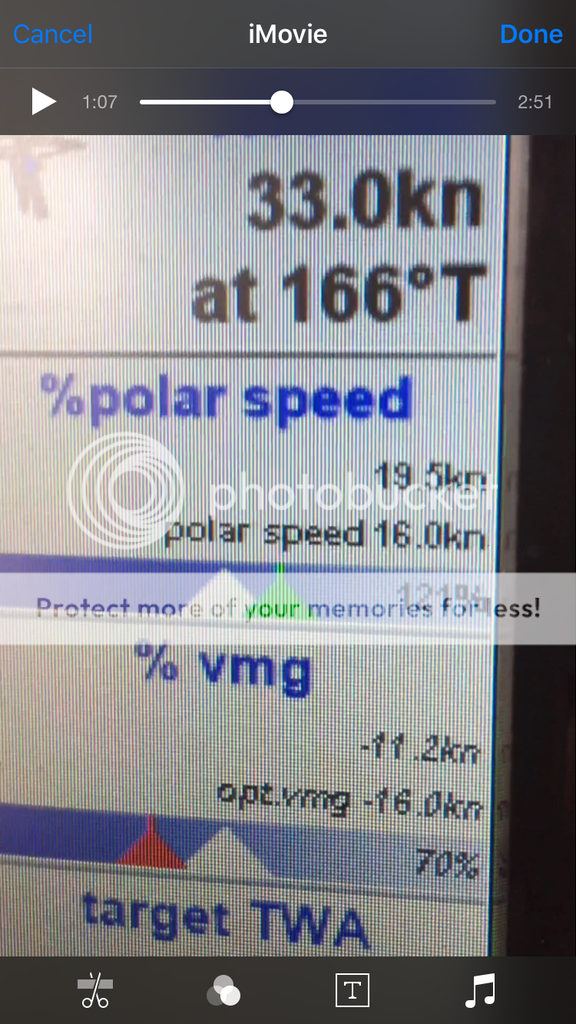
My second thing you need - instruments - to get to the mark first - a VMG indicator: A way of measuring your instantaneous VMG to the mark. Many old salts on this page already know this so skip it, but for the beginners. VMG (Velocity Made Good) is the critical speed measurement in a race. Its no use having the boat going fast if its going in the wrong direction. You need to know the speed you are going towards the mark.
The reason why you need a VMG indicator is this:
When I was racing a lot (and we have bragging rights due to many championship wins) we would go out to each mark the day before and really carefully measure their latitude and longitude. Then I programmed those numbers into a bit of software I wrote on a laptop on board that measured our current position at any time and calculated the speed we were heading toward any given other position (mark) and displayed it in big numbers on a display in knots on the mast. You dont have to do that any more, there's instruments you can buy that do it (like in posts above).
To use VMG, as an example, before the start enter the lat and long for the top mark into the VMG indicator. Once you're away and you're heading upwind for the mark you need to to set the sails best you can on the tack you want (later in race may be reach or run), then change course slowly up and down up and down and find the fastest VMG, once you've got that get the sail trimmers to trim slightly and watch the VMG and set for fastest, then vary the sitting position of the crew also watching the VMG. I found for real that if all the crew stood up going downwind we would do slightly better than if they were sitting for example!! Because the wind fluctuates you need to do it slowly to see the effect on the numbers.
The wonderful thing about VMG I found was it could remove some aspects of local knowledge of a race area. For example if there is a current and it flows faster one way on one side of the course the locals know that and use it, but you dont know. Unless you have VMG and you very soon find out which side of the course is better because it can show you the 0.2kt difference before you find the other boats in front.
the previous posts all have valid points the real art is trying to work out what is going to happen this can be achieved by studding charts and weather heavily before race start , vmg is important but i prefer for me comparing heading on the gps to compass heading [ shows tidal or current set ] this keeps me more aware of what is happening in the environment around me, depth is handy as this allows you to sail the edges of the course better to benefit from current , speed assists with trim and heading though because of varying sea state and breeze should always be taken with a grain of salt ,
I often dont even switch the instruments on especially on short course as i find it can confuse crew and they spend to much time staring at the gadgets and not sailing the boat
i dont even like wind vane on the mast as you get a sore neck staring up at it and prefer ribbons on the shrouds
Select to expand quoteboty said..
the previous posts all have valid points the real art is trying to work out what is going to happen this can be achieved by studding charts and weather heavily before race start , vmg is important but i prefer for me comparing heading on the gps to compass heading [ shows tidal or current set ] this keeps me more aware of what is happening in the environment around me, depth is handy as this allows you to sail the edges of the course better to benefit from current , speed assists with trim and heading though because of varying sea state and breeze should always be taken with a grain of salt ,
I often dont even switch the instruments on especially on short course as i find it can confuse crew and they spend to much time staring at the gadgets and not sailing the boat
i dont even like wind vane on the mast as you get a sore neck staring up at it and prefer ribbons on the shrouds
+1 for the sore neck, me too!!
I think tell tales on the head sail are excellent as trimming guides and steering guides. If the windward ones are streaming horizontal and the leeward ones lightly fluttering upwards, this usually indicates optimum sailing angle when beating and beam reaching at least and of course if tiller steering from the windward cockpit coaming the tell tales will usually be in your direct forward line of sight.
For short course club racing the NEED for instruments is very debatable. It is more about knowing the yacht, observing approaching gusts and what other yachts in the fleet are doing or experiencing.
For longer and offshore races, instruments will be more about navigation. I have sailed with wind instruments a couple of times and they are really good to sail to when out of sight of land but I don't think absolutely necessary.
This is my "instrument" set which brand new cost about $360. Along with VHF radio it is minimal but more than adequate for coastal passage making.

Select to expand quotecisco said..
I think tell tales on the head sail are excellent as trimming guides and steering guides. If the windward ones are streaming horizontal and the leeward ones lightly fluttering upwards, this usually indicates optimum sailing angle when beating and beam reaching at least and of course if tiller steering from the windward cockpit coaming the tell tales will usually be in your direct forward line of sight.
For short course club racing the NEED for instruments is very debatable. It is more about knowing the yacht, observing approaching gusts and what other yachts in the fleet are doing or experiencing.
For longer and offshore races, instruments will be more about navigation. I have sailed with wind instruments a couple of times and they are really good to sail to when out of sight of land but I don't think absolutely necessary.
This is my "instrument" set which brand new cost about $360. Along with VHF radio it is minimal but more than adequate for coastal passage making.
Just as a nit-pick, a very high percentage of boats do NOT want to have the leeward tufts fluttering upwards much of the time; that indicates they are sailing too low.
True. Depends if you want to just join in races or actually win them. VMG has been the primary instrument used in the Americas Cup for the last 20 years.
Select to expand quoteTrek said..
True. Depends if you want to just join in races or actually win them. VMG has been the primary instrument used in the Americas Cup for the last 20 years.
Have a look at this, racing big time !
Chris l like the idea of a talking countdown timer. Do you use the one shown on ebay?
Select to expand quoteMadmouse said..
Chris l like the idea of a talking countdown timer. Do you use the one shown on ebay?
I think you mean Trek.
I use an earlier model to that exact one I posted link to, which I bought originally from Jaycar. When I wrote the post I wanted to put up a reference so others could get one and found Jaycar dont sell it any more so found one that looks identical. I think its the same unit.
The one I had counted down out loud in minutes down to 1 minute to go, then counted down seconds from 10 to 1 out loud, then rang an alarm at 0. Couldnt have been better.