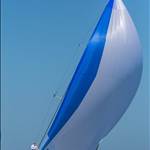
can any body help me out with what would be a suitable size for a asymmetrical spinnaker on a triton 24.
Hi Corz
if you don't mind me asking have you tried flying a symmetrical spinnaker on your Triton
Regards Don
Don,
Never flown either one before, I'm looking at getting one in time for summer. I figured an asymmetrical would be more versatile. Happy to hear advise as I don't really know.
Hi Corz
Is the boat set up for either at the moment
If it hasn't got any of the gear to fly a symmetrical such as a spinnaker pole, topping lift and down haul the asymmetrical would be easier to set up but if it has all of the things I mentioned the symmetrical would allow you to sail dead down wind
Also how many crew would normally be on the boat or will you be sailing single handed
Regards Don
Hi Don,
the boat has 2 x spinnaker poles, topping lift, halyard and I have spare blocks and lines.
Crew would usually consist of me and my partner.
Corey.
With just 2 onboard one of these may be easier to handle.
Selden GX Top Down furler - How it works and what you need
Select to expand quotecorz said..
Hi Don,
the boat has 2 x spinnaker poles, topping lift, halyard and I have spare blocks and lines.
Crew would usually consist of me and my partner.
Corey.
Hi Corey
It sounds like you have everything (apart from the down haul) to run a symmetrical spinnaker but with only the two of you on board you would be pretty busy putting it up and down and gybing it
The assy would be a lot easier for the two of you so it is probably be the way to go
Regards Don
Having had both while racing (usually with inexperienced crew), I'd have to agree with Donk.
The symmetric does have it's advantages (cheap, as you've got the gear already, better on a dead downwind run etc), but gybing is definitely something you want a bit of experience with. I've done it two up, but we were a really good team and had a fair bit of practice.
Issues with symmetric;
* Setup - my old Soling didn't have safety lines or anything so we'd launch under the main. You needed to be able to figure out which side the pole was going and make sure the halyard was on the right side of the forestay, which led to some dodgy bow work. After that, we'd prefeed the brace, then hoist, pull back on the brace and trim the sheet. All ok, assuming we didn't have to gybe in the meantime.
* Gybing - again, you're sending someone up on the bow, moving an awkward pole about, trying to grab a couple of lines that are under load. Not super easy.
* Repacking - after every use, you really need to run the tapes on at least two sides to make sure it's not twisted next time you hoist. That was really hard in our open cockpit.
What I've got now is a furling assy using a profurl spinex. I'm absolutely still getting used to it - what angles to sail etc. I've also had really inconsistent crew lately, so it's been a bit hard for me.
Biggest issues I've found so far are;
* Setup - One of the things they never address in any of the videos is the full setup. My boat has a full pulpit (I suspect yours does too) with no gap in the middle, so I have to connect the tack going over the top of it, BUT remember to set the furling line underneath. When I pack it away, I leave the sheets attached, as they help it stay furled...of course, when it comes time to set it up again, we have to have an impromptu maypole dance on the deck to unwind them a bit so they can be properly led back to blocks at the stern, then forward again to ratchet blocks. Gotta watch where each of the lines cross over each other too - I've had to re run the sheets mid race after finding the crew had somehow run things under the jib sheet or something equally stupid.
* Unfurling - No matter what they say, you really need to have both the halyard and the tack cranked on hard with the winch, otherwise it just won't unfurl properly.
* Upwind sailing - Maybe I don't have it furled tight enough, but I found that if I left it up, mine would start to partially unfurl and at the very least provide a lot of turbulence. I'm probably more sensitive to this as I race, but now I get the guys to drop it back on the deck after furling and tie it to the stays or something so it doesn't fall overboard.
* Gybing - I've got it set for inside gybes (which are faster with a decent crew). When it works, it's awesome, but it does offer the entertaining ability to wrap around your forestay. Definitely recommend furling it to gybe when short handed. It'll take longer, but much safer.
Select to expand quotecorz said..
can any body help me out with what would be a suitable size for a asymmetrical spinnaker on a triton 24.
Get a long tape, attach to spinnaker halyard.
Tie another rope to the halyard, in case the tape measure breaks, you won't have a halyard you can't get down.
Measure from full hoist to where your tack point will be.
Assy luff length will be about 10% longer than this measurement.
As far as foot length, if your buying 2nd hand, you might find your aft block too far aft, as an assy of something (like an SB20) that might fit height wise, will probably be off a shorter boat.
Either a down haul on the sheet, or moving block fwd will solve this
Select to expand quoterumblefish said..corz said..
can any body help me out with what would be a suitable size for a asymmetrical spinnaker on a triton 24.
Get a long tape, attach to spinnaker halyard.
Tie another rope to the halyard, in case the tape measure breaks, you won't have a halyard you can't get down.
Measure from full hoist to where your tack point will be.
Assy luff length will be about 10% longer than this measurement.
As far as foot length, if your buying 2nd hand, you might find your aft block too far aft, as an assy of something (like an SB20) that might fit height wise, will probably be off a shorter boat.
Either a down haul on the sheet, or moving block fwd will solve this
Fyi
a maxi runner asymmetrical is about 105-107 % of the straight line luff length. 110 is getting out there.
all purpose asymmetrical are about 103 and reachers 100%
and that is pin to pin, ok for flat out racing! A lot of cruisers and club racers, on boats with lifelines, have a little clearance ( less likely to catch and better visibility) In this case measure to top of pulpit and fit a floating tackline that leads back aft.
bullsails.blogspot.com/2017/03/what-kite-is-right-for-me.html
Select to expand quotePlaneray said..
Having had both while racing (usually with inexperienced crew), I'd have to agree with Donk.
The symmetric does have it's advantages (cheap, as you've got the gear already, better on a dead downwind run etc), but gybing is definitely something you want a bit of experience with. I've done it two up, but we were a really good team and had a fair bit of practice.
Issues with symmetric;
* Setup - my old Soling didn't have safety lines or anything so we'd launch under the main. You needed to be able to figure out which side the pole was going and make sure the halyard was on the right side of the forestay, which led to some dodgy bow work. After that, we'd prefeed the brace, then hoist, pull back on the brace and trim the sheet. All ok, assuming we didn't have to gybe in the meantime.
* Gybing - again, you're sending someone up on the bow, moving an awkward pole about, trying to grab a couple of lines that are under load. Not super easy.
* Repacking - after every use, you really need to run the tapes on at least two sides to make sure it's not twisted next time you hoist. That was really hard in our open cockpit.
What I've got now is a furling assy using a profurl spinex. I'm absolutely still getting used to it - what angles to sail etc. I've also had really inconsistent crew lately, so it's been a bit hard for me.
Biggest issues I've found so far are;
* Setup - One of the things they never address in any of the videos is the full setup. My boat has a full pulpit (I suspect yours does too) with no gap in the middle, so I have to connect the tack going over the top of it, BUT remember to set the furling line underneath. When I pack it away, I leave the sheets attached, as they help it stay furled...of course, when it comes time to set it up again, we have to have an impromptu maypole dance on the deck to unwind them a bit so they can be properly led back to blocks at the stern, then forward again to ratchet blocks. Gotta watch where each of the lines cross over each other too - I've had to re run the sheets mid race after finding the crew had somehow run things under the jib sheet or something equally stupid.
* Unfurling - No matter what they say, you really need to have both the halyard and the tack cranked on hard with the winch, otherwise it just won't unfurl properly.
* Upwind sailing - Maybe I don't have it furled tight enough, but I found that if I left it up, mine would start to partially unfurl and at the very least provide a lot of turbulence. I'm probably more sensitive to this as I race, but now I get the guys to drop it back on the deck after furling and tie it to the stays or something so it doesn't fall overboard.
* Gybing - I've got it set for inside gybes (which are faster with a decent crew). When it works, it's awesome, but it does offer the entertaining ability to wrap around your forestay. Definitely recommend furling it to gybe when short handed. It'll take longer, but much safer.
The problem I see with using a assy on something without a bowsprit (unless you intend to fit one) and gybing on the inside is you haven't got a very big space for it to pass through
Gybing on the outside fixes this but you run the risk of the lazy sheet going under the front of the boat unless there is some kind of sheet catcher on the luff of the spinnaker
I guess one on a furler and furling on every gybe would overcome this but a Furler on a 24 footer seems a bit overkill to me
Regards Don
It will work fine on inside particularly on a 24' boat. Doesn't need much gap. If heavy weather and using a asymmetrical go outside and if you have to rerun the sheet if it falls under bow. Plus the sheet catcher will help as per Dons suggestion
Select to expand quoteDonk107 said..Planeray said..
Having had both while racing (usually with inexperienced crew), I'd have to agree with Donk.
The symmetric does have it's advantages (cheap, as you've got the gear already, better on a dead downwind run etc), but gybing is definitely something you want a bit of experience with. I've done it two up, but we were a really good team and had a fair bit of practice.
Issues with symmetric;
* Setup - my old Soling didn't have safety lines or anything so we'd launch under the main. You needed to be able to figure out which side the pole was going and make sure the halyard was on the right side of the forestay, which led to some dodgy bow work. After that, we'd prefeed the brace, then hoist, pull back on the brace and trim the sheet. All ok, assuming we didn't have to gybe in the meantime.
* Gybing - again, you're sending someone up on the bow, moving an awkward pole about, trying to grab a couple of lines that are under load. Not super easy.
* Repacking - after every use, you really need to run the tapes on at least two sides to make sure it's not twisted next time you hoist. That was really hard in our open cockpit.
What I've got now is a furling assy using a profurl spinex. I'm absolutely still getting used to it - what angles to sail etc. I've also had really inconsistent crew lately, so it's been a bit hard for me.
Biggest issues I've found so far are;
* Setup - One of the things they never address in any of the videos is the full setup. My boat has a full pulpit (I suspect yours does too) with no gap in the middle, so I have to connect the tack going over the top of it, BUT remember to set the furling line underneath. When I pack it away, I leave the sheets attached, as they help it stay furled...of course, when it comes time to set it up again, we have to have an impromptu maypole dance on the deck to unwind them a bit so they can be properly led back to blocks at the stern, then forward again to ratchet blocks. Gotta watch where each of the lines cross over each other too - I've had to re run the sheets mid race after finding the crew had somehow run things under the jib sheet or something equally stupid.
* Unfurling - No matter what they say, you really need to have both the halyard and the tack cranked on hard with the winch, otherwise it just won't unfurl properly.
* Upwind sailing - Maybe I don't have it furled tight enough, but I found that if I left it up, mine would start to partially unfurl and at the very least provide a lot of turbulence. I'm probably more sensitive to this as I race, but now I get the guys to drop it back on the deck after furling and tie it to the stays or something so it doesn't fall overboard.
* Gybing - I've got it set for inside gybes (which are faster with a decent crew). When it works, it's awesome, but it does offer the entertaining ability to wrap around your forestay. Definitely recommend furling it to gybe when short handed. It'll take longer, but much safer.
The problem I see with using a assy on something without a bowsprit (unless you intend to fit one) and gybing on the inside is you haven't got a very big space for it to pass through
Gybing on the outside fixes this but you run the risk of the lazy sheet going under the front of the boat unless there is some kind of sheet catcher on the luff of the spinnaker
I guess one on a furler and furling on every gybe would overcome this but a Furler on a 24 footer seems a bit overkill to me
Regards Don
Sorry - should've been clearer - I have an extendable Selden sprit like in the video.
Guys, it is Triton 24.
Sym only and end for end gybe with one sheet.
Btw, etchell spin will be very close to right size.
luff is 8.00m.
Hi Lydia
I know on my 28 footer with everything at the mast and only two onboard, the bloke on the helm is fairly busy steering and adjusting the sheet and brace at the same time during hoists
Regards Don
Select to expand quotelydia said..
Don
why have a brace and a sheet
only a little boat
Hi Lydia
Only one line per clew but I called it the brace on the pole end clew and sheet on the opposite clew
The interesting thing is that the tiny little spinnaker on my spacesailer 20 had a sheet and a brace on each clew
Regards Don
Thanks for all the great info everyone.
The furling option would be great but I suspect it would be close to half the value of my boat. I think I'll end up with a Assym as I'll be cruising more then racing and will be able to use it on more points of sail. If I find a need a bowsprit I'll weld one up and bolt her on.
Cheers
Corey.
A 16ft skiff no2 spinnaker will be close.. and there's plenty going cheap that are in decent condition..