If I use a 20A 240v SPST toggle switch on a 12V 20A load, will it cause problems like arcing? It is IP 56 sealed, and looks better made than the 20A 12V switch I also have. There is a 20A fuse in the circuit.
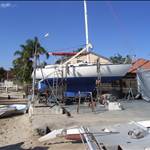
Isn't it fun trying to work out the electrics on an old boat you just bought.??
Your switch won't like 20A DC very much at all. AC has a "zero voltage point" during its alternating cycle, at which time any arc drawn as the switch contacts separate will tend to self-extinguish. In a DC system there is no such zero point to help with extinguishing the arc, so the switch current rating must be reduced. If not, your switch might be incapable of extinguishing the arc and thus end up a molten mess, undistinguishable from the rest of the molten charred mess of you and your boat (I'm being a bit melodramatic here, but I'm sure you get the picture). And while it is continuously arcing, it is possible that it might not pull enough current to blow the 20A fuse, but still generate enough localised heat to cause lots of damage.
The low-voltage circuit breaker application guide in my bookshelf shows a derating to around 1/3 - 1/4 of the AC current rating. Go with 1/4 and you will be safe.
Good on you for asking,
Cheers, Graeme
Could you get around the upscaling by using double pole/single throw? Each pole carries half the current?
Select to expand quotewongaga said..
Your switch won't like 20A DC very much at all. AC has a "zero voltage point" during its alternating cycle, at which time any arc drawn as the switch contacts separate will tend to self-extinguish. In a DC system there is no such zero point to help with extinguishing the arc, so the switch current rating must be reduced. If not, your switch might be incapable of extinguishing the arc and thus end up a molten mess, undistinguishable from the rest of the molten charred mess of you and your boat (I'm being a bit melodramatic here, but I'm sure you get the picture). And while it is continuously arcing, it is possible that it might not pull enough current to blow the 20A fuse, but still generate enough localised heat to cause lots of damage.
The low-voltage circuit breaker application guide in my bookshelf shows a derating to around 1/3 - 1/4 of the AC current rating. Go with 1/4 and you will be safe.
Good on you for asking,
Cheers, Graeme
That is such good info Wongaga that you got me all excited. I'm embarrassed to admit that made perfect sense...after you explained it!
Thanks!
As Wongaga says. Most decent relays and switches have the AC rating and DC rating stamped in tiny numbers somwhere on their case. If not the specification sheet from the maker nearly always have the numbers.
Select to expand quoteRubikRedDog said..
Could you get around the upscaling by using double pole/single throw? Each pole carries half the current?
Yes, but it would probably be better to wire them in series. That way each set of contacts only has to deal with a little arc driven by 6V, not 12.
Select to expand quoteshaggybaxter said..wongaga said..
Your switch won't like 20A DC very much at all. AC has a "zero voltage point" during its alternating cycle, at which time any arc drawn as the switch contacts separate will tend to self-extinguish. In a DC system there is no such zero point to help with extinguishing the arc, so the switch current rating must be reduced. If not, your switch might be incapable of extinguishing the arc and thus end up a molten mess, undistinguishable from the rest of the molten charred mess of you and your boat (I'm being a bit melodramatic here, but I'm sure you get the picture). And while it is continuously arcing, it is possible that it might not pull enough current to blow the 20A fuse, but still generate enough localised heat to cause lots of damage.
The low-voltage circuit breaker application guide in my bookshelf shows a derating to around 1/3 - 1/4 of the AC current rating. Go with 1/4 and you will be safe.
Good on you for asking,
Cheers, Graeme
That is such good info Wongaga that you got me all excited. I'm embarrassed to admit that made perfect sense...after you explained it!
Thanks!
I'm so glad I'm not the only weirdo who gets hot over switch ratings and such.
Select to expand quotewongaga said..RubikRedDog said..
Could you get around the upscaling by using double pole/single throw? Each pole carries half the current?
Yes, but it would probably be better to wire them in series. That way each set of contacts only has to deal with a little arc driven by 6V, not 12.
Hi Wongaga, That's not correct, with switchers in series there is still 12 volts differential across each set of of contacts unlike batteries. There is still full current across each set of contacts which in fact could cause both sets of contacts to ignite. It would probably extinguish quicker as technically the total air gap in the circuit would be doubled, a bit like cascading circuit breakers. If the switches were in parallel the fault current would be shared by each switch providing the impedance is identical in each cables and switch. The best option is to go with a single suitable DC rated switch or even better a DC rated circuit breaker.
Yara, The IP rating of a switch has nothing to do with it's switching ability. It relates to its ability to keep out moisture and dirt particles.
Thanks guys. I will use the 12V rated one. Most times it will only be used as an isolator, as each sub-circuit has its own switch.
Once I have sorted out this problem, the next discussion will be the rotary OFF Both 1 2 switch, and trying to work out how it has been wired in relation to the engine wiring. Previous owner suggested starting with switch on Both. Doubt that there is a dual battery regulator, and the Engine and House batteries are different sizes. Currently with only a small solar panel connected to one or other of the batteries, they will have unequal voltage and charge on start-up.
Got the multimeter sorted (must take the old analogue one to the boat), both batteries fully charged at home, so next trip will continue the exploration into the dark tangled jungle of a previous owner's wiring/ mind.
Select to expand quoteJode5 said..wongaga said..RubikRedDog said..
Could you get around the upscaling by using double pole/single throw? Each pole carries half the current?
Yes, but it would probably be better to wire them in series. That way each set of contacts only has to deal with a little arc driven by 6V, not 12.
Hi Wongaga, That's not correct, with switchers in series there is still 12 volts differential across each set of of contacts unlike batteries. There is still full current across each set of contacts which in fact could cause both sets of contacts to ignite. It would probably extinguish quicker as technically the total air gap in the circuit would be doubled, a bit like cascading circuit breakers. If the switches were in parallel the fault current would be shared by each switch providing the impedance is identical in each cables and switch. The best option is to go with a single suitable DC rated switch or even better a DC rated circuit breaker.
Yara, The IP rating of a switch has nothing to do with it's switching ability. It relates to its ability to keep out moisture and dirt particles.
Jode
No, sorry: when the contacts open there is a voltage drop across each of the arcs. Since they are in series, Kirchoff tells us these will add up to 12V. There can't be a total of more than 12V (we're assuming it's not a huge inductive load here), so each one must see 12V minus something, that something being the voltage across the other arc. So each set of contacts sees less than 12V, and hence has a better chance of extinguishing the arc than if it saw 12V. But let's not bore everybody, pm me if you want and we can delve into the theory together, and if you convince me I'll post a big mea culpa. And yes you're right, applying a switch in line with the manufacturer's rating should be the starting point.
Cheers, Graeme
Select to expand quotewongaga said..Jode5 said..wongaga said..RubikRedDog said..
Could you get around the upscaling by using double pole/single throw? Each pole carries half the current?
Yes, but it would probably be better to wire them in series. That way each set of contacts only has to deal with a little arc driven by 6V, not 12.
Hi Wongaga, That's not correct, with switchers in series there is still 12 volts differential across each set of of contacts unlike batteries. There is still full current across each set of contacts which in fact could cause both sets of contacts to ignite. It would probably extinguish quicker as technically the total air gap in the circuit would be doubled, a bit like cascading circuit breakers. If the switches were in parallel the fault current would be shared by each switch providing the impedance is identical in each cables and switch. The best option is to go with a single suitable DC rated switch or even better a DC rated circuit breaker.
Yara, The IP rating of a switch has nothing to do with it's switching ability. It relates to its ability to keep out moisture and dirt particles.
Jode
No, sorry: when the contacts open there is a voltage drop across each of the arcs. Since they are in series, Kirchoff tells us these will add up to 12V. There can't be a total of more than 12V (we're assuming it's not a huge inductive load here), so each one must see 12V minus something, that something being the voltage across the other arc. So each set of contacts sees less than 12V, and hence has a better chance of extinguishing the arc than if it saw 12V. But let's not bore everybody, pm me if you want and we can delve into the theory together, and if you convince me I'll post a big mea culpa. And yes you're right, applying a switch in line with the manufacturer's rating should be the starting point.
Cheers, Graeme
No problems Graeme, I think we are both actually going down the same path. I was just trying to keep it in layman's terms without get into the technical side of voltage drop across the arc which varies depending on the air gap. Your correct, this is a sailing forum and who wants to know the technical side of a switch. All they need to know is to buy the correctly rated switch for DC.
Regard John
Select to expand quoteJode5 said..
Your correct, this is a sailing forum and who wants to know the technical side of a switch.
Regard John
Me!
I admire you chaps that have a grasp on the weirdness and nuances of electricity. I would have liked to do an electrical apprenticeship, but fibre optics by comparison is so much simpler, and you have the added benefit of a screwup won't potentially kill you  .
.
After 40 years as an Electrical and Controls engineer I was delighted to leave it behind when I retired. But the knowledge sure comes in handy on the boat, and keeping recalcitrant appliances from the dreaded nature-strip chuck-out.