I have posted this before but as there are a few posts on wind vanes I though it was worth posting again.
Slocum says he sailed from Darwin the the Cocos Keeling islands without touching the tiller.
Maybe an exaggeration, but he certainly circumnavigated without a wind vane or electric tiller pilot.
His boat, "Spray" had virtually no keel as we know them today.

He basically, set the sails, tied off the wheel and let Spray guide herself.
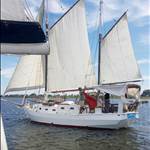
My boat has a "70'/'80's keel with a skeg hung rudder, Which is world apart from Spray.
She will self steer using sheet to tiller steering.

It is a cheap, proven reliable system.
I had a Aires year ago and am convinced that in light airs and when running a well set up sheet to tiller system will do the job as well if not better.
Gary
It does take some experimentation and playing around.
Thanks for the link Gary, I think it's always a subject worth revisiting.
It's not for me intuitively as I like any self steering system thingammy to be useful in foul weather. So aside from playing around with sheet to tiller in nice weather for fun, I've never seriously had a good go at it. I do understand the appeal though.
Ive been chatting to a French mob called Pixel Sur Mer and hope to visit them before the end of the year. They are at the other end of the spectrum, building autopilots that are just next level smart. These are the pilots you find in the Imocas 60's or Class 40's that can trim the sailplan as well as drive the boat even in the most horrific conditions.
But the starting price, for the pilot alone, is $25K Aussie. On top of that is all of the high speed sensors and other stuff.
That's an awful lot of bungy chords!
Select to expand quoteshaggybaxter said..
Ive been chatting to a French mob called Pixel Sur Mer and hope to visit them before the end of the year. They are at the other end of the spectrum, building autopilots that are just next level smart. These are the pilots you find in the Imocas 60's or Class 40's that can trim the sailplan as well as drive the boat even in the most horrific conditions.
The servo windvane steering systems main advantage is it's ability to steer in extremely unpleasant weather and in the dark. You can be sheltered in the cabin and make small adjustments to your steering. Sheet to tiller or shockcord is fine on nice days when you have a good view of the sails.
The downfall for windvane self steering is the fast accelerating boats like catamarans and planing fixed keelers with the rapidly changing relative winds. The windvane self steering gear just can't react fast enough and that is why the French came to the fore with their superb auto pilots for the singlehanded French sailors.
Select to expand quotegarymalmgren said..
I have posted this before but as there are a few posts on wind vanes I though it was worth posting again.
Slocum says he sailed from Darwin the the Cocos Keeling islands without touching the tiller.
Maybe an exaggeration, but he certainly circumnavigated without a wind vane or electric tiller pilot.
His boat, "Spray" had virtually no keel as we know them today.
He basically, set the sails, tied off the wheel and let Spray guide herself.
My boat has a "70'/'80's keel with a skeg hung rudder, Which is world apart from Spray.
She will self steer using sheet to tiller steering.
It is a cheap, proven reliable system.
I had a Aires year ago and am convinced that in light airs and when running a well set up sheet to tiller system will do the job as well if not better.
Gary
It does take some experimentation and playing around.
Thanks for the video. I've read just about everything available online about sheet to tiller steering and bought a second hand hardcover book on the subject which is lying around somewhere. I've bought some bits and pieces to try it out on my Cavalier 28 but have never got around to it. When I purchased the boat I had intended to do some overnight/weekend coastal hops in the boat visiting esturies around Sydney but I am lucky to get a half a day sail in as I've been crewing on another yacht. One day I'll get around to trying to set up sheet to tiller. Anyway...
The first thing I did when I got the boat was install a "Tillerclutch".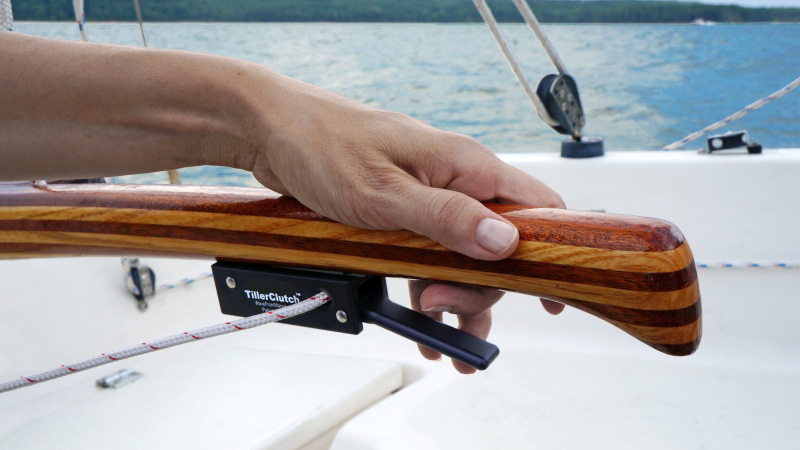
wavefrontmarine.com/
As I sail mainly solo, I can't imagine not having it. It is the first thing I rig up on the boat. My pushpit posts are conveniently aligned just aft of perpendicular to the clutch so I can tie off the line to them. I've tried tensioning the lines around the posts with a midshipman's hitch and a reverse midshipman's hitch to keep the lines taught but after a while the tiller always induces a small amount of slack, just ten or fifteen mm into the line . Next time I go sailing I'll just rig up a bungie cord to keep the tiller under tension to take out that annoying little bit of play in the rudder.
I can use it to make small adjustments to the tiller possition as I trim the sails, adjust the traveller, etc with both hands free. Once I've got the boat balanced I can go forward or below to do other things for a while. As many people have observed, yachts will tend to hold their course better on balanced sails when sailing closer to the wind but tend to not hold their course as well when sailing off the wind. When on a beam or broad reach my boat tends to bear away if the boat gets out of balance to the wind or gets knocked about by the swell. Also, the boat stays balanced better when sailing into the swell rather than down it.
It also helps me when sailing or motoring onto or off the mooring. I lock it off to point the boat slighly away from the wind before I run forward to cast off the mooring line so that the boat gently bears away from the mooring and my attached dinghy/paddle board while I am still forward. When returning to the mooring I often lock it off to keep the boat pointing towards the mooring line as I go forward to retrieve it. Although, last weekend the wind was swinging around in all directions at the mooring and I didn't get back in time to release the clutch and the boat kept sailing with the main still up while on the mooring line and gybed even though I had the main sheet slack. So maybe it's not a good idea to have the tiller tied off when trying to secure the boat to the mooring!
When I go sailing I am not making passage but just heading out for a few miles then turning around and going home again, so I don't really have much need to hook up my tiller pilot, but I can't imagine not having my tiller clutch!
I have a Navic windvane that is available for a nominal price. Suits boats up to 30ft. PM me if you are interested.
My offshore days are over, and I don't need a windvane for short hops. Mind you, in my youth I had an original Autohelm with a windvane attachment, and it did work well on a trip up to Lake Macquarie. Only trouble was I had a sleep, and my crew on watch did not pay attention to the compass, and the windvane was steering us out to sea instead of up the coast! Better than onto the shore!
Gary,
Spray had two things different from a modern boat:
* She was heavy. A heavy boat tends not to be knocked around by small waves
* She had a long keel. Long keels track well, and are not as sensitive to changes in weather helm caused by gusts. Also, they can luff up, and then fall back, so a nice little oscillation whilst keeping the general direction. The heavy weight and the long "keel" slows the cycle, so a bit of damping.
Select to expand quoteYara said..
Gary,
Spray had two things different from a modern boat:
* She was heavy. A heavy boat tends not to be knocked around by small waves
* She had a long keel. Long keels track well, and are not as sensitive to changes in weather helm caused by gusts. Also, they can luff up, and then fall back, so a nice little oscillation whilst keeping the general direction. The heavy weight and the long "keel" slows the cycle, so a bit of damping.
I can attest to the fact that a heavy, beamy, long keel vessel does track well. Depending on wind direction i usually set the main & head sails for best effect adjust the mizzen so the helm is light then tie it down. You need to be very mindful of over sheeting a making excess leeway. (The harder you try the more sideways you go ) & beating to windward is rarely successful, big long tight haul reaches gives the best chance to make ground but not always
Ps: April 24th was the 130th anniversary of Joshua Slocums departure on his solo circumnavigating. October 10th next year ( 2026) will be the corresponding anniversary of his arrival at port Jackson
It's very easy to read about Slocum and have a kind of envy.
However the conditions necessary in his life for him to pull off this stunt were totally unenviable.
he didn't just take early retirement with a wad of cash to sail the world.
He was basically unemployable in his main occupation (master of large sailing ships), wrecked marriage, too old to re-skill and largely estranged from his family.
Obviously a good time to spend 18 months rebuilding a boat and clearing off round the world