If my old Tohatsu 6HP achieved 5 knots max per hour on my yacht.
What will my new Tohatsu 9.8 achieve ?
Select to expand quoteBundeenaboy said..
If my old Tohatsu 6HP achieved 5 knots max per hour on my yacht.
What will my new Tohatsu 9.8 achieve ?
5 knots. Same speed but better into a bit of breeze. Square root of your waterline length[feet] multiplied by 1.3
my calculation is 5.2 knots, having Yamaha 9.9 4 stroke,
full bore pushing boat about 6.5
regardless my comfortable , economical speed
is just under 5 kn, about 2 litres / h
Select to expand quoteBundeenaboy said..
If my old Tohatsu 6HP achieved 5 knots max per hour on my yacht.
What will my new Tohatsu 9.8 achieve ?
if we're having a poll put me down for 6.2 kts going downwind 
Select to expand quoteHarb said..Bundeenaboy said..
If my old Tohatsu 6HP achieved 5 knots max per hour on my yacht.
What will my new Tohatsu 9.8 achieve ?
if we're having a poll put me down for 6.2 kts going downwind
So someone knows how to calculate square root x1.3 . Ha
My Castle 650 with a 5 hp mercury gets 6 to 6.5 knots flat chat. Its true that a larger motor doesn't always mean faster but hull speed isnt gospel. So you should see an increase.
Two Dogs the Castle 650 is no more a planing hull than an S80 is. Much to my displeasure. 
Select to expand quoteMadmouse said..
Two Dogs the Castle 650 is no more a planing hull than an S80 is. Much to my displeasure.
I was meaning the S80 is planning I don't know much about the castle.
Out of interest I did a test between a 9.9hp merc and 15hp merc same motors just different jetting and intake size. At the same speed the 15hp was slightly better fuel economy. Max speed didn't change it just pushed the stern deeper into the water. Boats a Seaway 25.
Select to expand quoteslammin said..
Out of interest I did a test between a 9.9hp merc and 15hp merc same motors just different jetting and intake size. At the same speed the 15hp was slightly better fuel economy. Max speed didn't change it just pushed the stern deeper into the water. Boats a Seaway 25.
Find that very useful info - thanks for posting Slammin.
Continuing the drift from the OP's original question, I have another question about outboard fuel consumption.
With a 9hp outboard (2-stroke) mounted on a typical small fishing "tinnie" (4.5m alu runabout), which travel mode would give the best mileage on a tank of fuel:
mode A: run engine WOT (max throttle) with boat on the plane
mode B: run engine about half of WOT with boat in displacement mode (not on the plane)
Mode "A" on the plane obviously has less water resistance but burns through fuel quicker. Anyone have a grip on which would give better mileage?
(Note: due to weight of load, this boat will only plane when you go full WOT)
I sailed on an S80 that had 10 Evinrude on the back, I seem to remember it doing 8knts or could have been more.
old days was easy to obtain revs. to fuel consumption graph for particular engine, these day I seen only graphs
for a few new top line engines. From my expirience is fuel consumption directly proportional
how you open open fuel. Speed really depends on the boat / load.
Select to expand quoteBananabender said..
So someone knows how to calculate square root x1.3 . Ha
That's like the pirate code, more like what you call a guideline then a precise formula. When it comes to pushing a 1.6T boat using a small outboard the prop, shape of hull , weight and a clean bottom can affect the calculations.
Extra power will get you very little extra speed. What it will give you is the ability to punch into a heavy sea or a strong wind. But you wont get that power unless your motor can develop max revs, and to do that it needs a fine pitch sail type prop, designed for working at around 5 or 6 knots.
Yara, can I generalise?
Finer Pitch (lower number) will give me more low end power but less high end speed
Courser pitch (higher number) will give me more high end speed but less low end power
sometimes ago I bought 15HP Mercury, heavy displacement prop
was available , just recently ask for heavy displacement prop
for 9.9 Yamaha , not available .
have to say the boat performance is identical.
since we are all drifting further, what if your lucky enough to have 2 hulls?
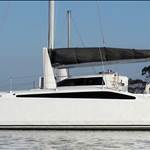
With the cat, weighing about 2T, Yamaha 9.9HT gets about 6.5-7 knots max, if the hulls are clean, and maybe 2l per hour also.
The Yamaha 9.9 high thrust probably like Charriot couldn't get a prop for, is geared to push, so add gearing into your thoughts also.
Models from about 5 years ago onwards have a different gearbox ratio,the head unit is slightly narrower, but they aren't the same anymore.
Charriot the prop should be is still available, both original and knock offs.
I bought one admittedly a few years ago, but it is common to have to replace them, as the rubber bonding 'doughnut' that it drives through perishes in the end, meaning you lose 99% of the drive all of a sudden, in my case it was a long slow motor back to the mooring, relying on friction to keep driving the prop.
I've looked at different props on the same 9.9 motor, as well as imported copies of the Yamaha engine.
Unless it can spin the original high thrust prop, which looks like a dinnerplate size in comparison , you can get a little higher hull speed, but no grunt, especially in reverse.
Select to expand quoteBundeenaboy said..
Yara, can I generalise?
Finer Pitch (lower number) will give me more low end power but less high end speed
Courser pitch (higher number) will give me more high end speed but less low end power
No. Basic fact of life is that for a boat that goes though the water (dispacement hull) you hit a brick wall at a certain speed where more power does not give you any more speed. You want a prop that wiil give you max power at a speed just below that.
Has it got to do with the wavelength the hull creates?
i.e, the wave rises at the bow, drops down amidships, and rises again at the stern.
This wave length can't change due to the length of the displacement hull? Once this wave is achieved, you are at hull speed.
Is this right?
Select to expand quoteshoodbegood said..
Has it got to do with the wavelength the hull creates?
i.e, the wave rises at the bow, drops down amidships, and rises again at the stern.
This wave length can't change due to the length of the displacement hull? Once this wave is achieved, you are at hull speed.
Is this right?
yes, but the "hull speed" calculations that are commonly referred to for displacement hulls are only approximations, since hull design is a factor.
the 1.34 * square root of the waterline length gives an approximate figure past which a lot more power is required to go any faster...
Select to expand quoteYara said..Bundeenaboy said..
Yara, can I generalise?
Finer Pitch (lower number) will give me more low end power but less high end speed
Courser pitch (higher number) will give me more high end speed but less low end power
No. Basic fact of life is that for a boat that goes though the water (dispacement hull) you hit a brick wall at a certain speed where more power does not give you any more speed. You want a prop that wiil give you max power at a speed just below that.
Hi Yara,
I was generalising that we could achieve higher speed, not specifically on my boat.
Thanks again , you have helped me alot.
Hull length is a good indicator, but it isn't the be all and end all in relation to speed, apparently: Here's a good explanation: