Hi brainstrust,
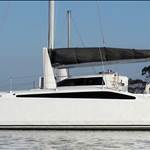
recent events have lead me to assess the sailhandling arrangements on my current boat, a 30ft cat, as per some comments in another thread my already suggest. In particular, the ability for any of our crew to to release pressure from the mainsail when suddenly overpowered.
A number of scenarios in combination could require such quick action when sailing in stronger winds: Sudden unforeseen squall,just getting ready to put that reef in,not having put the reef in in time, leaving the helm momentarily for a drink/pee/jumper, taking evasive action, novice helmsman, unpredictable seas etc.
In the case where the boat cant be sailed through or steered out of a momentary increase in pressure, and the windward hull starts to lift, how long do you have to take evasive action? The rig tries to accelerate, the leeward hull goes down under pressure, the boat reacts and tries to catch up to the rig, with pressure enough to lift and begin spilling to a degree. The windward hull now has pressure below it and things dont start to look good.
What if you could drop the mainsheet completely from the boom end? The boom end isnt complicated by having the traveller, and you replace a clevis pin or a shackle with a releasable version. Something like a small 12V solenoid in the boom, ideally controlled via Bluetooth, to avoid cabling.Power is done by battery, or small solar cells mounted on the boomcap, and you have a paired Bluetooth switch at the helm, or anywhere to activate it. (Lifejacket?)
I'm sure there are a number of ways of looking at the hardware issues, electric door/gate locks for example may be similar and are 12V?
Other sailing hardware have pins releasable under load, just need to remotely actuate it.
There are plenty of smarter Seabreezers than myself, so what you do think?
KISS.....Keep it simple ... you know the rest...
there are mechanical release clutch type things available on the market, even electromagnetic stand alone units set up for this stuff... never seen one in real life but have seen photos on $$$ yachts. Some Gunboats and the likes have them...
myboatsgear.com/2017/01/12/upside-up-anticapsize/
My time on cats, with a long traveller( double end twin system, I was told better to dump the traveller, and even tune the main via traveller and leave the main sheet as last resort.
Problem with this is the main sheet is normally stuffed into a rope bag and likely to jam in a knot through the clutch... keep a knife handy( another story when the furled code 0 got air inside it while on a mooring at 2am, when a 55knt front arrived , dumped the clutch, the halyard threw a dive tank 10mtr into air, bent the valve and jammed in clutch...knife to halyard and a Code 0 crashing to deck)
Neither will work down wind if the booms against the shrouds, probably make it worse.
Turning up in a cat close hauled actually can momentarily power it up more, as it doesn't heel over and wash off pressure . Turn and run at least washes off apparent wind
I don't have the answer you want, I guess good seamanship is to reef well before you should and have a plan of action practiced ready to go when it hits the fan.
On the other thread I mentioned cats should reef by numbers not feel, know your cat, make a table/spread sheet, laminate it and stick on the helm somewhere so everyone knows when to reef and ALWAYS use it
There was a post on CF about a guy that was hit by a microburst, and it raised the main out of the closed sail bag.. he even cut the Outhaul, and Halyard though some said not too...
Nothing is 100%, and so many variables, sailing angle, wind angle, apparent, sea state, crew, boat and luck...
Was also taught, when on watch at night on a passage, if you feel a sudden drop in temp, you've got about 3-4 seconds to get to the main/head sheets... because a squall is about to hit... radar not always on, and sometimes not seen.
Be a Boy Scout and always be prepared!
Cats usually dump the travellers not the sheet.
The issue with dumping the sheet is that the boom goes up, causing twist which means at 90deg of different wind direction, the main is still catching wind.
If you dump traveller the main stays with a narrow lead to the wind, meaning far less force pulling the boat over.
A trigger style snap shackle (the type big boats use a fid for to fire the brace) on each side of the traveller might work.
Traveller side load is also only 0.2 of mainsheet load, so easier to release
absolutely agree Cabron, way better to be prepared as much as you can, but this is for when it's still going to hit the fan, despite your best intentions.
I've only had one close call early on, and it probably wasn't even that. Sailing alone on a reach, full main, and my one size fits all no.2 in about maybe 8 knots and flat water on the bay. From a westerly, I passing a local quay, and the wind channelling through with ships docked on both sides must have created a tunnel of some sort. The boat took off, and we went from a few knots boat speed to good double digits. I let the main out, but we just kept rocketing upwards in speed, and it looked like it was going to keep building.
It only lasted maybe 30 seconds, and in hindsight i'm sure the boat was absolutely fine, but I do remember a hull going quiet, so it would have lifted. Again, just a learning experience, but still equal parts exhilaration and cack material at the same time.
RF: if i pulled a release on the main block attachment at the boom strap, it would totally let the whole block go instantly, so that would let the boom come down?
Separate Side trigger release snaps on the traveller might be the go as well, I hadn't pictured that option, and easy to rig up......
The other thought on traveller rather than mainsheet....
If you do pull the (oh ****) handle and it's on the sheet, you'll have a boom swinging around uncontrollably and it will be dangerous to get it back on if it's still blowing.
If you only release one side of the traveller, once things have settled you could simply tack!!
As some others have said dumping the main moves the centre of effort of the main forward and up. If you blew the block this would happen very quickly,a lot quicker than dumping the main. This may not be what you want. It depends on wind angle waves etc. It could also make the main difficult to get down if you cant luff up. I have been on boats when the mainsheet has snapped and it's not fun.
I am pretty sure most of the big multi hulls have a dump on the traveller. All sorts have been tried with inclinometers etc.
Again as someone else said KISS. Have the traveller on a cam cleat that is easily reached at all times.
The big multi hull sailors talk about "The death angle" around the beam. Turning either way powers the boat up.
Maybe something like this (see bad drawing below) on the traveller.
It could be set up so that the panic clutches were near the helm, or maybe a rip cord that runs through fairleads across the back of the cockpit could be attached to the clutch levers.

Before thinking about any system that released the mainsheet control system, it would be worth reading this report
www.maritimenz.govt.nz/commercial/safety/accidents-reporting/accident-reports/documents/Platino-mnz-accident-report-2016.pdf
Essentially a bad gybe overloaded the main traveler and sheered it off its track.
That left the mainsheet system swinging around the end of the boom like a medieval mace; knocking two crew overboard with fatal results.
The out of control boom then smashed against the shrouds repeatedly until it dismasted the boat.
OK, it was a big boat with enormous forces, but worth taking into account. You don't want to lose control over the boom.
Stray's double ended system is another matter worth considering.
Maybe, if becoming over powered with the wind abaft the beam, hardening up on sheet and traveller then quickly rounding up would avoid getting topsy turvey.
Thoughts??
How far away is Point one 'powered up, sailing well, all under control' from Point two 'oh **** there's a hull up and nothing's working to de-power the boat?
if Point one and Point two are a long way apart, then it's a matter of when to make decisions such as reefing, and optimising low friction reefing, mainsheet and traveller . If Point one and Point two are close together, I'd suggest a smaller mainsail...
Release traveller and mainsheet. Pull up on topping lift. Curling the boom up. Halving sail area.
I don't agree with the idea of using the traveller. It has been along time since I sailed Tornados and small cats but I hardly ever saw anyone trimming traveller - main all the way. Traveller for twist control and then main for power and fine tune.
Blowing the main will lower the CE with twist - you will blow the head off which is what you want. Lowering traveller will still keep the head powered up. Skiffs, yachts, even Lasers all ease vang when overpowered downwind, when there is no other way of depowering and you have a heap of main up, ease the vang (or in your case the sheet).
Lots of travellers on cats I have sailed are slow to move and almost need help to run to leeward as the are hard to move under load. Also they can very nasty things running at lower deck level when they do move. So my advice would be to stay well away from traveller dumping. Go back to the sheet.
Something simple would be similar to what Ian Johnston had on Verbatim back in 1988. It was a quick release that ran inside the cabin. A small line much like the ropes to ring the bell on old buses. It was led to the front of the boom and led back to a large snap shackle on the mainsheet.
As for worrying about a thrashing boom, install a secondary leash on the mainsheet so that you dump three foot or so of sheet and then the leash takes the load. This would allow you control so that you could rig up a temporary sheet safely, re-attach snap shackle and sail on.
Dumping 3 ft of mainsheet would be the equivalent of releasing about 18ft of mainsheet at the end of a 6;1 system, that is a lot of easing.
Remember too - that hard and fast rules on whether to head or bear away are wrong. Safety in a gust is either headed up and luffing or bearing away and running with reduced apparent. A beam reach can be dangerous on a cat or skiff because it will take time to get the boat to bear away or head up. When close hauled - head up to depower. When on a broad reach bear away - when on a beam reach - either but maybe doing a spectacular round up is fastest.
Whichever mode you choose - keep a look out to windward on a beam reach when pressing the boat. If you see a gust bear away or head up before it so that you have less angle to turn to safety. And have your mainsheet close by as well.
cheers
Phil
Select to expand quotecisco said..
Maybe, if becoming over powered with the wind abaft the beam, hardening up on sheet and traveller then quickly rounding up would avoid getting topsy turvey.
Thoughts??
Cats and skiffs call this the "power zone" (or "death zone" if you're a more emotional cat sailor). The problem is the turn invokes what amounts to a broach; tripping the boat over. The faster you turn and the faster the boat is going, the more the tripping effect. Add a following sea and the result is pretty ugly.
On a skiff you generally try for a sheets completely off, full hiking, slow turn.
Kankama said
"Lots of travellers on cats I have sailed are slow to move and almost need help to run to leeward as the are hard to move under load. Also they can very nasty things running at lower deck level when they do move. So my advice would be to stay well away from traveller dumping. Go back to the sheet."
I must admit, I nearly added that to my last post but wasn't sure if it applied to cats. If you have a straight traveler, then the problem is, as the car moves out, it tightens the mainsheet. So it's not surprising there's a lot of resistance to the movement.