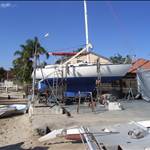
I've been locking everything down quite securely when leaving the boat - talking about tying off the tiller centrally and pulling on main sheet hard. Aim is to resist significant wash from passing ferries and stink boats. Wonder if this is "doing it right" given have detected some give in the rudder when tiller tied - could zero flexibility in the tiller create forces that weaken the rudder connection to hull?? (Pintels and gudgeons??). So question is - what to do with tiller, and what sheets/halyards to keep loose or tight. Note boat is folkboat with long attached rudder so may get more lateral force applied than a spade rudder for instance....
Someone with more wisdom may know better than me but I leave my wheel/rudder tight.
My theory being if it wheels port and starboard all day due to wash its going to wear out quicker. The other reason is based on helicopters with engine stalled. Amazingly they fall slower if they auto rotate on their way down and landing is feasable whereas in the case of locked rotor they drop like a stone. So I applied that to locking prop while racing (less drag in my theory) and similarly locking rudder when parked, hopefully less drag than if left free.
I think someone on the forum suggested some time ago that leaving the rudder free
on the mooring can lead to a lot of bearing wear. Seems right to me.
Everything locked down tight. Especially the boom, rudder and halyards. Sitting on a mooring the constant rocking, maybe 30 times a minute, 1800 an hour, 43200 a day, 300,000 a week. It is a given that has to wear rudder bearings, goosenecks and halyard shackles out.
Unless you have a tidal flow there won't be any drag, just the constant rocking and yawing.
i agree with above comments though a crutch under the boom to take load off the rig and stop movement in the boom is also agood thing also makes for aquiter night when sleeping on board
Lock it all tight. We sit in a pen, but get signficant beam wash from passing traffic. If loose it just flogs around causing wear & tear, not good!
Thks - that all makes sense. Will need to figure out boom situation given constant tension on mainsheet and topping lift which can't be good. Get movement regardless of tautness. Have figured out that keeping boom lower reduces length of pendulum swing if you like and reduces movement. Suspect the give in the rudder may be unavoidable wear and tear. Situation exacerbated by tidal location so on average side-on to passing traffic...
Yes every thing tight .
Im not sure what your rudder pintals look like on my old H28 there are top and bottom and one just below water line.
Easter a couple of years ago I slide in a piece of copper sheet to take up the slack on the center pintel. Also on the walker h28 there is a replaceable bushing on the bottom pintel this wears down over the years and then you replace it if it wears very badly the rudder tiller stainless bracket would bottom out as it come into the cockpit mines OK it just looks like a bushing of tuffnel the weight of the rudder sits on it above the bottom pintel basically its a self lubricating bush
If you looked closely in this photo on the block of wood the keel is sitting on is my bush its now fitted in place but Ive still to fit the center pintel.
Ive coats my pintels with epoxy to take up any slack and I will spend a good 4 hours fitting the center pintel in the next week or so making sure there is no movement that pintel has two bolts going through the hull and one bolt on the out side which you can sim and then lock up the out side bolt
I used a piece of copper sheet even a drink can cut into a strip will do for short term


Dam the bolt I was hoping to show is just out of the picture at the center pintel but you nip that one up to take the slack out of the rudder shaft to pintel
The tufnel bush in my rudder is slipped over the rudder shaft just before you fit the rudder back into the pintel.
In the photo below you can see th bolt on the end of the center pintel ( three bolts two through the hull and the one on the rudder end)

 I was not great at English expression at school Im afraid my sons run rings around me
  . I guess doing there masters helps
Hope the photos help
Select to expand quoteFolkboatM26 said..
Thks - that all makes sense. Will need to figure out boom situation given constant tension on mainsheet and topping lift which can't be good. Get movement regardless of tautness. Have figured out that keeping boom lower reduces length of pendulum swing if you like and reduces movement. Suspect the give in the rudder may be unavoidable wear and tear. Situation exacerbated by tidal location so on average side-on to passing traffic...
We use a strop from boom sheet block to grab rail on cabin top, keeps it tight and stops boom from swaying. After furling headsail, I also keep the sheets fairly tight as people undoubtedly use them as hand rails when going forward.

I used to put one more line from the boom to safety rail, that stop boom movement
and all the other lines are just tight.
Select to expand quoteCharriot said...
I used to put one more line from the boom to safety rail, that stop boom movement
and all the other lines are just tight.
Me too. Three points of contact to stop all motion.
Select to expand quoteTrek said..
Someone with more wisdom may know better than me but I leave my wheel/rudder tight.
My theory being if it wheels port and starboard all day due to wash its going to wear out quicker. The other reason is based on helicopters with engine stalled. Amazingly they fall slower if they auto rotate on their way down and landing is feasable whereas in the case of locked rotor they drop like a stone. So I applied that to locking prop while racing (less drag in my theory) and similarly locking rudder when parked, hopefully less drag than if left free.
Interesting theory that Trek. I would have thought that with water being non-compressible the opposite would be true.
The prop being able to turn would allow an easier passage for the water rather than the 'dam' effect of a locked prop.
1. Boom crutch is solid but might not be stored easily.
2.Tie a rope to a se cure point on one side run the rope via boom with a few turns to winch on other side, secure.
3. Drop the boom on the top of the cabin, secure with an ocky strap to the cabin top winch and tighten main sheet.
To take care of the slapping effect on the rudder l hooked up few rubber rings from a cut up inner tube and secured the tiller to the centre of the traveller with one rubber ring and the end of the tiller is secured by two of the hooked up rings somewhere on the sides of the cockpit.

Thanks everybody for the replies, esp. HG for the photos. Will see what I can do when she's next out of the water. For now I think securing the boom with a line or occy strap looks like a plan. Dropping the boom to the cabin top could be interesting too - certainly will take away all the movement. Just need to check if the boom cover will gather near the companionway - there are a few gaps that normally keep out the elements.
Cheers.