Hi all
A mate is looking at buying a new Jenneau 349 as a coastal cruiser/club racer http://www.boatsales.com.au/content/boat-reviews/2014/cruiser--racer/jeanneau/sun-odyssey-349/jeanneau-sun-odyssey-349-47457
Any thoughts or experiences would be appreciated
Regards Don
I have owned one since new in December 2014 and can't speak too highly of it. Good value, well built and clever design.
In that size range of modern production boats - 10m overall - which is easily handled by one or two yet capable of taking half a dozen for a day sail, it is the stand-out pick from the other European manufacturers. Having said that, the Dufour 350 would be worth comparing as the two yachts are almost identical.
The 349 has been hugely popular and hull numbers are probably in the high 300s now worldwide. There must be 15 now in Sydney split between Pittwater and the harbour.
There is some good reading from other owners on this forum - jeanneau349.freeforums.net/ - that will give your mate an idea of what to expect.
And a lot of useful data on this site set up by a Canadian owner - jeanneau349.com/

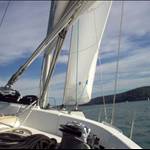
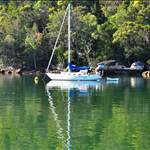
This is a sister to mine and currently lives on Lake Macquarie. It has the hinged keel option. Shoal draft is also available but mine is the standard keel of 2.09m draft.
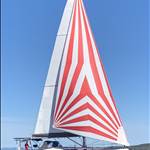
The twin rudders are amazingly effective when sailing like this in a decent breeze. It makes for a very safe and predictable ride with never any concern about rounding up or being unable to bear away as can often be the case with a single rudder. The trade-off is the extra drag in light winds. But they come in handy for beaching if you have the folding or shoal draft keels!
Hi Gravy
Thanks for your thoughts and the link to the forum
Just a couple of questions if you don't mind
If you were racing it with a full crew (helm, 2 head sail trimmers, main sheet trimmer and forward hand) how does the layout work because looking at the website it looks like the head sail sheets and main sail sheets go back to through clutches to the winches in front of the wheels to make it easy for the person on the helm to reach everything if sailing short handed
On his existing boat (Sun Odyssey 33i Performance) the head sail trimmers normally kneel behind the winches and can look at the head sail while trimming and the person on the main sits in the cockpit in front of the wheel and operates the 2 main sheets, (main one and tweeker) and traveller
On the 349 it looks like it would be hard for the head sail; trimmers to kneel behind the winches because the wheels would be in the way
On the 349 with the optional cabin top winches it looks like you could run either the main sheets or head sail sheets to them
Your thoughts would be appreciated
Regards Don
Hi Don,
You are absolutely correct. My boat has the optional cabin top winches and I would recommend them as essential if he is planning to race.
The cabin top winches give an ideal position for trimming the headsail and we have Spinlock cleats right next to them for the barber haulers.
Our boom vang is also led to a cam cleat on the cabin roof. It would be a good idea to have the Cunningham eye control line there too but ours is at the mast. If the outhaul cleat wasn't on the boom, I would definitely lead it back to the cockpit.

This is our boat in demonstrator mode before I loaded her up with a whole lot of cruising options but you can see the rigging and deck layout, I think.
For racing I would also recommend the bowsprit option. The rig has no backstay with forestay tension coming from the 30 degree swept back spreaders. This means that the mainsail won't go out all the way so it's quicker to tack downwind than running square. So an asymmetrical spinnaker off the bowsprit is the way to go downwind. And for some extra oomph, a fat top mainsail can be fitted easily without a backstay to get in the way.
Back to the winches. One of my few complaints is that the rear winches positioned near the wheels aren't very comfortable to operate either from in front or behind the wheel. One is at full stretch to reach them and its hard to get a strong leverage on them unless you are crouching or kneeling on the seats. So I often use one as a turning block and do my grinding on one of the cabin top winches when tensioning halyards, for example.
I'm happy to run through the options list if you want me to. We ticked a lot of boxes with our purchase and I'm very happy with the final result.
Hi Gravy
Thanks for that
From your previous comments i assume that thew head sail sheets can be led directly to the cabin top winches which would be a good position when racing with a full crew
If this is the case i assume the 2 main sheets would go to the rear winches
With the main sheets it doesn't look like there is much mechanical advantage in the system so i assume you would need to use the winches in any decent breeze
Regards Don
Hi Don,
Yes, you are right. The jib sheets come nicely back to the cabin top winches where they are well positioned for comfortable access.
And correct again with the double ended main sheet. There is a not a lot of purchase but in practice it is an excellent system similar to the Hanse set-up and despite the slightly awkward placement of the aft winches it is easy to get plenty of mainsheet tension even in a solid breeze.

Here we are with all of the cruising comforts installed. I bought the dealer's demo boat and kept adding stuff until the budget was spent! Note the rope bags that I would recommend and the cockpit table that you might not want with a cockpit full of racing crew although it does provide a handy grab rail and footrest.
Hi Gravy
She is a nice looking boat and you should be proud of her and thank you for the information so far
A couple of more questions if you don't mind
I like the twin rudders but what do you think of the twin wheels
I guess the advantage is that you can walk from front to back without having to climb around the wheel but if it had a single wheel like the 331 it would make the rear winches more accessible when racing with a crew
Do you have wind speed,direction and boat speed instruments in front of each wheel or only in front of one wheel
Also when my mate reverses his current 33I into the berth (pontoons on both sides) he normally stands in front of the wheel facing backwards and the control lever to give her a hit in forward to stop her is easy to access but on the 349 it looks like you would have to stand behind the starboard wheel to be able to reach the lever
Do you race her or do you mainly cruise ?
Regards Don
I certainly would be most happy with a boat like that, the missus would love the swim platform and ladder, yep,, nice boat Gravy,,, Hopefully my next boat 
Hi Don,
Thanks, it had to be a good boat as it is going to have to last me at least a decade.
Twin wheels are great for opening up the cockpit so that its much more usable when you are by the dock or at anchor. A single wheel is such a barrier that at some boat shows they even remove the wheel to make the cockpit look bigger. Under sail, you always have a clear view of the headsail whether you choose to helm from the windward or leeward side. It was one of the features that I had on my list of essentials when I started my research. The slight disadvantage of the position of the aft winches is well worth the trade-of IMHO.
We installed Raymarine instruments despite the Jeanneau options listing B&G. The choice was based on a preference for the Raymarine auto pilot which has proved to be a gem. So on the starboard side we have a multifunction screen with chart plotter which can also display all the data you need for sailing (wind, course, depth etc). Then on the port side there is a small screen for the autopilot and another dedicated to sailing data display. So, yes, for racing around the cans we have the same data at both helm positions.
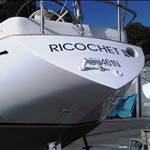
Reversing doesn't present a problem for me:

As you can see, I have got used to steering while standing aft of the wheel where I can easily reach down to operate the throttle lever (hidden behind the rego number in this pic). She is slow to get going in reverse which is probably due to the folding prop but steers very accurately and will stop on a dime as soon as you hit forward gear as the displacement is quite light at 5300 kgs.
We race regularly in non-spinnaker twilight races in a large and very mixed fleet. As I often end up sailing single handed, she is now rigged with a self-tacking jib. The best point of sailing is upwind where we see off Solings and Diamonds and stay very close to the Etchells and 5.5s. But down wind we suffer against anything with an overlapping jib except when the conditions are such that they start rounding up and we stay very nicely on our feet. One of my best results last season was sailing one-up without a reef in 30 knots.
But as it is well equipped for cruising, we get away a bit too. School holidays are best when my grandchildren come aboard for days and nights aboard making the most of the backwaters of Pittwater and Broken Bay.
Hope that helps.
Select to expand quoteJolene said..
I certainly would be most happy with a boat like that, the missus would love the swim platform and ladder, yep,, nice boat Gravy,,, Hopefully my next boat
A bit more room in the cockpit than the S&S 34 Jolene 
Select to expand quoteMorningBird said..
Looking at the amount of heel in the photo, what is the angle of vanishing stability of the Jeanneau?
Spot on MB. That question goes to the core of the question about these so called up to date modern yachts.
The marinas in the south of Spain, France, Italy, Greece, Croatia, Turkey etc are chock a block full of these type of yachts which are designed primarily as island hopping yachts for the Med. I would surmise most of them rarely ever venture more than 20 miles from their marina berth. Little more than fashion and status symbols.
Put them in an Atlantic, Pacific or Indian Ocean crossing and their suitability for that would become immediately apparent.
Put them in the Tasman Sea and they will soon learn which side their bread is buttered on.
Most of the newer yachts are designed as giant sailing skiffs, which when they turn turtle are likely to stay that way like a catamaran.
If you are only doing coastal cruising in them that is fine.
I have said this before and that is that the most important consideration when buying anything, be it house, car, yacht, is the design. Does the design suit your intended use?????
So what should the angle of vanishing stability be?
If you look at the first reference that Dr Google turns up which is sailskills.co.uk/Stability/sailskills_stability_stability_explained_AVS.html
You will find this table:

So, maybe for a 10 metre yacht, 138 degrees looks pretty good. But that's for the shoal draft version. The yacht in the photo MB commented on which has the swing keel and a square top mainsail has an angle of vanishing stability of 139.2 degrees as does my yacht with its standard keel and standard mainsail.
(Reference at page 23 of the owners manual: jeanneau349.com/index_htm_files/Jeanneau%20SO349%20-%20Owners%20Manual.pdf)
Select to expand quoteGravy7 said...
So what should the angle of vanishing stability be?
If you look at the first reference that Dr Google turns up which is sailskills.co.uk/Stability/sailskills_stability_stability_explained_AVS.html
You will find this table:
So, maybe for a 10 metre yacht, 138 degrees looks pretty good. But that's for the shoal draft version. The yacht in the photo MB commented on which has the swing keel and a square top mainsail has an angle of vanishing stability of 139.2 degrees as does my yacht with its standard keel and standard mainsail.
(Reference at page 23 of the owners manual: jeanneau349.com/index_htm_files/Jeanneau%20SO349%20-%20Owners%20Manual.pdf)
Thanks for the info. The S&S34 AoVS is in the mid 140s so I am surprised at an AoVS in the high 130s.
It looked to me from the angle of heel and wide hull they have a lot of form stability. Most modern hull forms do use form stability rather than a heavy keel resulting in an AoVS around 115 to 130 degrees.
When inverted the same wide hull makes them very stable upside down.
Just checked the manual and see the high 130s is for an unladen boat. When loaded the AoVS is 131 to 132 degrees. There are also warnings that the boat is liable to capsize or become flooded if carrying too much sail, sail is to be reduced above Force 3. Gentle breeze 7-10 knots.
As Cisco says, horses for courses.
Select to expand quoteMorningBird said..
Thanks for the info. The S&S34 AoVS is in the mid 140s so I am surprised at an AoVS in the high 130s.
It looked to me from the angle of heel and wide hull they have a lot of form stability. Most modern hull forms do use form stability rather than a heavy keel resulting in an AoVS around 115 to 130 degrees.
When inverted the same wide hull makes them very stable upside down.
Just checked the manual and see the high 130s is for an unladen boat. When loaded the AoVS is 131 to 132 degrees. There are also warnings that the boat is liable to capsize or become flooded if carrying too much sail, sail is to be reduced above Force 3. Gentle breeze 7-10 knots.
As Cisco says, horses for courses.
Indeed, horses for courses. (Cisco was not quite so polite.) But this horse suits my course perfectly and I have no aspirations to cross the Tasman.
Back to the stern-on photo of Voila: This was taken during a promotional photo shoot and I was sailing on a parallel course to leeward at the time, higher and faster than the sistership Voila by keeping the windward rudder immersed by half a metre or so. There is a noticeable resistance from heeling as the aft chine digs in but then there is a sweet spot at which she flies upwind. I'm sure you know the feeling.
It's interesting how much AVS reduces from 139.2 to 132.5 degrees between 'minimal load' and 'laden'. When I'm halfway upside down it will be something to contemplate!
As to reducing sail at Force 4 which is 11-16 knots, that sounds like someone's swallowed a Eurozone OH&S risk assessment. Force 4 is when we are starting to get interested isn't it? In the Viola photo, it was blowing about 18 knots true - Force 5 - just a typical Pittwater seabreeze. I would agree if the prudent advice was to reduce sail at Force 5 but normally we wait until Force 6 (22 knots) if we are racing.
I'd be happy to have you aboard, MorningBird, before you quit this backwater. PM me and I'll show you the ropes and even shout you a beer.
Select to expand quoteGravy7 said...MorningBird said..
Thanks for the info. The S&S34 AoVS is in the mid 140s so I am surprised at an AoVS in the high 130s.
It looked to me from the angle of heel and wide hull they have a lot of form stability. Most modern hull forms do use form stability rather than a heavy keel resulting in an AoVS around 115 to 130 degrees.
When inverted the same wide hull makes them very stable upside down.
Just checked the manual and see the high 130s is for an unladen boat. When loaded the AoVS is 131 to 132 degrees. There are also warnings that the boat is liable to capsize or become flooded if carrying too much sail, sail is to be reduced above Force 3. Gentle breeze 7-10 knots.
As Cisco says, horses for courses.
Indeed, horses for courses. (Cisco was not quite so polite.) But this horse suits my course perfectly and I have no aspirations to cross the Tasman.
Back to the stern-on photo of Voila: This was taken during a promotional photo shoot and I was sailing on a parallel course to leeward at the time, higher and faster than the sistership Voila by keeping the windward rudder immersed by half a metre or so. There is a noticeable resistance from heeling as the aft chine digs in but then there is a sweet spot at which she flies upwind. I'm sure you know the feeling.
It's interesting how much AVS reduces from 139.2 to 132.5 degrees between 'minimal load' and 'laden'. When I'm halfway upside down it will be something to contemplate!
As to reducing sail at Force 4 which is 11-16 knots, that sounds like someone's swallowed a Eurozone OH&S risk assessment. Force 4 is when we are starting to get interested isn't it? In the Viola photo, it was blowing about 18 knots true - Force 5 - just a typical Pittwater seabreeze. I would agree if the prudent advice was to reduce sail at Force 5 but normally we wait until Force 6 (22 knots) if we are racing.
I'd be happy to have you aboard, MorningBird, before you quit this backwater. PM me and I'll show you the ropes and even shout you a beer.
Your on. Where are you moored?
Don't get me wrong, I like modern yachts and love there practicality for local and coastal cruising.
But 250nm into the Tasman in 35-45kts and 6-8 metre swell and sea isn't their comfort zone.
Hi all
In my experience of crewing on a Jenneau 33I Performance for the last 3 seasons in winds up to around 50 knots we would normally carry full sails (over size main and head sail) up to around sustained 25 knots and then put a reef in until around a sustained 30 knots when the second reef would go in and the oversize head sail would come off and the original smaller furling head sail would go up and as the wind speed increased the head sail would be progressively wound off
The winds down here are changeable in both speed and direction but at no time does the boat feel unsafe
A couple of years ago the boat was racing from Port Huon to Cygnet on the River (I was not on it at the time) and a cold front came through (the predicted wind was 30 knots) and the wind went from about 5 knots to 75 knots plus in a matter of seconds (they said it sounded like a train was coming and then hit them) and it laid them over horizontal for a few minutes but the boat happily stayed there until the wind died off a bit and she came up again
They managed to get the big head sail off and continued to race into Cygnet doing 13 knots downwind under main alone
Some of the boats in the fleet had sails shredded and some of the older very experienced sailors said it was the strongest winds they had ever been in
This is a photo of a 42 foot Benneatu on the river at the time after the wind had dropped off a bit
A lot of people bag newer flat bottom boats but those onboard were impressed with how she handled the conditions
Regards Don

Hi NowandZen
Starting price is around $191,000 +++ depending on what option boxes you tick www.boatsalestas.com.au/new-sail-boats-jeanneau/jeanneau-sun-odyssey-349/138308/
Regards Don
I can answer that for Sydney prices: Advertised sail-away price is $199k but that's a pretty sparse set of kit. By the time you have finished ticking option boxes and getting comfortable you will have spent at least another $20-25k.
Select to expand quoteMorningBird said..Gravy7 said...
I'd be happy to have you aboard, MorningBird, before you quit this backwater. PM me and I'll show you the ropes and even shout you a beer.
Your on. Where are you moored?
Don't get me wrong, I like modern yachts and love there practicality for local and coastal cruising.
But 250nm into the Tasman in 35-45kts and 6-8 metre swell and sea isn't their comfort zone.
Sent you a PM, MB.
Yes - as has been said - horses for courses or each to their own...
If your mate has a fair bit of personal yachting experience, he will know what to expect of a potential purchase.
If someone has got more money than a bull can sh#t, and if it turns out to not tick all the right boxes, then he will just get rid of it and buy a different yacht.
I don't know which category your mate fits into, but a yacht like this will probably do exceptionally well for club racing and ok at coastal cruising as you have indicated the intended use will be.
If his desire changes to want to cruise waters further afield, then perhaps this type of yacht won't fit the bill. This won't bother your mate if he is a rich dude, he will just get something else and cop the loss of money.
In my opinion, you can get some awesome secondhand yachts for $200k that will give the owner a lot more of a versatile investment.
The question is whether this would be a good choice for coastal cruising in Tasmania. Coastal cruising in Tassie is very different to cruising the backwaters of Broken Bay.
The angle of vanishing stability is based on a horizontal water surface. Unfortunately the ocean surface is not always horizontal. This is where keel mass stability becomes more important than shape or form stability. This is also why boats of apparently similar angles of vanishing stability can behave differently in heavy seas.
IMHO sounds like the design is a good solution if the intention is only the occasional short daylight hop type coastal cruise, but maybe not an ideal boat to do a long trip across Bass Straight.
Select to expand quoteYara said...
The question is whether this would be a good choice for coastal cruising in Tasmania. Coastal cruising in Tassie is very different to cruising the backwaters of Broken Bay.
The angle of vanishing stability is based on a horizontal water surface. Unfortunately the ocean surface is not always horizontal. This is where keel mass stability becomes more important than shape or form stability. This is also why boats of apparently similar angles of vanishing stability can behave differently in heavy seas.
IMHO sounds like the design is a good solution if the intention is only the occasional short daylight hop type coastal cruise, but maybe not an ideal boat to do a long trip across Bass Straight.
What he said. 
 Sounds like you know exactly what you and the boat are about which is great for there are many on the water who are not so astute.
Select to expand quoteNowandZen said..
Yes - as has been said - horses for courses or each to their own...
If your mate has a fair bit of personal yachting experience, he will know what to expect of a potential purchase.
If someone has got more money than a bull can sh#t, and if it turns out to not tick all the right boxes, then he will just get rid of it and buy a different yacht.
I don't know which category your mate fits into, but a yacht like this will probably do exceptionally well for club racing and ok at coastal cruising as you have indicated the intended use will be.
If his desire changes to want to cruise waters further afield, then perhaps this type of yacht won't fit the bill. This won't bother your mate if he is a rich dude, he will just get something else and cop the loss of money.
In my opinion, you can get some awesome secondhand yachts for $200k that will give the owner a lot more of a versatile investment.
Hi all
The owner is regarded as one of the best sailors in Tassie, 13 Sydney Hobart's and lots of experience racing in Australia and overseas
She will be used for racing and cruising in the Huon and the Channel so she should do the job
Regards Don
A bit of a simple read on stability,
nordkyndesign.com/inverted-stability-once-upside-down/
Is the Vanishing Point of Stability angle able to be calculated or is a practical stability test the only way to find it ie haul the boat over by the mast??
Select to expand quotecisco said..
Is the Vanishing Point of Stability angle able to be calculated or is a practical stability test the only way to find it ie haul the boat over by the mast??
Hi Cisco
I don't think that there is anything to be gained by dragging it over by the mast as it would need the mast under water to reach the point where it would want to keep going
This is a link with a couple of animations that explains it well sailskills.co.uk/Stability/sailskills_stability_stability_explained_AVS.html
Regards Don