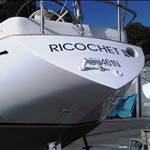
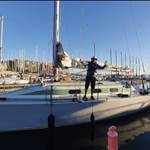
Yesterday I did something I haven't done before. I went out ( Pittwater ) on my mates 38 footer. There was a decent
breeze blowing ( there was white caps starting ) and we were heeling at the full 30 degrees. I was helming while the
owner was adjusting trim and gazing lovingly at the water lapping the toe rail. We sailed close hauled from Lion Island
to Scotland Island ( about 5 miles ) then sailed back and did it all again. But, I found it hard work. Having not done it
before I didn't know what to expect, but i didn't expect the steering to be so 'heavy'. I tended to stray too close to
the wind but I don't know if that's how it is sailing close hauled. On the second run I could feel my skinny arms protesting
a little and I'm wondering how the auto pilot would have coped. Ordinarily the boat is light on steering, so is this experience
just due to sailing under full sail at 30 degree heel or was it due to some trim problem. We were doing a hundred miles an
hour BTW.
assuming the steering system isn't damaged, then most likely you had too much sail up and/or the sails weren't trimmed well for the conditions, resulting in either lots of lee or weather helm...
G'day Sam,
What Lazz and Fish said. The fact that you mention it is normally "light" says it most likely is not a design issue, eg: too much trailing edge on a rudder compared to the rudder stock pivot point. Trim, or too much sail up, is absolutely a possible cause. You generally know when it's too much sail area, when:
You are luffing (too close to the wind) the boat will stand upright , it's slow , the headsail and main are luffing badly but it's manageable, the steering is light but spongy, you're going nowhere fast. Sooo;
You bear away a couple of degrees to fill the sails and then:
You are pinned on your ear, the steering is heavy, you feel like you're dragging the rudder sideways just to keep the boat pointing straight.
The telling factor is when you're only either upright or max heeled, and there is no in-between. You try and steer a couple of degrees to high, and its flat and depowered, a couple of degrees lower and you're fully powered up and heeled to maximum. That's a classic sign of you've got too much sail up.
To determine which sail to shorten:
Too much headsail, and you're fighting to keep the boat pointing to windward.
Too much main, its rounding up to windward all the time, and you're fighting to keep pushing the boat off the wind.
Too much of both, and the helm is pretty neutral but you're heeled so far you're just going sideways, as the rudder and keel are not effective at max heel angle.
It's exhausting and not pleasant with too much sail up, it's really hard work. Good on you for giving it a go though, experience is king!
As the guys said, was it constantly pushing you upwind or offwind?
OK guys, it looks like too much sail then. The boat was hooning along and seemed to want to go any which way but straight.
The owner has had the boat for quite a while but can rarely let his hair down because he's not confident to do it single
handed. He loved me helming because he could fiddle around and twitch this and that and just indulge in gazing at how
his boat was working. I got a lot of enjoyment just helping him do it. However, Shaggy, as you said, it did feel like I was
dragging the rudder sideways. The boat was going like steam and I never let it stand upright, but it did seem like hard
work to keep it going. The owner was quite thrilled at the performance but he wasn't the one hanging on to wheel.
I didn't complain at all. I was happy at the look on his face. If he wants to do it again I'll have to suggest a reduction
in sail.
ironically, if you reduce sail and flatten the boat out a bit, it will go faster, with less leeway. in most cases, with the sail trim you are aiming for a balanced helm with just a touch of weather helm.
Here is typical 'to much sail'
Main Luffing , I have have feet braced against cockpit seat on other side and tiller pulled into my stomach trying to look as if all's good while plane took photos. I really thought the rudder might give way there was so much pressure.Foredeck crew is behind Genoa waiting to raise no.2 and drop1. It feels fast but it's not your almost going sideways.
oh what a life.

I think on the question of whether I was being pushed upwind or offwind i would say the tendency was
always to be pushed upwind. I remember having to turn offwind fairly often which would make the boat
heel more. What is that a symptom of ??. Apart from bad helming that is.
if you are forced to steer away from the wind to stop the boat from rounding up into the wind, then that is what is referred to as "weather helm". as Shaggy mentioned above, it usually means that the power being generated by the mainsail is greater than the power of the headsail, and this imbalance tries to turn the boat around its pivot point.
the opposite is "lee helm", where the headsail is overpowering the main, and trying to push the bow to leeward...
Excuse the crappy drawing Sam, but this may help.
It is in essence because the boat will pivot on the mast and keel.
If you put too much sail up behind the mast, it will pivot to windward.
If you put too much sail up in front of the mast, it will pivot to leeward.
I hope this helps!

Edit: Fish beat me to it, and summed it up nicely!
Well explained Fishy and Shaggy. I guess I should told my mate about how the helm felt and maybe we could
have tried something, However, that'll be for next time. Yesterday I was happy to see him happy.
What is this weather helm rubbish, only difference between a good driver and a crap one is the good one can steer the boat with no load on the boat.
So that rules out about 99% of drivers.
The aim is to keep the foils as steady as possible in the water, that equals fast!
The other big issue however is hull shape.
A boat heeling over wants to round up and the hull shape determines how much.
Shaggy's POGO not at all, an Etchell plenty.
So you have to set up the rig accordingly and the sail trim.
Select to expand quotesamsturdy said..
Well explained Fishy and Shaggy. I guess I should told my mate about how the helm felt and maybe we could
have tried something, However, that'll be for next time. Yesterday I was happy to see him happy.
Hi Sam. The advice above is very well said IMHO.
The boat will go faster and straighter if the sail trim is balanced, and life is much more comfortable. If the boat is overpowered and the wind increases further you could/will find yourself in a great deal of trouble and danger.
It is a good idea when helming to always tell the skipper how the boat is acting. If he/she doesn't now they can't correct it and with wheel steering or an inexperienced skipper it might not always be obvious.
If the boat was trying to head into the wind, weather helm, the easiest and quickest thing to do is ease the main sheet or, if appropriate, drop the traveller, to spill wind out of the main and it will reduce pressure on the boat.
With lee helm tighten up on the main sheet or bring the traveller up, BUT, if you are overpowered this will make it worse.
Select to expand quotesamsturdy said..
Well explained Fishy and Shaggy. I guess I should told my mate about how the helm felt and maybe we could
have tried something, However, that'll be for next time. Yesterday I was happy to see him happy.
Good on you mate, if you're having fun who cares!
Out of interest, when we're racing the helm is always talking to the trimmers, sometimes every couple of minutes. Some examples "weather helm, ease traveller", or "no power, up traveller", or "too much heel, ease mainsheet", or "dirty air on back of jib, ease jib sheet".
The trimmers are talking back too. After adjustment, they'll ask how that does that feel "good, neutral helm", or "how is the boat speed" (against polars)
Other conversations will be general info "that's course, trim to suit", or "wind speed is xxx, boat speed is xxx, 83% of polars, what are we doing wrong", even the crew on the rail will be talking, calling gusts "pressure coming from the left in 3,2,1..." or "starboard tacker, close cross coming"
If the guys are trimming and I am not talking, I''ll get a not so gentle reminder "How is your helm? Talk to me!"
A good trimmer will be easing/trimming without waiting to be told, but communication is encouraged and welcome from the helm, all the time.
sounds like weather helm .....to much sail .... drop the traveler to leeward and feather her up in the gusts ,then drive her hard in the lulls .
Select to expand quoteshaggybaxter said..
Excuse the crappy drawing Sam, but this may help.
It is in essence because the boat will pivot on the mast and keel.
If you put too much sail up behind the mast, it will pivot to windward.
If you put too much sail up in front of the mast, it will pivot to leeward.
I hope this helps!
Edit: Fish beat me to it, and summed it up nicely!
Have not thought to much about it but if you look at my photo I have a number1 Mylar up on a masthead rig with the tiller pulled to hard to windward to prevent rounding up
I'm taking all this on board ( no pun intended ). The one big factor is inexperience on both our parts, but now
I think I can dazzle him with my sudden knowledge, thanks to you lot. As MB said, had the wind increased we
could have been in trouble. However, we got away with it and it was exciting and we weren't the only boat fully
rigged and heeling and nobody overtook us either, but next time I won't be so foolhardy.
Not to take away from what others have said, but how the rudder is mounted can also cause weather helm.
If the rudder's transom mounted with the leading edge behind the mounting point(s), then as soon as the yacht crabs, there will be weather helm caused by the higher pressure on the leeward side of the rudder.
Two other things have an impact. One is that most boats have their widest point aft. When they are heeled, this makes the immersed part of the hull asymmetrical and can force the hull to turn to windward, as in the drawing below from johnellsworth.com. Generally speaking the more asymmetry, the greater the weather helm if all else is equal. The ultimate in some ways was seen in the early Magnum skiff Moths which were shaped like a triangle; if it heeled to leeward it headed up, if it heeled to windward it bore away, and nothing you could do with the rudder stopped it.

There's also the towline effect. If the boat is heeled, there's some torquing style effect being generated because the power in the sail is now being developed out to one side. Just as if you towed a boat from a point (say) 10ft out to leeward it would turn the other way, so it turns away when the rig's power is being developed out to leeward. It's harder to see this in boats but you can notice it in windsurfers, particularly the older ones. A lot of the reason the early windsurfers were sailed with so much heel was because we needed to move the centre of effort to windward to compensate for the weather helm caused by the big centreboard being too far forward.
Only a few boats go fastest with the lee rail immersed, and they tend to be old boats that are slimmer, more symmetrical, and have higher drag hulls. It's better to luff gently (so the headsail windward telltales lift, not so the headsail luffs) and ease the main first. Lots of boats actually go best when the luff of the main is "bubbling" or luffing, anway.
Most boats are well balanced upwind when sailed well, although in some ways there's cause and effect being mixed up there.
Select to expand quotelydia said..
What is this weather helm rubbish, only difference between a good driver and a crap one is the good one can steer the boat with no load on the boat.
So that rules out about 99% of drivers.
The aim is to keep the foils as steady as possible in the water, that equals fast!
Depends on the boat. In boats that are sailing in larger waves and are comparatively beamy (JOG, J/24 and Lasers, for example) many of the champion drivers will specifically put load on the rudder quite often, sometimes about half the time, by bearing away and sometimes up, to steer them over the waves without pounding.
As Laser coach Colin Gowland says "we do want to steer, quite a bit - WHEN it gets wavy or choppy enough to slow us down and when there's enough time between waves to steer well. To smash into a wave, even a small one, is to decrease your speed and setup a chain reaction of events that can really hurt performance.We need to pull our tiller up at the very top of the wave to keep the bow in contact with the wave. Depending on the wave size, this might be a small or large pull - sometimes with the tiller crossing past the outside of the cockpit when viewed from astern.""From here, you stay in contact with the water more instead of flying off that ramp, maintaining a long waterline. This steer down should increase your little bit of weather helm somewhat and want to bring you back up - and almost as soon as you've pulled, it's time to push back."
Good drivers can weave the boat through the bad waves, pinch slightly or foot into a flat spot, anticipate the gusts and lulls and steer accordingly and do lots of other things that make them faster apart from just steering without load.
Sure, in an Etchells you often steer very little but in a dinghy or a cruiser/racer on Broken Bay it can be a different story.
Select to expand quoteChris 249 said..
Two other things have an impact. One is that most boats have their widest point aft. When they are heeled, this makes the immersed part of the hull asymmetrical and can force the hull to turn to windward, as in the drawing below from johnellsworth.com. Generally speaking the more asymmetry, the greater the weather helm if all else is equal. The ultimate in some ways was seen in the early Magnum skiff Moths which were shaped like a triangle; if it heeled to leeward it headed up, if it heeled to windward it bore away, and nothing you could do with the rudder stopped it.
Good point Chris. When I'm flat the hull is of course symmetrical, the hull becomes noticeably asymmetrical, pushing the boat up to windward.
This is the wetted surface area at 15 degree heel. Optimal heel angle is 20-25, so underwater this becomes even more asymmetrical. Anymore than that, and as you mention the chine digs in , so not even close to the toe rail, and drag goes up astronomically, ie: go slow mode.

Select to expand quoteSubsonic said..
Not to take away from what others have said, but how the rudder is mounted can also cause weather helm.
If the rudder's transom mounted with the leading edge behind the mounting point(s), then as soon as the yacht crabs, there will be weather helm caused by the higher pressure on the leeward side of the rudder.
Even with transom hung rudders there will be some pre balance on the blade, The leading edge will be ahead of the pivot point. On dinghies it's often not much but in some cases on yachts can be around 10%. The designers put this there to give that 2 finger steering pressure even in fresh conditions.
Select to expand quoteBananabender said..
Have not thought to much about it but if you look at my photo I have a number1 Mylar up on a masthead rig with the tiller pulled to hard to windward to prevent rounding up
That's a BIG headsail BB. There was a Van Der Stadt 44 that just did the Gladstone(One of Lydia's old boats), and in heavy airs they had two guys on the tiller, one to leeward pushing, one on the high side pulling for all their might!
Select to expand quoteshaggybaxter said..
Excuse the crappy drawing Sam, but this may help.
It is in essence because the boat will pivot on the mast and keel.
If you put too much sail up behind the mast, it will pivot to windward.
If you put too much sail up in front of the mast, it will pivot to leeward.
I hope this helps!
Edit: Fish beat me to it, and summed it up nicely!
On my boat, a large genoa appears to contribute quite a bit weather helm by its self. As wind increases no matter how much I reduce the main there will still be weather helm. On IOR boats at least, I don't think it is quite a simple as controlling the ratios of two sails as a heap of other factors come into play including those mentioned in this thread. Doesn't the pivot point move forward as the boat heals and wind increases, so it might be quite a bit forward of the mast ? In the example above increasing the genoa size could still result in weather helm.
To keep my boat balanced I need to reduce both sails roughly in the same proportion. Once balanced then i can then trim the traveler and main sheet to deal with gusts and lulls. eg 75% jib and 2nd Reef has less weather helm than 110% jib + 3rd Reef for the same heal.
A
Select to expand quoteshaggybaxter said..Bananabender said..
Have not thought to much about it but if you look at my photo I have a number1 Mylar up on a masthead rig with the tiller pulled to hard to windward to prevent rounding up
That's a BIG headsail BB. There was a Van Der Stadt 44 that just did the Gladstone(One of Lydia's old boats), and in heavy airs they had two guys on the tiller, one to leeward pushing, one on the high side pulling for all their might!
Mate I can imagine.
Boy I loved that sail with the new main on the Cole 35 .It just made the boat feel so powerful but when it got over 12k helmsman got tired very quickly Hanging on. To race we ran 5 headsails and three spinnakers, blooper and storm . Fractional really is way to go.
Select to expand quoteshaggybaxter said..Bananabender said..
Have not thought to much about it but if you look at my photo I have a number1 Mylar up on a masthead rig with the tiller pulled to hard to windward to prevent rounding up
That's a BIG headsail BB. There was a Van Der Stadt 44 that just did the Gladstone(One of Lydia's old boats), and in heavy airs they had two guys on the tiller, one to leeward pushing, one on the high side pulling for all their might!
That is because the rudder is the size of a house and tiller about one metre long but the you can still full size bag in over 35 true (the true test).
Direction stability was never a problem, safe as bro!
vidpicpro.smugmug.com/Brisbane-to-Gladstone-2018/Monohull-Fleet-by-Suzanne/i-v2bgRMq/A
Select to expand quoteRamona said..Subsonic said..
Not to take away from what others have said, but how the rudder is mounted can also cause weather helm.
If the rudder's transom mounted with the leading edge behind the mounting point(s), then as soon as the yacht crabs, there will be weather helm caused by the higher pressure on the leeward side of the rudder.
Even with transom hung rudders there will be some pre balance on the blade, The leading edge will be ahead of the pivot point. On dinghies it's often not much but in some cases on yachts can be around 10%. The designers put this there to give that 2 finger steering pressure even in fresh conditions.
I think youre referring to a forward sloping rudder blades, where the tip sits forward of the mounting point. Not all yacht designers have factored this into the design.
Dinghies generally don't encounter weather helm when trimmed correctly, as they are nearly always aiming to keep the boat dead flat.
It was more just a comment on what Sam maybe encountering. It may well be it has nothing at all to do with his situation.
As l am sailing a big dinghy, the Adams 28 is in essence a big dinghy, with it's transom-skeg hung rudder and tiller, l see the steering and weather helm problems through different spectacles to a larger boat with balanced rudder and wheel steering.
What is missing of Sam's report is the type of boat he was helming. We know it was a 38 but not much more. I guess it is a cruiser with the barbeque hanging off the transom. Definitely not a high class racer of which most of the commenting members sail!
Anyway, l was sailing in the same waters on the very afternoon and though, it was a fresh breeze of 14-16 knots, it was not gusting much and it was a steady ESE wind. My tiller pilot was working perfectly and when l took over the helm it was quite neutral with a normal weather helm with full main and 115% genoa. The wind is usu. manageable up to 22-24 knots on it before heel is becoming unpleasant.
The heel on the 38 - imo - was not excessive and the 'heavy' helm quite normal for the wind conditions, just short by few knots in wind speed, before the first reef would have been called for.
Perhaps, the lack of experience, on Sam's part in stronger winds, was the cause for his 'alarm'.
(I would push it to the limit just to know where it is, but that's me!  )
) 
My lack of experience is legendary SirG. The boat in question is a 38 foot Bavaria. If I go out on MY boat on a
windy day with the Missus then it's headsail only. My 28 footer is headsail driven and performs very well without
the main. Missus and I sail for fun and being oldies we have nothing to prove. Every man and his dog can overtake
us and we don't give a stuff. Now I know that what we do is NOT considered sailing but at our age, many folks
wouldn't be able to climb off the pontoon and into the dinghy so we are keeping ourselves 'young' and that
includes making mistakes and working out what went wrong or asking the forum and putting the advice into
practice. What happened on the Bavaria is completely due to my lack of experience of sailing ( not boat handling,
I am a Master class 4 ) I've only sailed a couple of times with the owner and so while I have the confidence in
handling the boat I have no experience in how it should 'feel', which is why I didn't comment to him on how the
steering felt. Had I done that he would have known how to correct it. I hope he asks me out again because I was
quite excited to be flying along on a big boat and contributing towards the effort.
good stuff Sam ! sounds like he may have had the traveler up to high ? sheet on and drop the traveler down to leeward will make a heap of difference .
I entirely agree with you Sam, and l can only recommend, carry on doing what you are doing!
Good on you! Both of you!