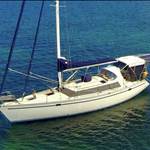
Hi All
Can anyone tell me what the max diametre of furler rope that can be used on a furlex 100s. I have an adams 10 and currently its about 4 or 5mm and pretty hard to grip.
Furler line?, my line is 4mm spectra. To operate I use small halyard winch. Winding/furling is one hand job, line does hold half furled jib no problem just stop winding. For furled genoa winch is next size up and line is 6mm (4mm would not look right on larger drum)

6mm double braid l use for years with success.
Spectra would be an overkill and waste of precious money.
I would NOT, under any circumstances use a winch for furling a jib on my 28 footer or any yacht bar a huge one.  It is a call for disaster the way l see it.
A well conditioned furler should furl in the jib without any undue force if the boat is helmed correctly, wearing a pair of gloves!
If you use your Furlex to reduce sail area, your furling line needs to be strong enough to withstand the sail pressure and jib sheet tension. It also needs to be fairly durable to resist chafe. I use 8mm spectra on my Furlex type B, because I want a strong, no stretch durable rope.
Select to expand quotesirgallivant said..
I would NOT, under any circumstances use a winch for furling a jib on my 28 footer or any yacht bar a huge one. It is a call for disaster the way l see it.
Ups, If I have done wrong thing by instilling reefing line winder/holder (halyard winch) please tell me what disastrous situation I will encounter, if convinced Ill of course remove this risk. Thanks for your help.
I would not use a winch either. If there is a problem you may not feel it and cause damage. I use 6mm double braid and use a dinghy ratchet block as a turning block at the rear of the cockpit. It is feasible to use a smaller line around the drum but have 8 or 10mm line joined so that you have a more comfortable line for handling.
I also will not use a winch on my furler. As Ramona says, the winch can mask a jam and you will break something. It is tempting to use it when the sail is full of air but the winch can be far to powerful if there is a problem and, if the sail is hard pressed, you won't know if there is a problem.
I luff up a bit and pull the sail in.
My sister does use the winch on her Valiant 40 with much larger sails and loads. I reckon she is still taking a risk but she is aware of the problem and is very careful not to winch hard.
I have a developed aversion of power-furling either by a manual or an electric winch.
I learned my first lesson in the Bay of Biscay when a power- furling main on the families 523 Benny Clipper decided it is time to jam, in the middle of a 50+ knot gale, while reefing. It nearly killed us.
The other reason, when l recently re-rigged the tub, the forestay had a bad kink in it from my mate using the largest winch on the yacht very hard to furl the recalcitrant genoa while l was cooking below, instead of luffing up and hand-furling it. The animal.
I was actually damned lucky not to have an accident with that forestay as l did not know of the kink which was inside the foil just below the top end of it, making it invisible for me and two riggers for years. The strands were twisted out of shape but there was no strand broken.
So, that's why.
Because furling head sails do not deliver optimum performance, I no longer have a head sail furler or the problem being discussed.
I am all for hanky yankees and slab reefing genoas.
Furling kites do though Cisco :)
But talking about the headsail, what part of the optimum performance is impaired?
I will pre-empt by saying if you refer to half furling a furling headsail I agree with you completely.
If you refer to all in, or all out, I think they work great, if when you furl in fully, you then hoist the hanked-on staysail :)
Having a bit both ways is cheating, but effective!
Select to expand quotecisco said..
Because furling head sails do not deliver optimum performance, I no longer have a head sail furler or the problem being discussed.
I am all for hanky yankees and slab reefing genoas.
You will change back Cisco, don't throw away your furler just yet 
That furling asymmetrical of yours shaggy I think is the best bit of kit I have seen for a long time.
There is no doubt that a half furled genoa is less efficient than a fully deployed smaller sail unless the genoa is a very expensive one designed and built for furl reefing.
Main problem I have with a furler is the time it takes to change sails on the furler. I tried it on my yacht while on the mooring with almost no wind and despite having plenty of silicon sprayed on luff and furler track, I had to keep going back and forth between cockpit and bow.
It would have been hopeless single handed in a seaway.
Fitting a "solent stay" just aft of the forestay is something I have considered and I will probably do that if I put the furler back on.
The furler I have is an older Furlex with twin luff grooves in the foil. It is in pretty good condition so I will hang on to it as you say nsw.
I just think that on a 30 footer, a furler can be a bit overkill as the sails are not too heavy to lug up on deck. My mate with an Adams 31 got rid of his furler and now uses a reefable yankee and hardly ever uses his staysail. The yankee lives in a long bag attached to his bow rail and safety lines for rapid deployment and dousing.
I have to admit that the furling genoa I have has passed it's use by date and I am unable to afford to get a new one built right now. 
I have four other sails from a past boat that are basically unused and will fit fairly nicely. I will see how I go with those for a while and make an assessment.
OK, firstly our furlers (Reefit) use 8mm rope up to 8mm wire forestay and 10mm above as it's a bigger furler.
If you want bigger rope on a smaller furler, remove the core out of some of the rope that stay on the drum all the time.
As for keeping a good shape, our furlers have a head AND tack swivel, unlike some of the cheap ones. That along with getting the sail cut correctly with what we call 'cut back' at the tack and head means the sail flattens as it furls, giving a good shape (not perfect) when the sail is reefed.
I installed one on and raced alot on a Viking 30 in WA and we had reef marks put on the foot, worked a treat. Not that you'd do that for a grand prix racer but for our twilight racing it was perfect.
Cisco, l see your problem changing furling sails on your own.
I don't know why are you changing the genoa when you got a cutter rig but if you must, follow my description which stops one running back and fort:
One must have a long enough jib halyard to start with.
I pull the bitter end out of the jammer and the fairlead(s) and take the halyard back to the mast. Using the mast winch as a turning block - or a sheave with a snap shackle if the mast winch is in a wrong position - take the bitter end of the halyard with me to the bow.
From then on it's easy, just feed the luff into the sail feeder and the foil and pull it up after lubricating the foil.
After all's well, feed the halyard back to the cockpit.
It works every time and it is easy.
I can see your method sirG. I do not have a cutter rig. I have an untapered mast with mast head fore, back and cap stays, single spreaders with fore and aft lowers. I think that is called a Marconi Rig.
I do not have any winches on the mast yet but I do have an Anderson 28 that I am planning to attach to it for the main halyard.
Do not worry about the Adams 28 photos. I have them somewhere in a drawer. I just have to find them, scan them and post them. I am a bit preoccupied with other things at the moment such as being on the hard since last October at $135/week.
Progress is slow but sure.
In for my 2 bobs worth. Firstly, you guys who can furl a flogging sail when it is time to reef down by rounding up and hauling on a reef line must be built like gorillas. I have used a small Maxwell Anchormax to furl the heady on 3 cats and a mono without breaking anything. You only take 1 turn on the winch and put enough tailing pressure on to do the job and let the line slip if it is putting too much pressure on. Bigger boats all use power furling, either electric or hydraulic without breaking things.
I really don't know how you reef or change a hanked on jib on a small boat. By the time you need to change down the bow is leaping about trying to throw you off the boat and both you and the sail on the deck are in danger of being washed overboard - and to get that sail down you need to round up then somehow go forward with the sheets flogging and the clew cringle trying to brain you. On a 40 footer , yes maybe, but then the sail is so big you need a gorilla to haul it down the forestay if it is full of wind and the boat is heeled over.
If you have crew it is a different matter, things can be brought under control.
With a decent furler and genoa you don't need a multitude of sails. My North furler has a tack swivel as well as a head swivel and my sail has a padded luff. It sets well enough even with 10 rolls in to go to windward in 30 knots plus if the track car is set well forward. And it balances ok with 2 reefs in the main. I just got back from Hinchinbrook, 18 days day sailing single handed in winds from 3 knots to 30 knots and never once wanted either a bigger or smaller sail, never left the cockpit to shorten either main or head sail beating or running and that is the way I like to cruise.
So why make your cruising life miserable. Different story if you are racing because you have a crew. And an incentive.
Well, in theory, mind, in theory, one should shorten sail well before the weather turns.
Good seamanship dictates having one eye on the sky all the time and read the signs.
Cruising is not - in my opinion - a set and forget event. One might set the sails but they are like babies, need constant attention.
Also, for killing time, it is a good occupation to try different sails, setups etc.
Just to beat ones PB. for fun.
Sailing from point to point while cruising makes - for me - cruising fun. Beating into the wind at high speeds l call "champagne sailing".
But that's only me.
Select to expand quotePhoenixStar said..
I have used a small Maxwell Anchormax to furl the heady on 3 cats and a mono without breaking anything. You only take 1 turn on the winch and put enough tailing pressure on to do the job and let the line slip if it is putting too much pressure on. Bigger boats all use power furling, either electric or hydraulic without breaking things.
+1 for the Anchormax to furl the Jib.
I copied this idea from you ages ago PhoenixStar & it works for me - I also use it to raise the main & sometimes to bring in the mainsheet if its been right out on a downwind run.
I have a hanked on stay sail because I tie the stay to the shrouds if I'm just putting around the lake so it's easier to tack.
Select to expand quotecisco said..
That furling asymmetrical of yours shaggy I think is the best bit of kit I have seen for a long time.
There is no doubt that a half furled genoa is less efficient than a fully deployed smaller sail unless the genoa is a very expensive one designed and built for furl reefing.
Main problem I have with a furler is the time it takes to change sails on the furler. I tried it on my yacht while on the mooring with almost no wind and despite having plenty of silicon sprayed on luff and furler track, I had to keep going back and forth between cockpit and bow.
It would have been hopeless single handed in a seaway.
Fitting a "solent stay" just aft of the forestay is something I have considered and I will probably do that if I put the furler back on.
The furler I have is an older Furlex with twin luff grooves in the foil. It is in pretty good condition so I will hang on to it as you say nsw.
I just think that on a 30 footer, a furler can be a bit overkill as the sails are not too heavy to lug up on deck. My mate with an Adams 31 got rid of his furler and now uses a reefable yankee and hardly ever uses his staysail. The yankee lives in a long bag attached to his bow rail and safety lines for rapid deployment and dousing.
I have to admit that the furling genoa I have has passed it's use by date and I am unable to afford to get a new one built right now.
I have four other sails from a past boat that are basically unused and will fit fairly nicely. I will see how I go with those for a while and make an assessment.
Cisco, have you got Second Wind to sea?
Select to expand quoteMorningBird said..
Cisco, have you got Second Wind to sea?
I wish.
How's the handstand rental up your way Cisco ? Where I'm located it's cheaper in a marina berth than sitting on the hard.
I was in the gently winch camp until the attachment point of the furling line failed in the first week of my solo circumnavigation. I actually don't think the failure was caused by winching but after then I never used the winch again and was able to furl both fore sails all the time even when I wanted to furl the storm jib to go just to the triple reefed main in some pretty strong winds. I can't even comprehend the idea dowsing and stowing a sail single handed in those conditions although I know that's what used to be done.
I found the easiest way to furl a foresail in strong winds is to head downwind, I nearly always had a preventer attached just for this reason. You only need to go to about 140 degrees and the boat will normally get pushed around far enough for the main to momentarily blanket the jib then it's easy to furl even if it takes a few goes.
If the sea state makes turning downwind a bit too scary then upwind method is the only answer. I start by easing the jib a little but not enough for it to flog. Then steering with my foot I push the boat into the wind and pull up on the furling line with both hands in front of the cleat then holding the line up with one hand I pull the line through the cleat. Sometimes you only get 2 inches of line each go but as the jib gets smaller it gets easier and easier, of course you have to keep easing the jib as you go.
Needless to say, it's always best to reduce sail before you need to.
The other great thing about a furling cutter/storm sail is you can reduce the size and use it half furled and even though it's such a tiny sail it seems to settle the boat down and give it a bit of extra drive to windward.
Select to expand quoteandy59 said..
I was in the gently winch camp until the attachment point of the furling line failed in the first week of my solo circumnavigation. I actually don't think the failure was caused by winching but after then I never used the winch again and was able to furl both fore sails all the time even when I wanted to furl the storm jib to go just to the triple reefed main in some pretty strong winds. I can't even comprehend the idea dowsing and stowing a sail single handed in those conditions although I know that's what used to be done.
I found the easiest way to furl a foresail in strong winds is to head downwind, I nearly always had a preventer attached just for this reason. You only need to go to about 140 degrees and the boat will normally get pushed around far enough for the main to momentarily blanket the jib then it's easy to furl even if it takes a few goes.
If the sea state makes turning downwind a bit too scary then upwind method is the only answer. I start by easing the jib a little but not enough for it to flog. Then steering with my foot I push the boat into the wind and pull up on the furling line with both hands in front of the cleat then holding the line up with one hand I pull the line through the cleat. Sometimes you only get 2 inches of line each go but as the jib gets smaller it gets easier and easier, of course you have to keep easing the jib as you go.
Needless to say, it's always best to reduce sail before you need to.
The other great thing about a furling cutter/storm sail is you can reduce the size and use it half furled and even though it's such a tiny sail it seems to settle the boat down and give it a bit of extra drive to windward.
Thanks for that Andy. Nice to hear the boat handled OK with just a triple reefed main.
Select to expand quotesouthace said..
How's the handstand rental up your way Cisco ? Where I'm located it's cheaper in a marina berth than sitting on the hard.
I tried to answer you yesterday but while I was typing the computer did something really weird.
In town at Bundaberg Slipways the cost is $200/week if you are working on the boat or $100/week storage only.
Bundaberg Port Marina is $300/week if you are working on it. These costs are for a 30 footer.