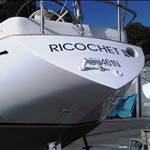
Hi All I bought a spirit 28 yahoo now the fun starts,Its got a furller and i got no idea what brand it is, can any one help?
It seems to work ok. just not sure if i want to keep it. Its the only mark i can find on it, should have taken a pic of the
whole unit i will get one tomorrow. Cheers

Nice boat. All Van De Stadt's are pretty good, hope this is not a steel one? It looks like a Plastimo furler, that is a guess, but Google images should help.
Put money on early model Plastimo.
If you google 'plastimo furler' then go to images you'll see why Ramona guessed at plastimo.

I think you maybe right, thanks for pointing me in the right direction, Any thoughts on their quality?
I bought one in the 80's.
Fwiw, I was once a mechanic and think that I recognise rubbish engineering when i see it.
My Plastimo was definately well made and it served me well.
If you look at the prices bieng asked for Plastimo (eg from Harbourside Chandlery in Coffs Harbour who I don't know) you'll that Plastimo furlers aren't exactly el cheapo.
Sure, Profurl and others are possibly better but they cost more too. If I decide after arriving in Tasmania that I do want a furler then I'll get Plastimo.
Cheers. Brian
Darmah, your furler sheet really could do with another turn or two still wrapped around the drum with the sail fully wrapped. Otherwise in some conditions there'll be no furling line on the drum but with a bit a genoa still stickong out.
And always furl that headsail really tightly by keeping loads of tension on the genoa sheet whienever furling with the green sheet.
The bronze fairleads built into the deck are impressive and suggestive of a builder who loved his/her product. I learnt to say his/her many years ago when I learned that Kay Cottee was a ship wright/boat builder.
Dar' what make is ship is she?
Thanks guys i appreciate the feed back she's a Spirit 28 and finer glass, yeah good spot on the fuller will get a couple extra wraps on it.
Im glad to hear that the fuller is ok, I was a little concerned with all the plastic and how it will cope if i want to reef it.
guess i will find out when the Fremantle doctor
kicks in Cheers for the info..
G'day Darmah.
When I first looked at the images of your furler on my tablet I thought that there appeared to be a crack on top of the drum very close to the P for Plastimo logo.
So I got this laptop out so as to download both images for a closer look.
But close inspection indicates that, what I thought was a crack is in fact merely UV deterioration of the powder coating (the paint).
Then I enlarged the other image, the one taken from a greater distance and what I see, crystal clear, (and I've done a lot of welding incl TIG of cast alloy)
is an advanced and lengthy crack of the alloy where the genoa tacks onto the furler drum.
With very little more headsail work I think that the fracture will let go and the bottom on the sail will have no downhaul which makes the headsail useless and would have to be removed from the forestay immediately'
Rectification of this problem is simple and easy.
First remove the shackle to release the tack of the sail and lift the sail up a bit.
Next....the furler tubes are riveted sections which in my Plastimo furler were merely grub screwed into the top of the drum. After locating the retaining screw simply lift the tubes & sail as a group up clear and free of the drum.
Then you will need to remove the forestay lower fitting so that the furler drum can be dropped off the forestay.
If you boat is rigged with lower stays coming forward of the mast centre line or a baby stay then releasing the forestay will have no adverse effect on the masts stability providing the backstay has had its tension released somewhat.
Any specialist welding shop can repair the crack and add reinforcing fillets to the bracket to ensure further cracking doesn't take place.
And were that drum mine, after welding I'd have it anodised in silver.
My eyes may be playing tricks on me (us) but I doubt it.
Have a look, let us know huh?
Cheers B.n
Darmah, an addendum.
When the welding is done get that great hole filled with weld metal and then drill a new hole NO LARGER than the diameter of the shackle pin you intend to use.....suggest 8mm.
The reason for the fracture is because of 'point loading' .
Had the pin thru the hole been the same diameter as the hole then the fault would most likely have not developed.
The shackle pin, tiny in comparo to the hole, caused the lug to elongate/distort and under halyard tension loading over time a fracture was unavoidable. Had a shackle not been used but rather a thick rope been used instead then the failure most likely wouldn't have ocurred.
Hi Brian
I see what you mean about the shackle on the fuller how it wears it away, needs changing.
The line in the corner of that cleat its not cracked its a line of dirt how lucky am i but if it wears any more
i can see how they can fail. Next time i pull her out i will remove it and get it welded.
Thanks for your concerns it has opened my eyes a bit more on the little things that can cause a lot of trouble when they fail.
Cheers Darmah
After all that drama.
I opened my laptop and really zoomed the image.
The wriggly black line is abraded residue from the s/s moving against the alloy.
Good... I'm REALLY glad I was wrong.
Loooove bieng proven wrong, opportunity to have learnt something.
Cheers Darmah.