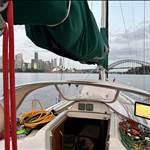
Just bought an old boat. the fuel tank is located in the bow behind the cockpit. Up high. I notice that the vent is just a tube three inches long sticking out of the back of the tank but not leading anywhere. It's just in the bow. I suspect when they filled the tank too high it leaked into the boat and down into the bilge and so they never filled it up too much.
I want to install a vent. Should the vent be placed in the deck (ie on the deck at the bow). Or should it go through the hull and be placed on the transom?
do you mean bow or stern?
either way one of the key things is that you don't want water to be get into your tank from the vent, so if fitting an outside vent it is best if it points downwards and aftwards, with a riser loop in the hose to act as another obstacle to any water that might enter the vent.
you definitely wouldn't want a vent hose to be exiting the deck, because of possible water ingress but also because of fumes.
the vent is just a tube three inches long sticking out of the back of the tank but not leading anywhere.
If as you say the tank is up high and you can't run the vent any higher, a cheap and nasty quick fix would be to mount a 2 litre plastic dink bottle somewhere and run the vent to it, If you do overfill you would have a 1.5 litre leeway.
Not very elegant but would work.
How do you measure the amount of fuel in the tank?
gary
Lead it inside but to a point higher than the filler
also make it very small diameter just a few millimeters
it's my understanding that the main purpose of the vent is to allow equalisation of pressure in the tank, is that correct?
Select to expand quotefishmonkey said..
it's my understanding that the main purpose of the vent is to allow equalisation of pressure in the tank, is that correct?
Not quite. The VENT is fitted to allow the gas that you are displacing when you fill the tank with flud, be it with fuel. water or anything else has someplace safe and practical to be released, and the opposite as the fluid in the tank diminishes.
Select to expand quotelydia said..
Lead it inside but to a point higher than the filler
also make it very small diameter just a few millimeters
Bigger tanks you have to lead outside though as Cisco says but can get away with little ones if the area is vented
Select to expand quotecisco said..
Not quite. The VENT is fitted to allow the gas that you are displacing when you fill the tank with flud, be it with fuel. water or anything else has someplace safe and practical to be released, and the opposite as the fluid in the tank diminishes.
Good point. When you use a fuel dock bowser, some of the trapped air may well escape past the nozzle, but if using a deep funnel that sits flush on a deck intake port, the vent tube diameter may have to be wide enough to channel all the air that needs to escape.
My tank is under the cockpit and the vent connects to the bilge pump outlet into the back of the cockpit. Not sure if it would work with your set up but useful alternative to another hole somewhere if set up properly.
Select to expand quotefishmonkey said..
do you mean bow or stern?
either way one of the key things is that you don't want water to be get into your tank from the vent, so if fitting an outside vent it is best if it points downwards and aftwards, with a riser loop in the hose to act as another obstacle to any water that might enter the vent.
you definitely wouldn't want a vent hose to be exiting the deck, because of possible water ingress but also because of fumes.
Thanks. Yes definitely mean stern.
think I'll try keeping it inside and rig something up with a smaller diameter tube. The tanks is so high that I don't think there is a great spot for a vent in the hull. It sits almost right up against the under side if the deck.
as mentioned above, the main reason for having a vent on a small tank is for equalisation of pressure in the tank, and these thus use small diameter hoses.
you do need to be a bit careful to not overfill of course.
a vent exiting to the outside that is beefy enough to also serve as an effective overflow is probably going to cause you more problems than it solves.
Select to expand quoteFuturecruiser said..
My tank is under the cockpit and the vent connects to the bilge pump outlet into the back of the cockpit. Not sure if it would work with your set up but useful alternative to another hole somewhere if set up properly.
Hi Futurecruiser
My tank breather is also a dedicated fitting the back vertical face of the cockpit
The only issue I can see with having a bulge pump outlet into the back of the cockpit would be if the bilge had oil or diesel in it you would end up with a mess in your cockpit if you pumped the bilge out
Regards Don
Select to expand quoteDonk107 said..Futurecruiser said..
My tank is under the cockpit and the vent connects to the bilge pump outlet into the back of the cockpit. Not sure if it would work with your set up but useful alternative to another hole somewhere if set up properly.
Hi Futurecruiser
My tank breather is also a dedicated fitting the back vertical face of the cockpit
The only issue I can see with having a bulge pump outlet into the back of the cockpit would be if the bilge had oil or diesel in it you would end up with a mess in your cockpit if you pumped the bilge out
Regards Don
Hi Don,
it drains into a covered area right at the rear of the cockpit near the drains and behind the steering position so even when pumping out it doesn't end up anywhere you can step in it. I actually like having it there as I always know straight away if the automatic pump kicks in for any reason. Always an unpleasant surprise!
Last time it happened I was in some heavy weather in Bass Strait and was panicking about which seacock might have given way only to find something had dislodged, fallen onto and burst a big cask of fresh drinking water, so in spite of some nervous moments thankfully the only outcome was an even cleaner than usual bilge!