Got myself a 50amp charger coming. Bells and whistles. 7 stage. Will hard wire it to rcd protected 240 shore supply.
Best way to hook her up??
At the moment the 4 yo 4 x Trojan 105s (470 amp hr) are and have only been charged by the 270 watt solar array via a Mark PV Solar regulator and the Balmar 100 Amp alternator.
Most of the boat electrics is run on 12v supply. I need the charger in particular to supply juice for the deiso heater through winter whilst at berth. The solar array seems to take care of the 12v frigomatic and lighting ok so far.
The electrics are hooked up to a link 2000 battery system which seems to show the voltage correctly and the amps used look legit although they door go into the positive when the sun is out and all 12v usage has ceased. The hours used/remaining are way out and I'm guessing need calibrating.
She also runs through the Mark PV Solar regulator which seems to show ok LED representation of battery capacity but other info such as amps coming in look off.
I'm wondering if I just hook the charger up to the terminals direct or should I run the solar array feed and the charger feed to a switch so that one or the other is feeding the battery only? ??
It's a ****ing mess in the battery box atm and the less I stuff with it the better until I can afford down time.
Thoughts????
I cant see any reason why you wouldn't just connect it straight onto the battery terminals.
Maybe just check that the new 240V charger doesn't load the battery when its 240V gets switched off. Solar regulators never do that but some mains ones do.
id say you should have a fuse...
check out this guys video which has a smart looking flexible fuse holder.
1/ good charger has enough internal protection, there is no need for fuse
2/ charge must be connected directly to battery terminal, unless you have solid copper bar installation
/ just 0. 2 ohms . under 50 amps creates 10 volts drop of voltage/
any drop of voltage confuses the charge and battery's will be never fully charge.
This is very common problem of many installation .
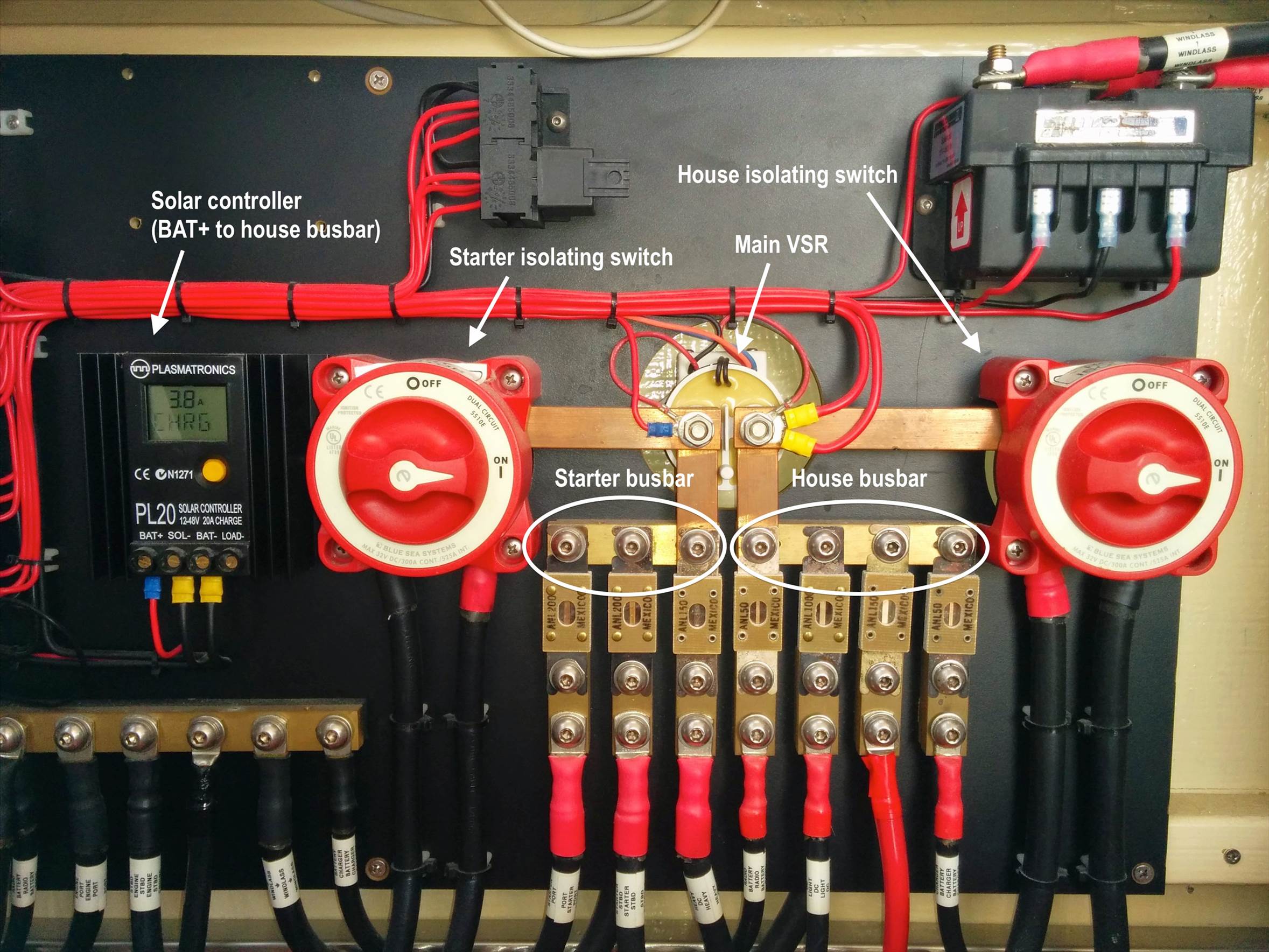
Depending on how much you want to invest, a really nice setup entails having separate busbars for the house and starter batteries, each isolatable (shown below).
The mains charger (not shown in photo) connects to the +ve terminal of the house busbar (as does the solar charger). A VSR isolates the starter busbar from the house busbar, unless the latter has sufficient charge.
Select to expand quotescruzin said..
Depending on how much you want to invest, a really nice setup entails having separate busbars for the house and starter batteries, each isolatable (shown below).
The mains charger (not shown in photo) connects to the +ve terminal of the house busbar (as does the solar charger). A VSR isolates the starter busbar from the house busbar, unless the latter has sufficient charge.
Scruzin, wow, nice board.
in this set up, are the isolators directly connected to the batteries or is there another fuse between the islorator and the battery ? How far away are the batteries ?
Select to expand quotescruzin said..
Depending on how much you want to invest, a really nice setup entails having separate busbars for the house and starter batteries, each isolatable (shown below).
The mains charger (not shown in photo) connects to the +ve terminal of the house busbar (as does the solar charger). A VSR isolates the starter busbar from the house busbar, unless the latter has sufficient charge.
Really good looking board. I might have added slightly longer cables so there was a downward loop to drain of water or condensation away from terminals. What would really finish this off is labels. Dymo machine and make a few labels would really set this off. You might not need labels but it will impress your friends.
Select to expand quoteRamona said..
scruzin said..
Depending on how much you want to invest, a really nice setup entails having separate busbars for the house and starter batteries, each isolatable (shown below).
The mains charger (not shown in photo) connects to the +ve terminal of the house busbar (as does the solar charger). A VSR isolates the starter busbar from the house busbar, unless the latter has sufficient charge.
Really good looking board. I might have added slightly longer cables so there was a downward loop to drain of water or condensation away from terminals. What would really finish this off is labels. Dymo machine and make a few labels would really set this off. You might not need labels but it will impress your friends.
Yes, labels are good idea. Most of the conductors (at very bottom of the photo) have labels, but I should label the components too.
Select to expand quoteAndrew68 said..scruzin said..
Depending on how much you want to invest, a really nice setup entails having separate busbars for the house and starter batteries, each isolatable (shown below).
The mains charger (not shown in photo) connects to the +ve terminal of the house busbar (as does the solar charger). A VSR isolates the starter busbar from the house busbar, unless the latter has sufficient charge.
Scruzin, wow, nice board.
in this set up, are the isolators directly connected to the batteries or is there another fuse between the islorator and the battery ? How far away are the batteries ?
There are no additional fuses. The isolators are directly connected to the batteries, which are less than 1 m away (below).