Hi all
I had a bit of spare time last weekend and ended up looking up Ferro Cement Boats on the net
Something that surprised me was that a few web sites said that the optimum hull thickness was 5/8 of a inch using 1/4 inch steel bar for the frame with 4 layers of mesh on either side of the bar and a 1/8th of a inch of plaster over the steel work but it also said that a lot of home builders made them a lot thicker believing that it would make them stronger but ended up with overweight boats compared to how they were originally designed
I had always assumed that the hull's were at least an inch thick and i have been asking others that i sail and work with how thick they think a Ferro hull would be and they all say between one and two inches
Looking at feedback from owners it appeared that most were happy with their boats and that there is a lot of misinformation about Ferro boats around
Wondering if any of the forum members have had any experience with them and what are your thoughts
Regards Don
More than 50% of the yachts in Greenwell Point are Ferro though few people realize this. Two motor cruisers as well. There is a ketch parked next to me at the moment my mate has on his mooring for an engine rebuild. Owned by a syndicate that paid 90 grand. That's silly money for concrete. If I had a choice between steel or concrete it would be concrete all the way.
Looking at Ferro boats for sale on the net it looks like they are a fair bit cheaper than other hull materials of similar length
Regards Don
Isn't the issue with ferro that it cracks into pieces if you hit the rocks? Therefore tricky to insure.
Happy to be educated...
I think the concept is fine and wonder why there is no modern equivalent
Would be interested to know when the last known ferro boat was made and why no more. To my mind 'lack of give' is crucial.
The story has it that because alot of ferro boats where built in the back yards, the standard or the quality of the builds are often unknown. Rumor often goes that mates got to drink lots of free beer on the weekends whilst helping with the rendering.
One of the most common problems I have seen with them is metal within the structure rusting causing expansion and cracking of the concrete, especially when you have Iron for ballast encapsulated.
I remember my dad knowing just about every ferro boat that was built in Perth, You could just about be driving anywhere in Perth and the old man would say" There's a boat being built just around the corner here,, we should drive past for a look"
There where some outstanding boats built along with some real dogs in this epidemic of ferro boats. Unfortunately the poor ones tarnished the reputation of concrete
With 'concrete cancer' in many seaside houses and apartments the problem-de-jour (these days), and its causes often sheeted home to reo (which is already rusted) being closer than 50mm to the outside edge of the floor slabs and columns and therefore liable to salt water infiltration, it begs the question about how much more exposed are the various layers of reo in ferro boats which may only be 25mm thick in total. I've seen quite a few ferro's advertised for ridiculously low prices and wondered if its a case of musical chairs where no one wants to be caught out.
I had a 40ft ferro boat for a while. It came with a certificate from a ferro boat inspector so I was happy with it. Because buyers were scared of "ferro" it cost about 1/3 the average 40ft boat cost at the time.
The home building I think is the problem. Its impossible to tell how well the hull was built. For example the cement should have a chemical mixed in it that inhibits the steel rusting. Its not possible to tell if that was done. If the steel rusts inside its hard to see that too.
If you have a good one like mine I found it wonderfully quiet down below. The hull absorbs sea noise really well and they are dust dry. The extra weight isnt always a problem. From time to time we would sail past someone and our beers would be sitting on the gunwales while the boat we were passing bobbed like a cork with its crew hanging on by their finger nails.
They can be very strong if built well. I saw one once that had been machine gunned in Croatia and survived. Timber or fibreglass wouldn't have 
Yes they are cheap - and often well built. Unfortunately the bad ones have tainted the rest, to the extent that insurance for a new purchase now falls into the "Don't even bother asking" basket, even higher up the list than racing multihulls. And no insurance means no entry into most marinas, or commercial/boatshed moorings, and it makes it hard to find a slipway. Hence the cheaper prices compared to equivalently sized vessels built of other materials.
Select to expand quoteRamona said..
More than 50% of the yachts in Greenwell Point are Ferro though few people realize this. Two motor cruisers as well. There is a ketch parked next to me at the moment my mate has on his mooring for an engine rebuild. Owned by a syndicate that paid 90 grand. That's silly money for concrete. If I had a choice between steel or concrete it would be concrete all the way.
im with you i like concrete much better than steel as there is a lot less steel in a concrete boat
About 1970 a ferro yacht came off it's mooring in Jervis Bay and went up the beach. It ended up in the sand and was removed by the council with dynamite! Wont ever see that happen ever again.
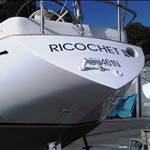
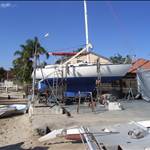
The photo is of a 54 foot ferro yacht I tried to give away on this forum awhile back. It had just been raised after sinking in a fairly suspicious to me situation. Professionally built in The USA it never left the mooring except when the chain riser failed and she went up on the beach. She was towed up the river and dismantled. Lovely boat but the rigging costs would be enormous.
My boat behind. On that mooring now is a 54ft Amel, to the left out of shot is now a concrete ketch and to the right a concrete cruiser.

hi i was gust asking if you still have the yacht that you where giving away if you do i will love to take it of your hands my number is 0456306750 thanks garry binns
I often sail with a ferro RORC Hartley professionally built in the early 80s and still sailed by the builder, and has done lots of miles with plenty of tales of groundings bar running bla bla .... Recently an awkward approach to a floating pontoon got a little out of shape and the corner of the pontoon knocked a good sized hole in her, luckily above the water line. This boat and her sister have an epoxy glass skin to boot !
Im very confident that my steel boat built in the same era would have broken the corner of the pontoon ! Losing some paint and getting a ding in the process ( take a sledge hammer to a piece of 6mm plate and try to belt a hole in it) don't get me wrong I like ferro, but with a steely you can see any rust develop and deal with it.
Anyway I'm glad me old mate didn't hit a half sunk container offshore
Select to expand quotegarry4 said..
hi i was gust asking if you still have the yacht that you where giving away if you do i will love to take it of your hands my number is 0456306750 thanks garry binns
A boat for free is all it is worth or less. It will become a negative worth when you account it's liabilities.
Select to expand quotegarry4 said..
hi i was gust asking if you still have the yacht that you where giving away if you do i will love to take it of your hands my number is 0456306750 thanks garry binns
The yacht was dismantled. Brand new unused furler chopped up and went to recycler.
Select to expand quoteRamona said..garry4 said..
hi i was gust asking if you still have the yacht that you where giving away if you do i will love to take it of your hands my number is 0456306750 thanks garry binns
The yacht was dismantled. Brand new unused furler chopped up and went to recycler.
Ouch!!!
I was reading about ferro's not long ago, it seems the 'best' ferro's were built by a New Zealander named Sayer, who had
developed a very good plastering method. The read also stated that it's a French invention and the first boats built in
the 1890's are still afloat.
Select to expand quotesamsturdy said..
I was reading about ferro's not long ago, it seems the 'best' ferro's were built by a New Zealander named Sayer, who had
developed a very good plastering method. The read also stated that it's a French invention and the first boats built in
the 1890's are still afloat.
Thats interesting !! But i cant help but think the world would have been a better place without the french . inventing that system . Oh may that second last full stop should have been a comma . :]
Select to expand quoteSandS said..samsturdy said..
I was reading about ferro's not long ago, it seems the 'best' ferro's were built by a New Zealander named Sayer, who had
developed a very good plastering method. The read also stated that it's a French invention and the first boats built in
the 1890's are still afloat.
Thats interesting !! But i cant help but think the world would have been a better place without the french . inventing that system . Oh maybe that second last full stop should have been a comma . :]
Select to expand quotewoko said..
I often sail with a ferro RORC Hartley professionally built in the early 80s and still sailed by the builder, and has done lots of miles with plenty of tales of groundings bar running bla bla .... Recently an awkward approach to a floating pontoon got a little out of shape and the corner of the pontoon knocked a good sized hole in her, luckily above the water line. This boat and her sister have an epoxy glass skin to boot !
Im very confident that my steel boat built in the same era would have broken the corner of the pontoon ! Losing some paint and getting a ding in the process ( take a sledge hammer to a piece of 6mm plate and try to belt a hole in it) don't get me wrong I like ferro, but with a steely you can see any rust develop and deal with it.
Anyway I'm glad me old mate didn't hit a half sunk container offshore
Thats something I thought about when I had mine - what would happen if it hit a hard sharp object. I think I would be relying on the steel reinforcing. Sounds like that one had lost its steels strength or there wasnt enough. The ferro I had was a RORC39. At least two ferro RORC39's disappeared completely with their crews at sea. One was off Africa the other Pacific.
Select to expand quotesamsturdy said..
I was reading about ferro's not long ago, it seems the 'best' ferro's were built by a New Zealander named Sayer, who had
developed a very good plastering method. The read also stated that it's a French invention and the first boats built in
the 1890's are still afloat.
That'd be Jon Sayer's dad. Jon then went out and built something which sounds like a contradiction in terms, namely a lightweight ferro racing yacht. It looked like a Farr 1104, went almost as fast, had something like the motor off an Austin A40 and second-hand sails. He launched it when about 19 years old and went out to win the Trans-Tasman singlehanded race with it. Sayer is of course now a renowned timber boat builder and designer in Qld.
Select to expand quoteTrek said..woko said..
I often sail with a ferro RORC Hartley professionally built in the early 80s and still sailed by the builder, and has done lots of miles with plenty of tales of groundings bar running bla bla .... Recently an awkward approach to a floating pontoon got a little out of shape and the corner of the pontoon knocked a good sized hole in her, luckily above the water line. This boat and her sister have an epoxy glass skin to boot !
Im very confident that my steel boat built in the same era would have broken the corner of the pontoon ! Losing some paint and getting a ding in the process ( take a sledge hammer to a piece of 6mm plate and try to belt a hole in it) don't get me wrong I like ferro, but with a steely you can see any rust develop and deal with it.
Anyway I'm glad me old mate didn't hit a half sunk container offshore
Thats something I thought about when I had mine - what would happen if it hit a hard sharp object. I think I would be relying on the steel reinforcing. Sounds like that one had lost its steels strength or there wasnt enough. The ferro I had was a RORC39. At least two ferro RORC39's disappeared completely with their crews at sea. One was off Africa the other Pacific.
My old mates boat is the 39 as well, nice boat sails good and comfortable. The steel was still intact but the render was shattered it didn't take a lot of effort to remove it, ended up with a hole about the size of a port light with reo and mesh in it. He re rendered it with thickened epoxy (didn't have time for cement to cure ) and sailed off as soon as the paint dried
Not forgetting that the first Helsal was a ferro boat designed by Joe Adams and when entered in the Sydney Hobart was a bit of a laughing stock and called the floating footpath, till it won that race, after which it was the flying footpath.
After it's racing career it became a cruising boat for years, till ran onto a reef in the Philippines. Not many things survive after hitting a reef.
Hi all. Have crushed three ferros at Montys with one to go when it finally gets stripped out. Two crumbled as they were laid over but one resisted my bobcats best efforts for a few hours. It was built in NZ but there is no way of telling how sound they are. There was one in Bundaberg which floated up and down the river for years breaking free its anchor from time to time and then resetting in another spot.I imagine the marine safety department disposed of it. Without doubt the most resilient material is steel but it has the drawback of rusting at the speed of light and needs constant attention to the paintwork. One of the strongest/lightest materials is balsa. It too has a drawback in that it rots if the fibreglass skin is damaged. I know this because I have a steel yacht,Sonya, and a balsa trimaran Bullfrog. If I had a ferro I would cover it with Innegra, the cheaper modern version of Kevlar, and biaxial fibreglass and of course epoxy resin. The boat would have to be special and fitted out well to warrant that expense. Cheers Bottman
I sailed to Coffs in 2006 two handed on a then 77 year old's concrete boat he built himself in the early 70s. It had been on a reef in New Cal, into a cliff at Tahiti and numerous groundings throughout the South Pacific. I caught the train home from Coffs, he headed off solo to New Cal.
It sailed like a dog but gee it was stable and comfortable,
The good new is he is still sailing in his concrete boat, must be 89 years old now.
Select to expand quoteMorningBird said..
I sailed to Coffs in 2006 two handed on a then 77 year old's concrete boat he built himself in the early 70s. It had been on a reef in New Cal, into a cliff at Tahiti and numerous groundings throughout the South Pacific. I caught the train home from Coffs, he headed off solo to New Cal.
It sailed like a dog but gee it was stable and comfortable,
The good new is he is still sailing in his concrete boat, must be 89 years old now.
Was that a chap by the name of Roy Starkey? If it was here is a link to his autobiography:
www.google.com.au/search?client=tablet-android-samsung&ei=FBG1WpDLFMf08gX-grn4CA&q=around+and+around+and+around+roy+starkey&oq=around+around+around+roy&gs_l=mobile-gws-serp.1.0.0i22i30.7771.30662..32777...2....527.11429.2-32j4j2j2..........1..mobile-gws-wiz-serp.....3..0j41j0i71j33i160j0i67j0i131i67j0i13j0i13i30j0i13i5i30j33i22i29i30.6NJNgoBM88k%3D
I met him in New cal and then Tonga.
Select to expand quotesantanasaga said..MorningBird said..
I sailed to Coffs in 2006 two handed on a then 77 year old's concrete boat he built himself in the early 70s. It had been on a reef in New Cal, into a cliff at Tahiti and numerous groundings throughout the South Pacific. I caught the train home from Coffs, he headed off solo to New Cal.
It sailed like a dog but gee it was stable and comfortable,
The good new is he is still sailing in his concrete boat, must be 89 years old now.
Was that a chap by the name of Roy Starkey? If it was here is a link to his autobiography:
www.google.com.au/search?client=tablet-android-samsung&ei=FBG1WpDLFMf08gX-grn4CA&q=around+and+around+and+around+roy+starkey&oq=around+around+around+roy&gs_l=mobile-gws-serp.1.0.0i22i30.7771.30662..32777...2....527.11429.2-32j4j2j2..........1..mobile-gws-wiz-serp.....3..0j41j0i71j33i160j0i67j0i131i67j0i13j0i13i30j0i13i5i30j33i22i29i30.6NJNgoBM88k%3D
I met him in New cal and then Tonga.
No, not him. I can't divulge his name on here due privacy considerations but it is a European name. He came out here as a lad to work on the Snowy. Got the idea to go sailing in the early 70s and built his boat in a paddock near Sydney.
He does marine upholstery to fund his sailing, you might find him in Afloat.