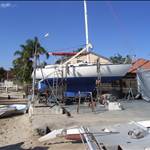
I will need to upgrade the navigation units, at least the sonar and the chartplotter on the boat. On our current motorboat we have a garmin and I am fairly happy with it.
For the yacht, I would have to install a thru hull sensing sonar but I think I may have issues with the thickness of the hull. I want to avoid drilling a hole in it.
I think most yachties use Raymarine units but there are Garmins and Lowrance units to. Would a Raymarine unit be more reliable or accurate for a yacht?
an old garmin s half a tube of silicon to bed the transducer down inside the hull . looking through at least 15 mm of solid fiberglass .
No problem !
+1 for oil bath, 30 years ago tested / use it first time / with rotating light depth sounder , works well
Select to expand quoteSandS said..
an old garmin s half a tube of silicon to bed the transducer down inside the hull . looking through at least 15 mm of solid fiberglass .
No problem !
do you mean the type that usually mounted on the transom?
Select to expand quotecazou34 said..
If you don't want a new thru hull the oil bath method works great.
so, take a small plastic sandwich box, put the external type of transducer inside, silicone it to he hull, fill it with oil?
Select to expand quoteSeebreasy73 said..
so, take a small plastic sandwich box, put the external type of transducer inside, silicone it to he hull, fill it with oil?
No. Glass in a small enclosure, plastic pipe or similar and fill with oil or silicon. The transducer has to be firing down through a medium with no air bubbles. In my yacht tender I have the sounder transducer mounted in epoxy resin. If you use resin make sure the bubbles disappear before placing in the transducer. Mount the transducer pointing forward slightly, the angle will vary depending how fast you intend to be traveling.
Seebreazy dont forget mounting the transducer as far forward as you can is advantageous. You get a small number of seconds advanced warning of the bottom coming up before it might hit the keel if you do that. A bit like having someone standing on the bow testing the depth with a big stick.
Our depth transducer is at the bow screwed down in a thin layer of Vaseline to get rid of the air between it and the 25mm hull. Works great. The vaso doesnt run everywhere and you can still replace the transducer if need be.
Select to expand quoteTrek said..
Seebreazy dont forget mounting the transducer as far forward as you can is advantageous. You get a small number of seconds advanced warning of the bottom coming up before it might hit the keel if you do that. A bit like having someone standing on the bow testing the depth with a big stick.
Our depth transducer is at the bow screwed down in a thin layer of Vaseline to get rid of the air between it and the 25mm hull. Works great. The vaso doesnt run everywhere and you can still replace the transducer if need be.
you would expect that no matter where you mount it, these chirps/sonars should look ahead and not down and sideways. I never heard of Vaseline before, I wonder how well would that work in liquid soap 
Select to expand quoteSeebreasy73 said..SandS said..
an old garmin s half a tube of silicon to bed the transducer down inside the hull . looking through at least 15 mm of solid fiberglass .
No problem !
do you mean the type that usually mounted on the transom?
yeah i think thats what it was meant to do .... nearly 7 years ago cant remember ..... still works a treat ...........
Mine is sitting in a layer of bubble free epoxy. To check that it works where you want it, put it in a plastic bag of water and turn the unit on. If you're on your mooring you can verify the depth with a sinker on a line. One verfied that it works the way you want it, epoxy it in place making sure the epoxy is bubble free.
Mines been in place for 8 years. Granted, if I need to change the transducer it's a bit of an effort, but it does work and is better than cutting a hole in your boat.
Bought inhull/transom from States few months ago. They sent through hull. Took a couple of months to get the inhull and they asked I return the through hull at my cost! So I have both . Can a through hull transducer work as an in hull