Sea-Fever
by
John Masefield I must go down to the seas again, to the lonely sea and the sky,
And all I ask is a tall ship and a star to steer her by,
And the wheel's kick and the wind's song and the white sail's shaking,
And a grey mist on the sea's face, and a gray dawn breaking.
I must go down to the seas again, for the call of the running tide
Is a wild call and a clear call that may not be denied;
And all I ask is a windy day with the white clouds flying,
And the flung spray and the blown spume, and the sea-gulls crying.
I must go down to the seas again, to the vagrant gypsy life,
To the gull's way and the whale's way where the wind's like a whetted knife;
And all I ask is a merry yarn from a laughing fellow-rover
And quiet sleep and a sweet dream when the long trick's over.
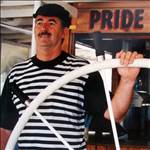
Not a poem, but every time I read or hear it I'm instantly reminded of my grandfather (below) in the late 1960s or early 1970s having tears in his eyes listening to a recording of John Ireland's setting of Sea Fever.

O Captain! my Captain! our fearful trip is done,
The ship has weather'd every rack, the prize we sought is won,
The port is near, the bells I hear, the people all exulting,
While follow eyes the steady keel, the vessel grim and daring;
But O heart! heart! heart!
O the bleeding drops of red,
Where on the deck my Captain lies,
Fallen cold and dead.
O Captain! my Captain! rise up and hear the bells;
Rise up-for you the flag is flung-for you the bugle trills,
For you bouquets and ribbon'd wreaths-for you the shores a-crowding,
For you they call, the swaying mass, their eager faces turning;
Here Captain! dear father!
This arm beneath your head!
It is some dream that on the deck,
You've fallen cold and dead.
My Captain does not answer, his lips are pale and still,
My father does not feel my arm, he has no pulse nor will,
The ship is anchor'd safe and sound, its voyage closed and done,
From fearful trip the victor ship comes in with object won;
Exult O shores, and ring O bells!
But I with mournful tread,
Walk the deck my Captain lies,
Fallen cold and dead.
Select to expand quotePurfler said..
Not a poem, but every time I read or hear it I'm instantly reminded of my grandfather (below) in the late 1960s or early 1970s having tears in his eyes listening to a recording of John Ireland's setting of Sea Fever.
That's such a wonderful photo.
And wonderful memories.
Utube has many versions.
Masefield's other famous one:
Cargoes'
Quinquireme of Nineveh from distant Ophir, Rowing home to haven in sunny Palestine, With a cargo of ivory, And apes and peacocks, Sandalwood, cedarwood, and sweet white wine.
Stately Spanish galleon coming from the Isthmus, Dipping through the Tropics by the palm-green shores, With a cargo of diamonds, Emeralds, amethysts, Topazes, and cinnamon, and gold moidores.
Dirty British coaster with a salt-caked smoke stack, Butting through the Channel in the mad March days, With a cargo of Tyne coal, Road-rails, pig-lead, Firewood, iron-ware, and cheap tin trays.
John Masefield
Select to expand quoteBundeenabuoy said..Purfler said..
Not a poem, but every time I read or hear it I'm instantly reminded of my grandfather (below) in the late 1960s or early 1970s having tears in his eyes listening to a recording of John Ireland's setting of Sea Fever.
That's such a wonderful photo.
And wonderful memories.
Utube has many versions.
He was an interesting man, ran away to sea as a teenager and continued to sail and then write for many years. One of his books, Harpoon, is an account of a voyage to Antarctica on a Norwegian whaling ship in the 1930s - they went too far south too late in the season and were stuck for many months.
Select to expand quoteErawai said..
O Captain! my Captain! our fearful trip is done,
The ship has weather'd every rack, the prize we sought is won,
The port is near, the bells I hear, the people all exulting,
While follow eyes the steady keel, the vessel grim and daring;
But O heart! heart! heart!
O the bleeding drops of red,
Where on the deck my Captain lies,
Fallen cold and dead.
O Captain! my Captain! rise up and hear the bells;
Rise up-for you the flag is flung-for you the bugle trills,
For you bouquets and ribbon'd wreaths-for you the shores a-crowding,
For you they call, the swaying mass, their eager faces turning;
Here Captain! dear father!
This arm beneath your head!
It is some dream that on the deck,
You've fallen cold and dead.
My Captain does not answer, his lips are pale and still,
My father does not feel my arm, he has no pulse nor will,
The ship is anchor'd safe and sound, its voyage closed and done,
From fearful trip the victor ship comes in with object won;
Exult O shores, and ring O bells!
But I with mournful tread,
Walk the deck my Captain lies,
Fallen cold and dead.
This poem was featured in the Robin Williams film 'Dead Poets Society'
Select to expand quotesamsturdy said..Erawai said..
O Captain! my Captain! our fearful trip is done,
The ship has weather'd every rack, the prize we sought is won,
The port is near, the bells I hear, the people all exulting,
While follow eyes the steady keel, the vessel grim and daring;
But O heart! heart! heart!
O the bleeding drops of red,
Where on the deck my Captain lies,
Fallen cold and dead.
O Captain! my Captain! rise up and hear the bells;
Rise up-for you the flag is flung-for you the bugle trills,
For you bouquets and ribbon'd wreaths-for you the shores a-crowding,
For you they call, the swaying mass, their eager faces turning;
Here Captain! dear father!
This arm beneath your head!
It is some dream that on the deck,
You've fallen cold and dead.
My Captain does not answer, his lips are pale and still,
My father does not feel my arm, he has no pulse nor will,
The ship is anchor'd safe and sound, its voyage closed and done,
From fearful trip the victor ship comes in with object won;
Exult O shores, and ring O bells!
But I with mournful tread,
Walk the deck my Captain lies,
Fallen cold and dead.
This poem was featured in the Robin Williams film 'Dead Poets Society'
truly a fantastic film!