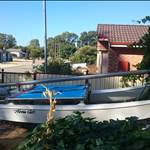
I recently swapped outboards on my Swarbrick S80 (26 foot) 'Sea Ya'.
I dropped at least 10 kgs in weight, changing from a 6 HP tohatsu and tank to a 4HP tohatsu.
We won race ten, Div G of the CYCA Winter Series.
The race time was 2.3 hours and we beat Sea Rug by 42 seconds.
My question is "Did swapping motors win me the race?
So much more than 10kg with the tank, so if the water was bumpy almost certainly yes as the pitching moment of the boat changed dramatically.
Hung off the transom?
Absolutely this would make a difference. Any weight out of the ends is important, 10kg is a great start.
Nothing would be even better, sadly impractical.
Talking about weight off the boat..in my last attempt at lightening the boat, some fellow sailors looked upon my efforts with hilarity and promptly took another few hundred kgs off. We sailed fantastically that next race, the wind speed needed for planing dropped by almost a knot.
Thank you both for your replys.
I suspected it did. We had 20 to 30 knots. We broached and still won the race.
Congrats on winning the race. I'm guessing you changed between the 2 strokes because the 4&6HP 4 strokes weigh the same ?
The difference between a 4hp & a 6hp is only 6kg but then the 4hp has a built in tank so fueled up the actual difference at the back of the transom would be more like 4kg. Assuming your boat weighted close to 2T loaded up I can't see how 4kg (even if off the transom ) could be the reason you won the race specially over a 2hrs+ race . Otherwise everyone could win races simply by moving their lunchbox near the bow.
IMO it was the superior performance that helped you win the race, now you just have to repeat what you've done and improve on that each time you race. 
Hi Harb,
I had a 2 stroke tohasu long shaft 6HP which I believe weighs 26 to 27 kgs plus fuel tank and fuel total 30 plus kgs.
My 2 stroke tohasu long shaft 4HP without a tank total 19 kgs.
I believe this is a significant improvement.
Now we just have make all the other changes too.
Thanks for your help.
I've never yet been on a yacht where 10kg was the difference between winning and losing on a harbour, even when you are winning national titles with or against Olympians, America's Cup sailors and pros. An S80 should be going the same speed as the Peterson 30 Fiction, (which is actually currently sailing about 10-12 minutes faster than you are) and about as fast as the Etchell in the light stuff, so there's lots of other stuff to sort out before looking at engine weight. The only pic I can find of Fiction shows her being well sailed -nice trim and excellent weight positioning- so she should be a good yardstick.
Sea Rug Hoo Ha used to be beaten by similar or greater margins by rotbox Thunderbirds with big engines and some old sails. The speed difference involved in an engine change is probably less than you lose by getting one or two roll tacks wrong. And if you haven't been out doing things like working on your roll tacking, making sure the rig tune is precisely right, that your tactics, trim and helming are at the level where you have won titles in classes like Lasers or Etchells, hitting the gym, etc, then engine weight is such a tiny issue as to not be worth even considering.
The best S80 at my old club used a 6hp, if I recall correctly - it may have been bigger. One of the guys had been 4th nationally in the most popular two person dinghy. Another had about three national title wins and a Sydney-Hobart victory to his credit. The sails were excellent and I'd reckon they were sailing it much better than any similar boat in Sydney (with the probable exception of some of the top J/24s). They were sailing in different conditions but if that sort of sailor will sail with a 6 then it's not going to slow the average S80 to any significant degree.
New sails,or should I say new well cut sails, are the biggest game changer outside of experience.
Add to that a focus on weight reduction, and a clean bum, and you're off to a really good start.
Select to expand quoteChris 249 said..
I've never yet been on a yacht where 10kg was the difference between winning and losing on a harbour, even when you are winning national titles with or against Olympians, America's Cup sailors and pros. An S80 should be going the same speed as the Peterson 30 Fiction, (which is actually currently sailing about 10-12 minutes faster than you are) and about as fast as the Etchell in the light stuff, so there's lots of other stuff to sort out before looking at engine weight. The only pic I can find of Fiction shows her being well sailed -nice trim and excellent weight positioning- so she should be a good yardstick.
Sea Rug Hoo Ha used to be beaten by similar or greater margins by rotbox Thunderbirds with big engines and some old sails. The speed difference involved in an engine change is probably less than you lose by getting one or two roll tacks wrong. And if you haven't been out doing things like working on your roll tacking, making sure the rig tune is precisely right, that your tactics, trim and helming are at the level where you have won titles in classes like Lasers or Etchells, hitting the gym, etc, then engine weight is such a tiny issue as to not be worth even considering.
The best S80 at my old club used a 6hp, if I recall correctly - it may have been bigger. One of the guys had been 4th nationally in the most popular two person dinghy. Another had about three national title wins and a Sydney-Hobart victory to his credit. The sails were excellent and I'd reckon they were sailing it much better than any similar boat in Sydney (with the probable exception of some of the top J/24s). They were sailing in different conditions but if that sort of sailor will sail with a 6 then it's not going to slow the average S80 to any significant degree.
Chris,
Your comments reek of negativity and inaccuracy and are not based on fact.
Your quote 'An S80 should be going the same speed as the Peterson 30 Fiction'.This is not what the CYCA handicapper says, but obviously
you know more than the handicapper. In 2017 Fiction won its division with a total of 11 points (3 firsts and 4 seconds after drops). Sea Ya finished in its first year of racing with 20 points.
This year Fiction came third with 15 points (with drops of 15 points). Sea Ya came fourth with 16 points( with drops of 12 points).
Sea ya beat Fiction to the line in races 1, 2, 4, 6, 7, and 10. We never came worse than fourth in 10 races. We would have won the series if we had the drops of the boats ahead of us. We were too consistent for our own good.
I welcome any positive suggestions that will make us race better, but unfortunately there were none in your post.
I suspect you look on much better than you play.
Placebo effect?
Not being personal but howz everyones mid line? Easy to lose 10kg over a few crew.
Select to expand quoteBundeenaboy said..Chris 249 said..
I've never yet been on a yacht where 10kg was the difference between winning and losing on a harbour, even when you are winning national titles with or against Olympians, America's Cup sailors and pros. An S80 should be going the same speed as the Peterson 30 Fiction, (which is actually currently sailing about 10-12 minutes faster than you are) and about as fast as the Etchell in the light stuff, so there's lots of other stuff to sort out before looking at engine weight. The only pic I can find of Fiction shows her being well sailed -nice trim and excellent weight positioning- so she should be a good yardstick.
Sea Rug Hoo Ha used to be beaten by similar or greater margins by rotbox Thunderbirds with big engines and some old sails. The speed difference involved in an engine change is probably less than you lose by getting one or two roll tacks wrong. And if you haven't been out doing things like working on your roll tacking, making sure the rig tune is precisely right, that your tactics, trim and helming are at the level where you have won titles in classes like Lasers or Etchells, hitting the gym, etc, then engine weight is such a tiny issue as to not be worth even considering.
The best S80 at my old club used a 6hp, if I recall correctly - it may have been bigger. One of the guys had been 4th nationally in the most popular two person dinghy. Another had about three national title wins and a Sydney-Hobart victory to his credit. The sails were excellent and I'd reckon they were sailing it much better than any similar boat in Sydney (with the probable exception of some of the top J/24s). They were sailing in different conditions but if that sort of sailor will sail with a 6 then it's not going to slow the average S80 to any significant degree.
Chris,
Your comments reek of negativity and inaccuracy and are not based on fact.
Your quote 'An S80 should be going the same speed as the Peterson 30 Fiction'.This is not what the CYCA handicapper says, but obviously
you know more than the handicapper. In 2017 Fiction won its division with a total of 11 points (3 firsts and 4 seconds after drops). Sea Ya finished in its first year of racing with 20 points.
This year Fiction came third with 15 points (with drops of 15 points). Sea Ya came fourth with 16 points( with drops of 12 points).
Sea ya beat Fiction to the line in races 1, 2, 4, 6, 7, and 10. We never came worse than fourth in 10 races. We would have won the series if we had the drops of the boats ahead of us. We were too consistent for our own good.
I welcome any positive suggestions that will make us race better, but unfortunately there were none in your post.
I suspect you look on much better than you play.
My comments are answering exactly the question you asked. If you don't want honest answers please don't ask questions.
As far as not being based on fact, you're completely wrong. The CYCA winter series is run on arbitrary handicapping (apart from the IRC division) where they adjust the handicap on the boat's finish placing, NOT on the actual design. That's why handicaps change from race to race even when the boats themselves do not. I'm not saying I know better than the CYCA handicapper because they were doing something different to what I am doing.
The comparative performance of the S80 and Peterson 30* has become apparent in the 35+ years the two designs have been racing each other, when boats like Superzilch, Casablanca, Cagou IV etc first competed in JOG events. Since I've sailed a bunch of S80s and own a boat of the same class as Friction and I'm interested in comparative performance, I've been checking out the performance ever since. In my last offshore regatta, my main competitor was a sistership of Friction. When I last looked at racing the same boat, my main competitors were S80s. The performance of these two boats is something I've kept an eye on.
So what do the experts who design rating systems to assess comparative boat performance say about the comparative speed of an S80 and a Peterson 30? The Offshore Racing Council's computer, tank test and VPP-based ORC system says the S80s have an average rating of 730.8, compared to the Peterson 30 which rates 723.1. That means an average S80 should finish a 12 mile course just 92 seconds slower than the Peterson 30.
Under the Royal Yachting Association's NHC system, the S80 rates .925 and the Peterson 30 .918. That means that if an S 80 finishes in 2.5 hours, a Peterson 30 should be just 68 seconds ahead. Under IRC, Peterson 30s rate .920 and the average S 80 .913, so again the Peterson should be only about a minute ahead in 2.5 hours. Under the Victorian class marks, which are confidential, the S80 and the Peterson 30 rate very close. So I'm not pulling this stuff out of the air - I'm using ratings derived by the top international authorities and others over several decades - and they accord with each other pretty closely.
There were positive suggestions in my post, just as when you asked the question earlier. The suggestion was to stop worrying about the boat and spend time and effort on sailing it.
Oh, and as far as your claims about being better at looking than playing, I've won enough national and state titles to have found out that the best way to play is by researching how fast your boat should go, how to tune and sail it to achieve that potential, and then training lots before you worry about the little stuff on the boat.
* That's the North Star/Friction style of "pintail" Peterson 30 as built in WA and NZ, of course, not the "Phase IV" design that was sold as the Santana 30 and Contention 30 but sometimes referred to as a Peterson 30, or the later Green Dragon, Skorpion etc types.
a well trimed boat is always fast but i have won maore races by tactics than speed if your going fast but the wrong way your just going faster the wrong way tactics wins every time
Firstly well done for winning.
To answer your question, No. The time that you would save from a smaller motor would be more than counteracted by a bad tack or poor spinnaker set/drop/gybe. In a 2.5 hour race you do so many maneuvers that this small difference would not make much difference.
End of the day if its a PHS competition then dont take too much stock in one race win. under this handicap system its the series that will matter.
Boty,
Yep, experience is king. You just summed up my racing results! Most of my mistakes now are tactical.
Racing is for me a game of inches and seconds, you make a couple of mistakes and its game over. I screwed up twice tactically in the B2G and was 16th overall in line honours heading out of the bay, not exactly a good start and making it much harder to claw back the leaders. If I'm honest I brute forced my way back through the fleet, concentrating all the while on mitigating the nav and boat handling mistakes after that.
In comparison, a Sydney boat called Sail Exchange was a good example of sailing a great tactical race. Symmetrical, she went down the rumb line, didn't put a foot wrong, took huge chunks out of my lead and passed me near Lady Elliot, (exactly where Jode and Lydia predicted I'd struggle).
It was really impressive and a joy to watch such good boat handling. A great example of what Boty is referring to, just wish it was me showing all the right tactics and not the other boat!
So you take 20 kg from a point above the centre of buoyancy and 5 m aft from the centre of gravity in a boat that weighs less than 2000kg.
The hull plane most likely takes about 8kg to sink one mm.
43 seconds over 3.5 hours so about 10 sec/hr.
I would be betting any VPP would be answering yes.
It depends on how you define the issue. For many of us, it would only be the change of outboard winning and losing the race if just about every other aspect of the race was sailed really, really well. That would mean a superb bottom finish on the boat, really good sails, great rig tune perfectly adjusted for the conditions (the top S80 guys adjust their forestay length depending on the conditions, as do many similar boats), hitting the start going at full speed right on the gun at the right end, getting the shifts rights, each spinnaker going up within a few seconds, etc etc etc.
If you don't sail the boat perfectly, why focus on the boat's gear as the reason for winning and losing? It's like when I lose a handicap bicycle race by a second - yes, if I got a $10,000 bike I'd have saved that second, but the real issue is that my heart, lungs and legs are minutes slower than those of the good guys. Why look at the tiny changes in gear when we could make huge improvements in ourselves?
Select to expand quoteBundeenaboy said..
I recently swapped outboards on my Swarbrick S80 (26 foot) 'Sea Ya'.
I dropped at least 10 kgs in weight, changing from a 6 HP tohatsu and tank to a 4HP tohatsu.
We won race ten, Div G of the CYCA Winter Series.
The race time was 2.3 hours and we beat Sea Rug by 42 seconds.
My question is "Did swapping motors win me the race?
Hi all,
When I posted this topic I tried to make the heading as simple as possible.
It was not what can I improve to race faster. This is a great topic which maybe we should have.
I just wanted opinions regarding what the difference in weight due to the change in motors would have to the boat speed.
The race time was 2.5 hours, all other considerations being equal.
My thoughts are, that I gained 30 seconds but probably more, and we know that many races are won and loss in this time frame.
My experience changing the motors has been very positive. It is so much easier to lift and operate and my old one is now causing problems for the dealer and not me. I traded it for $400.
Even my Ladies Day Series helmsperson can operate it after recovering from a broken back.
Kara Walter's great story has appeared in 'Offshore' the CYCA magazine.
To cut a long story short. She fell off the roof of her second story house and broke her back.
She spent seven months in the spinal unit of St Vincents and walked out (only one in 20 do). She now has such a passion for sailing.
Our crew will celebrate with her this Friday night as she came second in our division.
Lets all have a great day.