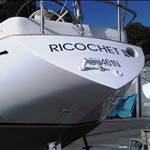
I was onboard this morning doing a few maintenance jobs and going for a motor around the western harbour. Tieing up the spinnaker pole I saw this corrosion in the toe rail. It is evident at irregular intervals around the boat.
I don't believe it is electrolysis or galvanic but!!
It might have been there for a long time but is worse now, coinciding with the increase in offshore sailing.
Any ideas please on what might be causing it?


Maybe from deep scratches through the anodized surface. Which may have come about through the toe rail being poorly handled.
Mine has the same, deep pinholes in places. Something about the era of when these were made?
ive seen a couple similar problems on yachts with alu toe rails . a difficult thing to replace / deal with . interested to here of any solution ?
It isn't a show stopper so I won't do anything about it. I suspect it is a weakness in the aluminium toe rail.
It won't stop the boat getting to Lord Howe in November.
Are the toe rails attached? If it is at regular spacing then perhaps fixing points could be playing a part?
Select to expand quoteG30ff0 said..
Are the toe rails attached? If it is at regular spacing then perhaps fixing points could be playing a part?
I looked for signs of dissimilar metals but they occur randomly at various intervals. It isn't worse near the switchboard, cabling, poles tied to the rails.
yhe toe rails are attached by through deck bolts every 12 or so cm. It doesn't correlate to them.
We had the same trouble in aluminium dive boats when lead shot weight belts came out.
Eventually they had to be encased in plastic bags, within the belt, before being allowed on board.
Quiet a few dive boats ended up with multi pin holes in their hull bottoms 
So, had any lead shot onboard?
Select to expand quoteMorningBird said..
I was onboard this morning doing a few maintenance jobs and going for a motor around the western harbour. Tieing up the spinnaker pole I saw this corrosion in the toe rail. It is evident at irregular intervals around the boat.
I don't believe it is electrolysis or galvanic but!!
It might have been there for a long time but is worse now, coinciding with the increase in offshore sailing.
Any ideas please on what might be causing it?
It is on the outside of your toe rails on the "fairing flange" as opposed to the inner "attachment flange" and therefore is not really a structural issue.
As to the cause, who would know?
My suggestion is that you gouge out the pitting with a suitably sharp end of a file ground to be a metal scraper to get rid of most of the oxidised alloy then pencil brush them with some hydroflouric acid, fresh water rinse, then pencil brush with PA 10 primer followed by pencil brush with silver frost (paint with aluminium dust in it).
With that treatment I think neither thee nor anybody else will notice them. 
Obviously getting from home to the boat for the love and attention all boats love is a lot less arduous from your new home to your new mooring than from Chatswood to Pittwater.
Good to see you are planning to go to LHI again. It is a unique event. I would love to do it again but my life is quite full ATM. No doubt you have potential crew members beating on your door. If not they should be.
I have a lovely German ice skater girl boarding with me currently and I am sure she would be enthralled with going to LHI on a yacht.
Would you like me to suggest it to her??
Select to expand quotecisco said..MorningBird said..
I was onboard this morning doing a few maintenance jobs and going for a motor around the western harbour. Tieing up the spinnaker pole I saw this corrosion in the toe rail. It is evident at irregular intervals around the boat.
I don't believe it is electrolysis or galvanic but!!
It might have been there for a long time but is worse now, coinciding with the increase in offshore sailing.
Any ideas please on what might be causing it?
It is on the outside of your toe rails on the "fairing flange" as opposed to the inner "attachment flange" and therefore is not really a structural issue.
As to the cause, who would know?
My suggestion is that you gouge out the pitting with a suitably sharp end of a file ground to be a metal scraper to get rid of most of the oxidised alloy then pencil brush them with some hydroflouric acid, fresh water rinse, then pencil brush with PA 10 primer followed by pencil brush with silver frost (paint with aluminium dust in it).
With that treatment I think neither thee nor anybody else will notice them.
Obviously getting from home to the boat for the love and attention all boats love is a lot less arduous from your new home to your new mooring than from Chatswood to Pittwater.
Good to see you are planning to go to LHI again. It is a unique event. I would love to do it again but my life is quite full ATM. No doubt you have potential crew members beating on your door. If not they should be.
I have a lovely German ice skater girl boarding with me currently and I am sure she would be enthralled with going to LHI on a yacht.
Would you like me to suggest it to her??
Could be fun but I'm not sure Sue would be real comfortable with that Cisco.
Very good advice on treating this little corrosion issue. Over time I'll get onto it but as you know I would rather spend my time making sure MB is seaworthy. It is only 20 minutes to stepping on the boat so I am onboard usually every week when we are home.
Always working not Sailing. E.g. MB had an engine overheat a couple of weeks ago, about 1/2 mile from the mooring the light and alarm came on. The engine boiled after shutdown. I topped up the water that had been spat out and we continued. I couldn't get it to repeat the over heat. A run last week it wouldn't overheat. This morning I cleaned the salt water filter, it was clear, drained the cooling water and filled it with proper coolant. A 30 minute run at a fast cruise and it didn't get over hot. Got me stumped, maybe a temporary blockage in the inlet. These jobs take my time.
A Seabreezer from Melbourne answered one of my posts re crewing to LHI. He came up to Sydney, we did a brief run on MB, got on well and he knows his way around a boat offshore. We will complete a proper shakedown nearer the day.
Havefun might be up for another trip so it could be a 3 hander this time.
Galvanic corrosion can occur without any disimilar metals around. All it takes is for the alloy to have slightly different concentrations of its constituent metals within (caused by things like phase issues when cooling) to have a zone of electronegativity compared to another - then a galvanic cell is created. So you may not find anything that causes it - it may be in the metal itself. With the anodised coating nice and thick, more oxidation could not occur but with the anodising thinner after age, oxidation could.
Select to expand quoteKankama said..
Galvanic corrosion can occur without any disimilar metals around. All it takes is for the alloy to have slightly different concentrations of its constituent metals within (caused by things like phase issues when cooling) to have a zone of electronegativity compared to another - then a galvanic cell is created. So you may not find anything that causes it - it may be in the metal itself. With the anodised coating nice and thick, more oxidation could not occur but with the anodising thinner after age, oxidation could.
Excellent stuff kankama, very sound theory....
Select to expand quote
Always working not Sailing. E.g. MB had an engine overheat a couple of weeks ago, about 1/2 mile from the mooring the light and alarm came on. The engine boiled after shutdown. I topped up the water that had been spat out and we continued. I couldn't get it to repeat the over heat. A run last week it wouldn't overheat. This morning I cleaned the salt water filter, it was clear, drained the cooling water and filled it with proper coolant. A 30 minute run at a fast cruise and it didn't get over hot. Got me stumped, maybe a temporary blockage in the inlet. These jobs take my time.
Cooling problem probably a calcium build up on the raw water side. Rig up a hose set up and let some phosphoric acid soak in the system for an hour or so. Or rig up an electric pump/drum set up like in the video but use the product of your choice. I use Metal Gleam.
I think you will find that the pitting corrosion is caused through a scratch in the surface that has allowed a tiny corrosive cesspool of acids and salts to form. The pit then starts oxidizing metal and like an anode and this becomes sacrificial to the good metal. (The process makes electrons that are absorbed in a different place with a different amount of ions)
Most boats of MB age with anodized aluminum toe rails have the same pit corrosion. Washing your boat down with fresh water after a sail helps prevent it. but the biggy is care when handling and working with the product,,,, So don't spray it with sparks. drag it across the floor or run it over with the fork lift.,, in other words, try not to scratch it and don't write on it with pencil.
Is it possible the corrosion is happening in the area that is screwed to the deck and can't be seen. And only once it has corroded enough does it break through to the surface areas that can be seen. Might explain why all of a sudden it looks worse. Also the area that is toughing the deck is possibly deprived of oxygen resulting in the natural oxide the forms on aluminium not forming. The stagnate sail water that sits under the toe rail may be providing the electrolyte needed to aid in the Galvanic corrosion process.
Just a thought
Select to expand quoteMorningBird said..
Could be fun but I'm not sure Sue would be real comfortable with that Cisco.
Havefun might be up for another trip so it could be a 3 hander this time.
You are right.
HaveFun is a better idea than Could be fun.