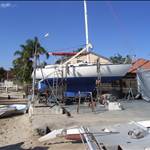
Does anyone have any experience with lightning protection devices, such as Sertec, based on CMCE (Controlled Mechanical Compensator for Electric fields)? The claim is that it creates a "shield" that makes it nearly impossible for a lightning bolt to form over a boat. With 8,000 installations and zero reported strikes, the stats look good, but of course, correlation isn't causation.
Anyone using one?
Personally, I'd much rather than prevent a lightning strike than attempt to channel one, as traditional lightning protectors do.
I find it difficult to have faith in the stated mechanism.
"passive sensor system that provides permanent protection by balancing and de-ionizing the effects of atmospheric phenomena through its compensators. By stabilizing the existing electric field in its environment, it creates a "shield" that cancels the formation of the upward tracer by draining the electric charges to the ground or surrounding water in harmless milliamperes.
"
Electric fields weaken at inverse square so how a button with a cap in it is going to meaningfully "de ionise" any sizeable area seems a stretch. It should be pretty easy to test and prove yet no corroborating experiments exist that I could find?
When our house / yard got hit by lightning it murdered 4 palm trees, a sizeable chunk of 2 large 10m trees, several possums and caused indirect inductance enough to fry small wiring (cat 6 network cable) 15 to 25 meters away. My point being both that the energy involved and the size of the leaders (multiple) and strikes seem to make this implausible??
I know two people who were on sailing boats that had masts hit by lightning. From what happened to them, and my experience with the nasty effects of high voltage arcs there are three protection methods. These apply if you find yourself on a boat vulnerable to lightning. 1. Sit far away from the mast at an extreme end of the boat. 2. Wear sunnies. 3. Plug your ears with toilet paper (if nothing else). Both people I know were burnt and got eye and severe hearing damage.
The CMCE claims are certainly bold, but there does seem to be some science behind it.
It is not to be confused with the older charge dissipation arrays, which attempted to prevent lightning by "bleeding" charge into the atmosphere via thousands of sharp points. That was proven to be ineffective 20 years ago.
Rather than trying to "neutralize the sky", which is impossible, the new CMCE method instead tries to neutralize just the upward streamer, by balancing the electric field locally between two internal plates (a capacitor-like structure). They absorb the potential difference and convert it into a controlled leakage current, which is measurable by a monitor.
The theory is based on the fact that a lightning strike is actually two-way "handshake" between the cloud and the ground. If the upward streamer can be suppressed, then downward strike has nowhere to go (or goes somewhere else, such as the next boat in the marina).
Here is a data sheet:
centralian.com.au/wp-content/uploads/2023/08/Data-sheet-CMCE-2021-ENG.pdf
I'm trying to get some data from the reseller.
Select to expand quoteTrek said..
I know two people who were on sailing boats that had masts hit by lightning. From what happened to them, and my experience with the nasty effects of high voltage arcs there are three protection methods. These apply if you find yourself on a boat vulnerable to lightning. 1. Sit far away from the mast at an extreme end of the boat. 2. Wear sunnies. 3. Plug your ears with toilet paper (if nothing else). Both people I know were burnt and got eye and severe hearing damage.
I would add:
- Sit on the floor in the middle of the saloon, below window height. Avoid leaning against the bulkheads or the sides of the hull.
- Sit with your knees tucked to your chest to reduce the chance of current traveling up one leg and down the other. This is what usually kills people, not a direct hit.
- Put your handheld equipment into something that will function as a Faraday cage (a microwave if you have one, or a steel pot with a tight seal).
It is the sonic boom that can rupture glass windows and ear drums. Acrylic windows are must safer.
7kg added to the top of the mast according to the specifications. That's a lot of weight in the wrong spot.
Select to expand quoteEastCoastSail said..
7kg added to the top of the mast according to the specifications. That's a lot of weight in the wrong spot.
Yes, 7kg would be a lot! The GOLD model, which they claim is sufficient for vessels up to 25m, weighs only 1.06kg
By comparison, a shielded cable sufficient to dissipate a lightning strike to a 15m mast would weigh ~20kg, albeit spread along the length of the mast.