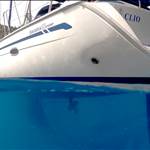
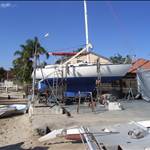
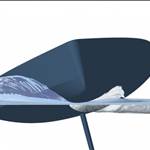
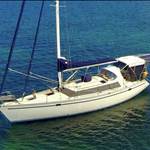
This time on the slip just from sitting on its keel not quite horizontal.
As much as I like watching good looking people, this type of Youtube - newbies with radiant looking woman with bloke attached wowing into the camera - has me reaching for the mouse. But I did watch it and was staggered that they could blame the yard. The yard seemed to be doing a fine job - resting the boat on its keel. They say it was not exactly at the right spot on the keel - but that is getting silly.
If a mono can't rest on its keel then you shouldn't be cruising it. If your boat needs cradles, like the AC and race boats boats, then the owner needs to go to the yard with their own cradles, much like the way you see race boats transported by road. I can't believe that anyone would be stupid enough to try and cruise this type of boat. There is no need to have this type of keel on a cruiser - you are going to run aground, lie on your side when the tide goes out, hit sand, mud, rock even, and the keel needs to be fine with it. Otherwise you risk the keel falling off.
In reality they are probably lucky it broke on them at the yard so they can scrap the boat and buy another one.
Just my experience but I've known a fair few production boat owners with similar problems. p-brackets flying off, keel cracks, improper epoxy work on keels, delaminating glass (many). Then I have people looking through my boat and they say it's not what they're after and want a production boat instead. I just wish them luck. I'm sure there's many good ones out there but for cruising, and for fewer dramas my personal preference is to stay away from them.
Select to expand quoteKankama said..
As much as I like watching good looking people, this type of Youtube - newbies with radiant looking woman with bloke attached wowing into the camera - has me reaching for the mouse. But I did watch it and was staggered that they could blame the yard. The yard seemed to be doing a fine job - resting the boat on its keel. They say it was not exactly at the right spot on the keel - but that is getting silly.
If a mono can't rest on its keel then you shouldn't be cruising it. If your boat needs cradles, like the AC and race boats boats, then the owner needs to go to the yard with their own cradles, much like the way you see race boats transported by road. I can't believe that anyone would be stupid enough to try and cruise this type of boat. There is no need to have this type of keel on a cruiser - you are going to run aground, lie on your side when the tide goes out, hit sand, mud, rock even, and the keel needs to be fine with it. Otherwise you risk the keel falling off.
In reality they are probably lucky it broke on them at the yard so they can scrap the boat and buy another one.
Tell us what you really think :-).
Yes I'm not sure where they are but obviously it has some facilities and better it happened there than somewhere else more remote.
To be fair however they are pretty young and inexperienced and everyone has heard of Beneteaus or whatever that thing is and they don't come with any warnings. The things certainly come looking like a cruising boat with a nice interior not some stripped out thing with exposed carbon and fold out bunks. Shame on the person that sold it to them. It's not quite as obvious as buying a Ferrari and expecting to go bush bashing.
It looks like a fairly big and well equipped marine facility and the staff there didn't know either.
Yeah bugger for the duo - but really - how could anyone survey that thing and think that the keel can handle cruising? Its a tiny chord keel, only suitable for careful racing and cruising close to home and near a cradle when slipped. That thing could not handle running into coral at 7 knots - I was on a boat that did that once (not mine and I wasn't on the helm), backed off , I went swimming, a few gouges and away we went. With this one - you hit the bottom and need a survey and X ray of the keel. It beggars belief that anyone would cruise such a beast. In some ways this is what happens when ignorant people buy boats based on how pretty the settee is rather than reasonable design considerations. I must be getting old because I can't understand why people can't read books by Dashew, or Perry, or Holland or Cornell or Kretschmer or Novak.
If you get your advice from giggling twenty somethings who are new into the scene you get very poor results. Stupid research produces stupid buys. So no sympathy from me - they were adults who neglected basic research and were dumb to buy the boat.I reckon different yards have different skills - so you better be in charge of your boat, not the yard. If you let the yard put the boat down wrong then it is on you - unless previously you have told them and drawn exactly how it needs to be held. And had that talk prior to the boat coming out. Do drawings, give measurements, explain structures, but don't expect a yard to know if youre boat has structural limitations that are way out of the ordinary. I had a yard try to bend my trimaran putting her up between bulkheads - so now I talk to any yard prior very clearly.
I have marks on the waterline and I have even swum on a slipway to check chocking before I let them pull my cat out. I am slipping my cat in two weeks and I will be there putting the padding on the slip before she goes up. At Boatworks the guys got a drawing with full measurements of strong points and places to lift - they did a great job - because we worked it out beforehand - yards can be stupid. So you should check that the yard will treat your baby with the love and care she deserves or you sail away. It's always on you to check the yard and ensure they know exactly how to hold her and what will happen if they don't. Don't expect the yard to know your boat better than you.
That boat is a Grand Soliel, 46' 2010 year. From comments by the owner on an earlier video. The manufacturer states is has a CE Rating of Category A Ocean.
Probably unfair to say the owners didn't do research. Do you trust the CE Rating system?
Fin keels. I guess it's the thing that makes them sail so well that also makes them vulnerable. Recent cruise in the Whitsundays, I was enjoying every second of sailing fast fin keel vessels, plotting course, soundings & tide variations I'm comfortable with, but the whale traffic had me concerned.
It looks as though even Grand Soliel now just drops the frames into bog. That's odd since I thought they were supposedly a top-end brand.
Select to expand quoteSeanTsv said..
That boat is a Grand Soliel, 46' 2010 year. From comments by the owner on an earlier video. The manufacturer states is has a CE Rating of Category A Ocean.
Probably unfair to say the owners didn't do research. Do you trust the CE Rating system?
I guess not - look at the root of that keel in the video. Think of the leverage the keel has on the root and compare it to a normal cruising fin keel. How is it that any competent body could certify that structure? I like monos and multis that can bounce on their keels for a day or so, in chop, a mono that can run into a reef and back off with grins and grimaces all round and gouges only in the keel bottom. Cats that can bounce up on a sandbank in a gale and winch themselves off. Have we seriously come to the point where this type of keel is suitable for a cruiser? If it is then I would view CE certification with huge misgivings. Have they not seen how boats are used and abused?
The only images of the Grand Soleil 46 I can find are these - this is not the keel shown on the video. It seems as though the video boat has a racer keel.

At least this keel has a root/chord that is almost as long as the depth of the keel - reasonable proportions. It also doesn't have the bulb on the bottom like the video boat. The longer chord also allows wider foil thickness reducing keel root loads - better for cruising all round.
Select to expand quoteKankama said..SeanTsv said..
That boat is a Grand Soliel, 46' 2010 year. From comments by the owner on an earlier video. The manufacturer states is has a CE Rating of Category A Ocean.
Probably unfair to say the owners didn't do research. Do you trust the CE Rating system?
I guess not - look at the root of that keel in the video. Think of the leverage the keel has on the root and compare it to a normal cruising fin keel. How is it that any competent body could certify that structure? I like monos and multis that can bounce on their keels for a day or so, in chop, a mono that can run into a reef and back off with grins and grimaces all round and gouges only in the keel bottom. Cats that can bounce up on a sandbank in a gale and winch themselves off. Have we seriously come to the point where this type of keel is suitable for a cruiser? If it is then I would view CE certification with huge misgivings. Have they not seen how boats are used and abused?
The only images of the Grand Soleil 46 I can find are these - this is not the keel shown on the video. It seems as though the video boat has a racer keel.
At least this keel has a root/chord that is almost as long as the depth of the keel - reasonable proportions. It also doesn't have the bulb on the bottom like the video boat. The longer chord also allows wider foil thickness reducing keel root loads - better for cruising all round.
I do agree with your logic but people trust certification. I don't know what engineering process is required to achieve this. I believe it has to handle 40 kt winds and 4 metre waves.
Link below shows it comes with 3 keel options. One in the link is similar to the video.
sailboatdata.com/sailboat/grand-soleil-46-bc/?units=metric
Select to expand quoteSeanTsv said..Kankama said..SeanTsv said..
That boat is a Grand Soliel, 46' 2010 year. From comments by the owner on an earlier video. The manufacturer states is has a CE Rating of Category A Ocean.
Probably unfair to say the owners didn't do research. Do you trust the CE Rating system?
I guess not - look at the root of that keel in the video. Think of the leverage the keel has on the root and compare it to a normal cruising fin keel. How is it that any competent body could certify that structure? I like monos and multis that can bounce on their keels for a day or so, in chop, a mono that can run into a reef and back off with grins and grimaces all round and gouges only in the keel bottom. Cats that can bounce up on a sandbank in a gale and winch themselves off. Have we seriously come to the point where this type of keel is suitable for a cruiser? If it is then I would view CE certification with huge misgivings. Have they not seen how boats are used and abused?
The only images of the Grand Soleil 46 I can find are these - this is not the keel shown on the video. It seems as though the video boat has a racer keel.
At least this keel has a root/chord that is almost as long as the depth of the keel - reasonable proportions. It also doesn't have the bulb on the bottom like the video boat. The longer chord also allows wider foil thickness reducing keel root loads - better for cruising all round.
I do agree with your logic but people trust certification. I don't know what engineering process is required to achieve this. I believe it has to handle 40 kt winds and 4 metre waves.
Link below shows it comes with 3 keel options. One in the link is similar to the video.
sailboatdata.com/sailboat/grand-soleil-46-bc/?units=metric
The OEM site only lists 2 keel options, not the longer one in the 'sailboatdata' link above.
www.grandsoleil.net/app/uploads/2021/08/Brochure_GS46-long-cruise.pdf
Very bottom of the page has spec and certification.
Is it not true they build most of the new boats to the limited requirements by law then even after only one grounding the minimal requirement is on its way down .?
Select to expand quoteKankama said..
If it is then I would view CE certification with huge misgivings. Have they not seen how boats are used and abused?
My bet is the big production manufacturer's write (or heavily influence) the CE certification standards. The stakeholders with the most money/power write the rules to suit themselves in most industries.
Who makes solid passage making yachts these days with robust appendages, cutter rigs and cockpits you can't be washed out of. Kraken Yachts? Are there others?
Select to expand quoteShifu said..
Who makes solid passage making yachts these days with robust appendages, cutter rigs and cockpits you can't be washed out of. Kraken Yachts? Are there others?
Kraken may be fine but $$$$$$$.
Too bad the whole industry is relatively low production otherwise we could have something like ancap and test a model to destruction by pulling and pushing every which way on the keel in a measured way.
You would hope that the larger manufacturers might do this on models where hundreds are going to be sold as of course they can do it to a shell before all the interior is completely together and other expensive stuff put on. Obviously not however and yes I agree that the certifiers and the manufacturers are highly likely to be in bed with each other. We need some high profile court cases which bring down significant manufacturers who should then be prohibited from using the same name in a rebirthed company sold by the liquidator
Fortunately economically I'm bound to buying older yachts before gluing became the norm. A few years ago I looked at one of the larger Sunfast yachts and the dealer was at pains to point out to me that it was one of their last models with tabbing rather than gluing - perhaps around 2008 vintage very approximately- (strange as he also sold new ones but maybe I said something about modern construction methods- I can't remember).
Not that tabbing is infallible but as it is lower tech there are probably less things that can go wrong and they are better known. I have a number of boats in my yard and decided over the last few weeks to get rid of a hydra catamaran. Probably stupidly rather than trying to sell it I decided to dismantle it and cut it up (good beams, mast, foils and sails available btw) . It was generally very well made but there were a couple of braces internally which just comprised a couple of layers of fiberglass matt extending through midair. At one side they were joined to the inside of the hull and I was absolutely horrified at how easily I could just pull them off by hand with almost no effort. A 4-year-old could have easily done it. Duct tape would have held on better!
if true: "I believe it has to handle 40 kt winds and 4 metre waves", that is woefully insufficient for an ocean going boat, IMHO. I would not set out to cross an ocean in a boat with those limitations.
Select to expand quoteKankama said As much as I like watching good looking people, this type of Youtube - newbies with radiant looking woman with bloke attached wowing into the camera - has me reaching for the mouse.
Just for you Kankama :). Same mob.
Select to expand quoteKankama said..
As much as I like watching good looking people, this type of Youtube - newbies with radiant looking woman with bloke attached wowing into the camera - has me reaching for the mouse.
You'll end up going blind if you don't stop that. 
Select to expand quotejulesmoto said..Kankama said As much as I like watching good looking people, this type of Youtube - newbies with radiant looking woman with bloke attached wowing into the camera - has me reaching for the mouse.
Just for you Kankama :). Same mob.
?si=MB9ooh-xypTKWkbx
The 'bonus guess..' move is feeling the cracks on the keel. ;)
Select to expand quoteQuixotic said..
if true: "I believe it has to handle 40 kt winds and 4 metre waves", that is woefully insufficient for an ocean going boat, IMHO. I would not set out to cross an ocean in a boat with those limitations.
Seems like CE Category B "offshore" is up to 40 knot winds and 4 metres significant wave height.
Cat A "Ocean" is winds exceeding force 8 (40 knots) and waves of more than 4 metres, but not hurricane conditions.
Unclear from anything I can find as to whether "more than force 8" but "not a hurricane", means they are thought to be able to survive force 9-11 winds (ie from strong gale to violent storm) and corresponding significant wave heights.
There are also differences in minimum AVS requirements based on ISO 12217 - apparently for Cat B it is minimum of 95 degrees for boats 7.5 tonnes and over, increasing to 122 degrees for boats of 2 tonnes or less, whereas for Cat A it is minimum 100 degrees for 15 tonnes and over, increasing to 123 degrees for 3 tonnes and less.
None of this appears to go to structural specifics about keel attachment/design. However, I understand CE tends to be tied to ISO standards.
There're ISO standards for small monohull (up to 24m LOA) hull structure ISO 12215, including appendages (ie keels) - ISO 12215-9, so presumably these are picked up in CE, though it is not easy to see specifically how, as ISO docs are not available unless you pay (~$A400 for just 12215-9) and it is also not easy to see how they are used by the various certifying organisations that certify a design / sample boat as meeting the requirements. There may be an engineer out there who can shed light on this?
To be fair tho' 12215-9 does cover different types of keels (fixed single, dual, canting etc) in different materials (metal, wood, FRP) and also load cases covering 90 degree knockdown, longitudinal impact and vertical pounding.
For those with particular views on keels, these ISO standards are stated as not meant to be the basis of design for racing boats...
Select to expand quoteQuixotic said..Quixotic said..
if true: "I believe it has to handle 40 kt winds and 4 metre waves", that is woefully insufficient for an ocean going boat, IMHO. I would not set out to cross an ocean in a boat with those limitations.
Seems like CE Category B "offshore" is up to 40 knot winds and 4 metres significant wave height.
Cat A "Ocean" is winds exceeding force 8 (40 knots) and waves of more than 4 metres, but not hurricane conditions.
Unclear from anything I can find as to whether "more than force 8" but "not a hurricane", means they are thought to be able to survive force 9-11 winds (ie from strong gale to violent storm) and corresponding significant wave heights.
There are also differences in minimum AVS requirements based on ISO 12217 - apparently for Cat B it is minimum of 95 degrees for boats 7.5 tonnes and over, increasing to 122 degrees for boats of 2 tonnes or less, whereas for Cat A it is minimum 100 degrees for 15 tonnes and over, increasing to 123 degrees for 3 tonnes and less.
None of this appears to go to structural specifics about keel attachment/design. However, I understand CE tends to be tied to ISO standards.
There're ISO standards for small monohull (up to 24m LOA) hull structure ISO 12215, including appendages (ie keels) - ISO 12215-9, so presumably these are picked up in CE, though it is not easy to see specifically how, as ISO docs are not available unless you pay (~$A400 for just 12215-9) and it is also not easy to see how they are used by the various certifying organisations that certify a design / sample boat as meeting the requirements. There may be an engineer out there who can shed light on this?
To be fair tho' 12215-9 does cover different types of keels (fixed single, dual, canting etc) in different materials (metal, wood, FRP) and also load cases covering 90 degree knockdown, longitudinal impact and vertical pounding.
For those with particular views on keels, these ISO standards are stated as not meant to be the basis of design for racing boats...
How about running aground at five knots; running aground at eight knots... in mud, in sand, onto solid immovable object; sitting boat on keel on the hard...
Probably plenty of boats that have not gone out in over 40 knots but next to none that have never run aground although I would think that continuous dropping off 4-6 metre waves would involve similar stresses to running aground albeit perhaps from a different direction.
Select to expand quoteQuixotic said..Quixotic said..
if true: "I believe it has to handle 40 kt winds and 4 metre waves", that is woefully insufficient for an ocean going boat, IMHO. I would not set out to cross an ocean in a boat with those limitations.
Seems like CE Category B "offshore" is up to 40 knot winds and 4 metres significant wave height.
Cat A "Ocean" is winds exceeding force 8 (40 knots) and waves of more than 4 metres, but not hurricane conditions.
Unclear from anything I can find as to whether "more than force 8" but "not a hurricane", means they are thought to be able to survive force 9-11 winds (ie from strong gale to violent storm) and corresponding significant wave heights.
There are also differences in minimum AVS requirements based on ISO 12217 - apparently for Cat B it is minimum of 95 degrees for boats 7.5 tonnes and over, increasing to 122 degrees for boats of 2 tonnes or less, whereas for Cat A it is minimum 100 degrees for 15 tonnes and over, increasing to 123 degrees for 3 tonnes and less.
None of this appears to go to structural specifics about keel attachment/design. However, I understand CE tends to be tied to ISO standards.
There're ISO standards for small monohull (up to 24m LOA) hull structure ISO 12215, including appendages (ie keels) - ISO 12215-9, so presumably these are picked up in CE, though it is not easy to see specifically how, as ISO docs are not available unless you pay (~$A400 for just 12215-9) and it is also not easy to see how they are used by the various certifying organisations that certify a design / sample boat as meeting the requirements. There may be an engineer out there who can shed light on this?
To be fair tho' 12215-9 does cover different types of keels (fixed single, dual, canting etc) in different materials (metal, wood, FRP) and also load cases covering 90 degree knockdown, longitudinal impact and vertical pounding.
For those with particular views on keels, these ISO standards are stated as not meant to be the basis of design for racing boats...
I am certainly not an expert in this matter but the way it reads to me a boat designer can prove his boat out at 41 knots and 4.1 metre waves. He could then tick the box as >40kt, >4 metre waves and not hurricane conditions.
I think it is a bit weak unless I am missing the point.
Many products require CE marking before they can be sold in the EU. CE marking indicates that a product has been assessed by the manufacturer and deemed to meet EU safety, health and environmental protection requirements. Nothing to do with robust construction (other than seaworthiness) or product life.
Select to expand quoteSeanTsv said..Quixotic said..Quixotic said..
if true: "I believe it has to handle 40 kt winds and 4 metre waves", that is woefully insufficient for an ocean going boat, IMHO. I would not set out to cross an ocean in a boat with those limitations.
Seems like CE Category B "offshore" is up to 40 knot winds and 4 metres significant wave height.
Cat A "Ocean" is winds exceeding force 8 (40 knots) and waves of more than 4 metres, but not hurricane conditions.
Unclear from anything I can find as to whether "more than force 8" but "not a hurricane", means they are thought to be able to survive force 9-11 winds (ie from strong gale to violent storm) and corresponding significant wave heights.
There are also differences in minimum AVS requirements based on ISO 12217 - apparently for Cat B it is minimum of 95 degrees for boats 7.5 tonnes and over, increasing to 122 degrees for boats of 2 tonnes or less, whereas for Cat A it is minimum 100 degrees for 15 tonnes and over, increasing to 123 degrees for 3 tonnes and less.
None of this appears to go to structural specifics about keel attachment/design. However, I understand CE tends to be tied to ISO standards.
There're ISO standards for small monohull (up to 24m LOA) hull structure ISO 12215, including appendages (ie keels) - ISO 12215-9, so presumably these are picked up in CE, though it is not easy to see specifically how, as ISO docs are not available unless you pay (~$A400 for just 12215-9) and it is also not easy to see how they are used by the various certifying organisations that certify a design / sample boat as meeting the requirements. There may be an engineer out there who can shed light on this?
To be fair tho' 12215-9 does cover different types of keels (fixed single, dual, canting etc) in different materials (metal, wood, FRP) and also load cases covering 90 degree knockdown, longitudinal impact and vertical pounding.
For those with particular views on keels, these ISO standards are stated as not meant to be the basis of design for racing boats...
I am certainly not an expert in this matter but the way it reads to me a boat designer can prove his boat out at 41 knots and 4.1 metre waves. He could then tick the box as >40kt, >4 metre waves and not hurricane conditions.
I think it is a bit weak unless I am missing the point.
I'm certain it is not done by sea trials, but rather by modelling based on the design parameters, tho' the keel standards may include deflection testing on a sample boat. But even for the keel standards I think is probably done by formulae and computer modelling techniques (I think finite element analysis gets a mention). So the Cat A rating would be based on the output of the modelling such as the AVS being calculated to be greater than X for Cat A and greater than Y for Cat B (noting Y is always less than X and both vary according to the weight of the boat).
How anyone has decided, for example, that 100 degrees for AVS for a 15 tonne boat means it can be certified for more than 40 knots of wind and more than 4 metre SWH, I don't know.
I think it is better than nothing, but I would not rely on it, and to be honest, I don't think more than 40 knots of wind and more than 4 metre SWH is necessarily the correct minimum benchmark for a truly open ocean boat.
Also studies have shown that all boats will capsize if caught be a breaking wave side on that exceeds 60 percent of their length. If so, for a 40 feet boat, a breaking wave of more than 24 feet (8 metres), breaking side on is pretty much guaranteed to capsize it. For a 30 foot boat, it requires only an 18 foot (6 metre) wave breaking side on. Of course some of this comes down to seamanship - not being side on to breaking waves! - which a CE certification cannot address.
But sticking to what studies have shown, it is important to remember the significant wave height is roughly speaking the average of the tallest third of waves - so if the SWH is 4 metres there will regularly be 6 metre waves (about one in every 100 on average) and less frequently 7.5 metre waves (about one in every 1000 or so). I am not sure if the CE certifies the boat for 4.1 metre waves only or for all waves that are likely to occur when the SWH is 4 metres.
It's not clear, and unless someone with expertise where to unpack it in full, with a plain English explanation of how it is arrived at, I would not rely on it. But as I said earlier, better IMHO to have some standards than none.
Select to expand quoteQuixotic said..Quixotic said..
if true: "I believe it has to handle 40 kt winds and 4 metre waves", that is woefully insufficient for an ocean going boat, IMHO. I would not set out to cross an ocean in a boat with those limitations.
Seems like CE Category B "offshore" is up to 40 knot winds and 4 metres significant wave height.
Cat A "Ocean" is winds exceeding force 8 (40 knots) and waves of more than 4 metres, but not hurricane conditions.
Unclear from anything I can find as to whether "more than force 8" but "not a hurricane", means they are thought to be able to survive force 9-11 winds (ie from strong gale to violent storm) and corresponding significant wave heights.
There are also differences in minimum AVS requirements based on ISO 12217 - apparently for Cat B it is minimum of 95 degrees for boats 7.5 tonnes and over, increasing to 122 degrees for boats of 2 tonnes or less, whereas for Cat A it is minimum 100 degrees for 15 tonnes and over, increasing to 123 degrees for 3 tonnes and less.
None of this appears to go to structural specifics about keel attachment/design. However, I understand CE tends to be tied to ISO standards.
There're ISO standards for small monohull (up to 24m LOA) hull structure ISO 12215, including appendages (ie keels) - ISO 12215-9, so presumably these are picked up in CE, though it is not easy to see specifically how, as ISO docs are not available unless you pay (~$A400 for just 12215-9) and it is also not easy to see how they are used by the various certifying organisations that certify a design / sample boat as meeting the requirements. There may be an engineer out there who can shed light on this?
To be fair tho' 12215-9 does cover different types of keels (fixed single, dual, canting etc) in different materials (metal, wood, FRP) and also load cases covering 90 degree knockdown, longitudinal impact and vertical pounding.
For those with particular views on keels, these ISO standards are stated as not meant to be the basis of design for racing boats...
This is kinda answered with the part of ISO 12217-2 related to stability and seaworthiness, or simply called your Stability Index (STIX) number. The STIX number is a calculation of hull form, displacement, beam, righting moment, and bouyancy.
Category compliance requires a certain STIX number, eg: Cat A >32 STIX, Cat B is >23 STIX and so on.
This is my old STIX number as a reference. This is without cruising payload, but does include crew and the basic sail configuration. 

Doesn't matter what numbers your boat has built into its design if the glue lets go. It's just poor quality construction
Select to expand quoteShifu said..
Who makes solid passage making yachts these days with robust appendages, cutter rigs and cockpits you can't be washed out of. Kraken Yachts? Are there others?
There's a few more than Kraken including the Aussie build Bluewater 420.

Select to expand quoteSeanTsv said..julesmoto said..Kankama said As much as I like watching good looking people, this type of Youtube - newbies with radiant looking woman with bloke attached wowing into the camera - has me reaching for the mouse.
Just for you Kankama :). Same mob.
?si=MB9ooh-xypTKWkbx
The 'bonus guess..' move is feeling the cracks on the keel. ;)
Make it stop! But I love the new move of "Go aground and drop the keel" or "Sail along until the keel falls off" or "fall overboard trying to collect drone" maybe "Wave to man overboard to get good tic toc video"
I need to go on a digital detox - these guys are not real are they?
Select to expand quotesouthace said..Shifu said..
Who makes solid passage making yachts these days with robust appendages, cutter rigs and cockpits you can't be washed out of. Kraken Yachts? Are there others?
There's a few more than Kraken including the Aussie build Bluewater 420.
Exactly!
I don't get the idea of just using glue on a boat's structure.
I think I said it before somewhere, but when I build a boat I lay down a strongback. I often glue it with epoxy to the concrete floor. After the hulls are complete I need to remove the strongback and it is easy to remove the glue dabs holding the legs onto the concrete - you just give them a solid whack with a mallet - then they crack and fail totally. Epoxy glue is wonderful stuff, it is incredibly strong but it is not shock resistant.
That is the job of glass tabbing. I cannot do this on boat parts that have both fillets AND tabbing. These must be laboriously cut and ground away. There are no shortcuts with glue AND tabbing. It is for my mind the only way to make a composite boat's structure.
The idea that any reasonable manufacturer would glue structural parts on a boat without tabbing them is really worrying. Glung will take loads that are slowly applied but shock loads or over loads will cause total failure of the joint. There should be no way gluing alone is acceptable.