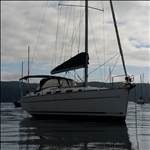
The anti foul on our 30 boat is Altex no5. After 11 months its looking good and gets reasonably regular use of at least once a week.
Are you supposed to scrub it or does that do more harm than good?
Thanks
Ed.
if it aint broke.......
seriously though, if it is clean of shell any minor / major slime or growth, why touch it....
best case i use leather glove rub over only, not scotch brite or brush....but everyone has a different approach
as soon as the slime seal is broken though the 'power' of the anti-foul reduces as you would expect
If the boat is starting to get slimy, a light rub with a scotch pad will be OK. Altex 5 is a semi ablative antifouling and is much the same as Micron 66. I have used Altex 5 and Micron 66 and regularly have a diver clean the hull so as to maintain maximum performance. Keeping the propeller clean is a bigger issue as the Altex 5 will out last the Propspeed. The people at The Boat Works were only telling me yesterday that there a a couple of new products coming on the the market that look like they may out perform Propspeed.
I put four coats [8 lts] of Altex No 5 on my Top Hat SEAKA in April 2015.
I then sailed north to Bowen and returned to my home port of Camden Haven in NSW after seven months cruising. Done a bit of local cruising since then but most of the time SEAKA has sat in the Camden Haven River which has a history of heavy fouling.
I have from time to time cleaned off the slime. I am now in the position that I am getting some growth on the leading edge of the bow and around the water line. Before I did the anti-fouling in 2015 I found that Altex No 5 when put on with a roller needs 3 coats minimum. Next time I'll get a fifth coat around the waterline and on the leading edge of the bow.
By putting those extra coats on I got 3 years which in fact means I saved one tin of paint [if I'd only put the usual one per year] and two slippings!!!
For me that means around $1300 saved.
It is worth the extra coats from the costs and being able to do the odd clean down 
Ablative implies you do NOT scrub it. Just loosing anti foul.
A very light wipe occasionally to get rid of the slime is OK. Wear soft divers gloves.
Hi all
I also have Altex 5 and have been searching for a definitive answer to the questions of whether to clean it or not? there are many varied answers all over the net so it's difficult to know which way to go. Mine is just on 1 year old (admittedly it was not well applied, PM if you want to discuss who did the work) and was getting very slimy and had some shell developing. I could definitely feel the difference in hull speed plus the running gear needed a good clean. I didn't want to have to get new antifoul this close to Xmas $$$ (plus the fact that many Sydney docks are booked out for 3-4 months in advance...gotta love Sydney$$$) so I engaged "ScubaBees" to dive and clean the hull.
On a side note, the team at Scubabees were excellent, very professional, great communication (which is unusual in Sydney) and fast! They also provided a large number of before and after photos- I have no affiliation with the company but believe in promoting great service when I find it.
So now I have a clean hull but I guess it commits me to getting a diver in (or doing it myself) every 2 months. They say they used a soft sponge for the majority of the hull so hopefully not too much Altex was removed but less antifoul is still less antifoul...So what's the answer?
Given the dollars involved and the amount of growth we seem to get in and around Sydney, would it be better to get a hard antifoul and have a diver clean it every 8 weeks, or something like the "Copercoat" which appears to be an epoxy mixed with copper (not sure about the antifouling properties being encased in epoxy) but at least it would be rock hard and could be cleaned regularly without damage.
Thoughts??
Gos
Shaggybaxter had a great idea. Get a length (say 4 to 5 meters) of artificial grass 6" wide with a rope on each end and then sling it under the boat with a person each side see sawing along the hull.
It is not going to reach everywhere under the boat and will not suit all hull shapes but I thought it was a damned good idea.
It will scrub most of the hull with only a short dive needed to tidy up the unreachable bits.
Select to expand quoteGos2017 said..
Hi all
I also have Altex 5 and have been searching for a definitive answer to the questions of whether to clean it or not? there are many varied answers all over the net so it's difficult to know which way to go. Mine is just on 1 year old (admittedly it was not well applied, PM if you want to discuss who did the work) and was getting very slimy and had some shell developing. I could definitely feel the difference in hull speed plus the running gear needed a good clean. I didn't want to have to get new antifoul this close to Xmas $$$ (plus the fact that many Sydney docks are booked out for 3-4 months in advance...gotta love Sydney$$$) so I engaged "ScubaBees" to dive and clean the hull.
On a side note, the team at Scubabees were excellent, very professional, great communication (which is unusual in Sydney) and fast! They also provided a large number of before and after photos- I have no affiliation with the company but believe in promoting great service when I find it.
So now I have a clean hull but I guess it commits me to getting a diver in (or doing it myself) every 2 months. They say they used a soft sponge for the majority of the hull so hopefully not too much Altex was removed but less antifoul is still less antifoul...So what's the answer?
Given the dollars involved and the amount of growth we seem to get in and around Sydney, would it be better to get a hard antifoul and have a diver clean it every 8 weeks, or something like the "Copercoat" which appears to be an epoxy mixed with copper (not sure about the antifouling properties being encased in epoxy) but at least it would be rock hard and could be cleaned regularly without damage.
Thoughts??
Gos
Semi ablative anti foulings e.g. Altex 5, Micron 66 and others are the way to go for a number of reasons.
1. You can give them a clean.
2. Easy to clean.
3. Only a very small amount of antifouling is lost when cleaned, unlike full ablative soft antifouling which totally clouds the water when cleaning.
4. Good life , 2 to 2.5 years even with cleaning. (Must be applied to manufactures specifications)
4. Doesn't build up on the boat requiring to boat to be fully stripped after a few bouts of antifouling.
5. Washing actually helps by removing any small growths which only promotes further growth and also activates fresh antifouling.
6. Disadvantages are : cost, don't like to be left out of the water, don't like water with a lot of fresh in it.
7. Performance is about the same as hard antifouling if the boat is not regularly used.
Hard antifouling.
1. Hard to clean.
2. Requires a lot more cleaning.
3. Builds up on hull.
4. Good if boat is kept out of water.
5. Cheap
This is only my opinion from looking after and trying most options over the last 40 years.
At present I am using Micron 66 and getting 2+ years in warm water.
The best antifouling ever was the old Micron 25 which is no longer available, it killed everything including you when you scrubbed it.
Used MExtra before, lasted two years +
Now Altex 5, seem to be worse, more growth after six months.
Mate applied M66 on his boat yesterday, hates it, hard to apply he said. Will see how it works in a yearor so.
Antifouling sucks big time. Period
I always thought Altex No5 was fully ablative.
If you touch it your hand goes black.
Ed
Select to expand quotesirgallivant said..
Used MExtra before, lasted two years +
Now Altex 5, seem to be worse, more growth after six months.
Mate applied M66 on his boat yesterday, hates it, hard to apply he said. Will see how it works in a yearor so.
Antifouling sucks big time. Period
How many coats did you put on??