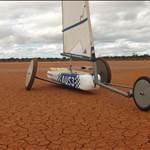
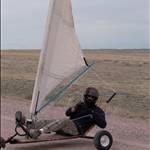
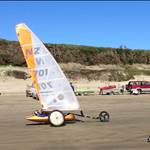
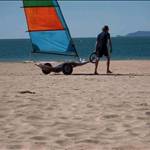
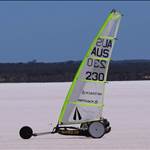
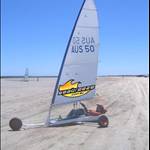
what are the key differences in sail characteristics with regards to luff legth- boom length.i like the look of the square head type sails AUS 222 AUS 52 AUS230[pics in register]with that style sail what would longer luff-shorter boom compared to shorter luff-longer boom be.is there a formula ie. a 4 sq m sail with 4mtr luff[square head style]should have a boom length x?-y?
My thoughts on sail design (it might be wrong it might be right) but have a look at things around you... Light planes, gliders, seagulls, eagles etc.
What i have noticed is the things that have a high lift have long wings, Shorter wing planes have bigger engines, why does the F111 swing its wings out to land and take off?

This subject was previously been talked about on sea breeze, Have a look it may help you.
www.seabreeze.com.au/forums/topic.asp?TOPIC_ID=34155
for your little beasty , I would consider a foot length of 1.2m to be the max , after that the low down grunt of the sail will pull you sideways, if you have a flexible mast EG one of those early blue windsurfer masts, it will be nice and flexible and you will be able to have a nice tall sail up around 3.5-3.8m
Brian ;being a windsurfer i know how lift benifits planing.does lift have same effect [benefit]landyacht.??[or] is the wind the engine ,does that mean stronger the wind shorter the mast??Paul ,mast is a 2 pce 460 cut aprox 300 of of each end so its quite stiff,what bearing will that have on sail design??I;ll post some pics of a sail i wiil prob use [9.8 monofilm formula sail] an d several cuting options before i cut it.
Newtons 3rd law of motion....To every action there is always opposed an equal reaction
With sailboards leaning the rig into the wind , lift is created and will give the board less drag in the water.
If a rig leans away from the wind like in sailboats and to some degree land yachts this does give some downward force. And downward force creates drag in the hull in water or wheels on land.
Land yachts over time have come to use a more flexible and chassis than was used 20+ years ago. The Lefroy mini uses a torsional frame and flexible rig to take some of the wind force (Newtons law)
In a basic principle..... a taller rig will make the CE centre of effort higher and tip the yacht easier, but with a flexible rig this bends, twisting the sail and depowering it, this lowers the CE...making the yacht easier to keep upright.
Like most things it becomes a balance between yacht, mast / boom and sail....
I hope this answers your question
Let me see if I've got this straight...
Thank you for your understanding with the barrage of questions to follow:
#1:
The reason for sail head twist is for taking advantage of lower wind pressures by maintaining lift at the top, but then twisting and therefore spilling air, becoming less drag (if not flapping), moving CE forward and partially depowering to maintain control at high wind pressure. Is that correct?
#2:
Does anyone have any IMCS numbers from the masts you're using. I'd like to compare my masts to known good ones.
#3:
Seems to me the sail on a landyacht is the highest drag element of the machine. Unlike boats where the hull is the largest contributor of drag. Is this true?
I still have alot to learn about sails, but for me that's one of the most exciting aspects of "flying" on the ground.
Ok ... I will try and answer your questions.
1.
Sail twist gives a more "forgiving" sail and works over a wider range of wind angles, and suits new sailors and shifting and or gusty wind conditions.
In an hypothetical ideal world sail twist would be a negative but as we sail in the real world a slight twist in the sail seems to be good....
Spend time and watch a soaring bird in the sky and have a look at the wing tips and how they move them....fascinating 
Dont get to hung up with CE and CR except in the initial building of the yacht as these change slightly when you are sailing.
This is a good read ....http://www.neilpryde.com/insiders-guide/insiders-guide/windsurfing-sails-design-function.html
2.
Very little has been done with IMCS numbers and testing as most of us are just happy to get a mast rather than pick and choose.
for more info in IMCS here is a link
www.neilpryde.com/insiders-guide/insiders-guide/understanding-mcs-and-imcs.html
3.
Yes... aerodynamic drag is possibly the most limiting factor of landyachts, I often say put your arm out of a car window at about 60kmh / 40 mph and feel how much wind drag is on your arm... this is a similar speed to what land yachts travel at....and on a landyacht your complete body is exposed to the wind.
hope that has sort of answered some of your questions....
I have been thinking more on the subject of aerodynamic drag since my last posting and what an amazing effort it was to achieve the speed for the world speed record set recently.
Upon looking at various sites comparing Land yacht speeds and ice yacht speeds in the same style of yacht (manta class) in similar winds they are almost identical. This get me thinking that the limiting factor is infact aero drag and not the surface, wheels or bearings.
And then taking a step further if 2 yachts of similar but different types (Blokart and Lefroy Mini) had the same size sail , on the same surface, and with pilots of equal ability were in fact put side by side sailing at maxium speed which would be the fastest?
Which one would be aerodynamicly better and how much difference would it make?
best comparison weve had was on lake gillies last year . 2xmelbourne BK club blowies( arjay and ben?) with 2m sails , carbon and pods vs me and faze 5 in minis. glass seats , windsurfer masts and a 3.5 and a 4m sail. the blowies would have had less drag and probably more control, but speed and acceleration was about the same.
arjays rig would basically be the one he had for his yepoon 106kph
Great link Gizmo and exactly the stuff I was looking for.http://www.neilpryde.com/insiders-guide/insiders-guide/windsurfing-sails-design-function.html
I've learned alot from their website, but hadn't found this until your suggestion.
It's nice to see Neil Pryde is more open about their designs than most other sail makers. Good PR in my opinion.
Thanks for the info guys and appologies to Pirrad for possibly steering off topic.
That would explain why you could pick the wind gusts in RADA TILLY. the lower the windbown sand layer, the stronger the gust
best comparison weve had was on lake gillies last year . 2xmelbourne BK club blowies( arjay and ben?) with 2m sails , carbon and pods vs me and faze 5 in minis. glass seats , windsurfer masts and a 3.5 and a 4m sail. the blowies would have had less drag and probably more control, but speed and acceleration was about the same.
Hi Landytch,
Not Arjay, It was Ben Graham & Crash
B,
there you go then, sorry its very hard to tell when they all look the same, At yepoon I jumped in my yacht to go race , and then realized that my GPS was taped to a yacht further down the beach
Regarding aero drag, I had a chat with Clem today, and we discussed drag from the frame.
As a clarification to my rant above.
If we are going say 50km, then the frame is actually seeing more than this, cos the wind is probably around 15km/hr from roughly 15 degrees off centreline ahead. (Apparent wind) So the frame feels 65 (50 forward speed + 15 windspeed), IF EXPOSED TO THE FULL WIND FORCE. If the frame is close to the ground, it will still feel the 50 but less of the 15. It's called wind gradient. The further from the ground, the stronger the wind until all "boundary layer" is negated.
This is why I believe that on a hard surface, with no water, a low frame will be aerodynamically better. This takes absolutely no account of the mechanics of frame twist!
Way back , we made a stick with lots of wool tel tales on it and went hunting across the lake for that ellusive wind gradient.
never did find any, so maybe they are apparent after all
From my experence bigger wheels have always been faster on any surface, hard or soft, rough or smooth. As long as they are not to heavy. We proved it one day on ohope beach. Darren's 5kg 26" Imac wheels were faster than his 3kg carbon 19s. The 19s are similar OD to a 24" bike size. We left him behind when he had the 19" wheels on, but when he changed to 26" he was back to even. Same day, same beach, same wind. Ohope is a hard smooth beach (mostly???).
110kph in a Mini? Yikes! I've been thinking 30mph was scary enough. Haven't been running on the smooth surfaces you guys have though.
At that speed I could see how aerodynamic frame drag would be a factor to consider.
hi kiwi303,
I think you are right about the height verses boom +surface.
What I have found is that my tallshort boom sail is at its best on hard surfaces such as Lefroy.
At Lake Walyungup the club88 with shorter /longer boom sails are able to handle the rougher surface and keep moving of the line better and also get through the areas that I have problems with in lower wind conditions at there lake.
I sail with an r@j sail I think you would be familar with it as I have seen a few on the NZ web site. I also use a sail from NZ that Bill Naine recomended (windward) and I find that is the best sail for lighter winds.
Cheers
AUS230
I found this diagram that might explain a little about sail shape /aspect ratio and how it relates power / speed.

Often the sailing surface conditions and - or class limitations like mast height often dictate rig setups.
therefore if you want to overcome walyungups rough bits, either go low with a longer boom or build a yacht that has less drag and stick with the high aspect rig.
'which brings us back to Do"