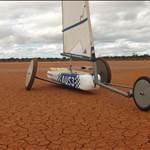
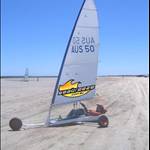
two for the price of one,maybe..?looking at cutting this sail and making a 4mtr[aprox]luff side and a 3mtr[aprox] leech side.mast laying on sail is 3800 long[40% carbon 25 imcs]i stuffed up the cuttig of it initially and then changed mast base on buggy so now it has a 530 ally tip to bring it up to 3800.from previous posts i think it is prob stiffer than ideal,both sails would have a foot length of 1300.[close to your rec specks Paul]top of the luff side batten is 600,leech side 400.

torsional frames and softer masts have been mentioned in previous posts and could work against me here.not sure about the 3mtr option when i am only going to get a 4mtr.still like the idea of the square top sail and pushing the limit to around 5mtr and just make the one sail[picture the mast at an angle to use complete top batten]from previous posts while all that extra sail at the top is considered by some to be a waste i have read that the sail twist can provide a more forgiving ride.

dont know iff you can tell to well from picture but i think i might give it a little more mast rake as well.

p.s.just had another look and if i go for the larger 5mtr option[square top to use all top batten i can still get a smaller sail by bringing mast down to bottom of sail .
I will be very interested to see how it turns out. I suspect that you will end up with a completely flat sail, because the rear half of that sail would be cut to be a big flat slab.
Im thinking that the sail is way bigger than is suitable for the size of the recut
As usual , feel free to prove me wrong
Thanks for the response Paul ,is it just the rear half[3mtr option] that your conserned about,or the front as well.I realise the 3 mtr option from the rear of the sail cant be cut straight as the mast is pictured,but needs to be cut with desired mast curve,will that still not work because it doesnt have shape stitched into it like the front of the sail had when it was made.
Been away for the weekend,got the scissors out this arvo and in fading light snapped a quick pick.Its had no luff pocket mods yet and is pictured fully sheeted.As is, fully sheeted the battens are sitting about 20-30 mm behind mast but ther is loosness in the luff pocket.[without sheet rope pressure the middle 2 battens are about 30mm in front of mast]with a fair amount a sewing to do on the leech ,before i remove luff pocket completely i might try and stitch a tuck into luff pocket and try it like that.Decided not to use all top batten,sacraficed about 300mm and squared bottom to batten,i reckon its prob just under 4mtr.foot length 1400.After reading in another post that someone used a domestic machine i might give that a try.....mast rake??

Hi pirrad
That sail looks like it will be great to me
I would suggest you take a photo in line with the rear wheels that is dead square
from the side and perhaps Gizmo will do his magic stuff with the Cof E and sort out your mast rake for you
Thanks Graeme,if i get some sewing done tomorrow,and boom modified to suit i'll take another pic from side on as you suggest.i've just been wondering about using fibreglass tape, got some 25mm, folded and stitched around leech side,it would prob look better with a bit of colour though.what about battens,i've got some hollow tube battens[13 mm] that have 8 mill ends ,or just use 8mm battens full length.
Sailmakers normally use dacron for the tabling they call it about 40 to 50 mm wide folded in half and ironed flat and then sewn down with one row of zig zag on the inner edge
10mm double sided tape will hold it down nicely for you if you put it on the underside and just hold the top as you sew You will need to unpick the ends of the batten pockets and sew the tabling under them and then sew the ends back down
Have a look at how the original leech was done
Not sure about fibreglass tape it may be all right it shouldnt stretch
Have never had anything to do with tubular battens so cant advise you there
Good luck
that doesnt look too bad. I would set up with a seperate downhaul of 3:1 or 4:1 so you canpretension the luff ,. Have a look in the description of the boom set up, or the landyacht register photos of nappy rush, and set the rear sheets to be more vertical. when set up right the boom rowlock should just float next to the mast , rather than press into it. when you do the battens see if you can make up some battens that are softer with a bit of depth more forward , Ie softer battens at the front.
Im rely pleased with how this sail is going
Oops , that was me in the last post. Promogirl would have said," very shiny," or" I like red"
Did you think of that idea to make the battens 'softer' at the front yourself or pick it up somewhere? Maybe its common knowledge but its the first time I've heard of it, and sounds like a great idea. I guess Im excited to learn something new which i think I could maybe use. 
I think I posted these notes on battens some time ago. May be usful info .(from NZ Sandpaper mag)
Planing class 5 Battens:
Although the object of your aerofoil is a
maximum camber at around 40%,
because of the mast and mast pocket the
battens need to be shaped slightly differently.
I recommend that the shortest top
batten should have it's maximum camber
at 22% back and the longest at 35% with
the rest arranged logically in between.
Some people prefer 25% for all battens
and the fact that both methods give good
results shows that what is most important
is that you have a uniform shape over the
whole length of the sail. Mixing stiff and
soft battens with the max. camber at vary
-ing amounts is the worst of all worlds.
There need be no magic skill to planing
class 5 battens so long as you are
methodical and prepared to take quite a
long time about it.
Cheers
AUS230
Hmm wonder who wrote the previous in the first place!
A further refinement is to get the scales (kitchen and perhaps bathroom) they need to read to around 15lbs (thats about 7.5kg).
Shape the batten, easiest to do the longest first. When you like what you see, and this is art, not science, push the batten down on the scales, pressing just on the back end. You will find that there is a reading when the batten "pops" to it's curve, and it hardly increases any more. Now you shape all your battens trying to achieve the same "bending weight".
What you will find is that you need to use a thicker initial section for the bottom, compared to the top, simple really, cos they are longer.
An above post suggests that a variation of thickness is bad. In my experience I/we commonly mixed battens, especially in strong winds ON BEACHES so that you could retain area to give punch out of turns, and low drag for top end.
The vital bit though, was to have a gradient thru the sail, rather than a mish mash.
My personal max bend was normally at around 25 -28% to give decent punch out of every tack and turn, but would then flatten nicely under sheet load.
leech sewn,battens in,luff pocket no yet altered.

can the experement below be used at all to match mast flex to luff curve ??

might make a start on my stormy tomorrow,just need to work out how to cut luff curve

Hi kiwi307
It is part of the New Zealand Sandpaper magazine. It was written by Mike Hampton
Guess you probly know him. Does the magazine still exist as I could only find one copy on the net. It was excellent and would love to see more.
Cheers
AUS230
just found Gizmo's,rope test for matching luff curve in another post [thought i'd seen it somewhere]ill set that up tomorrow to work out curve for stormy.Paul, shifted the pulleys forward as mouch as i can in top pic,didnt seem to set as well so i put it back to the rear of boom which takes more loosenes out of the luff pocket ,draws battens back further behind mast.i'll put a tuck in luff pocket tommorow and rig it again,no wind at moment but i've got a simple clamp setup so i can test that position[forward and back] when i get some wind.
That sail looks like its going to work out really well Just a thought though
Do you think you will be able to get the whole rig lower?
Aus 230 Landsailor magazine is available again on the web
check out the general forum
I wouldnt change anything till after Id sailed it the reason for the softer battens was so that it wouldnt end up as a slab
stormy's finished ,
on top blue leech [or is it just a slab ?]not mouch smaller than other sail but sets a lot flatter[= less power?]

rigged and fully sheeted,if i push on middle sail at bottom batten it bellies in about 100mm without mouch trouble,still some work to do on rigging[boom and pulley setup etc but i can test as is,
when it blows again??

no sheet rope pressure ,middle batten sits at front of mast .
i've asked before ,how does mast rake look??

edit;just checked 5 day forecast,got some wind coming next fiew days,AND I'M GOING BACK TO WORK,get home MONDAY and guess what.NO BL/###Y WIND..EDIT 2 if theres some one out there who knows how to ??combine photos i would like to see [in one pic]the two sails side by side rigged and sheeted.
I will be interested to see what the more experienced guys say about rake etc
I really like the look of those sails What was the area of the original? It must have been huge
it was a 9.8 and for those out there making there own sails and want to try the monofilm type there are a number of them around quite cheep.there was a resurgence in formula sailing a fiew years back with the arival of the wide style boards ,but it didnt realy take off .
You might have to have a look at your sheeting angle, sheeting from the end of the boom at the angle you have is very inefficient, the blue line would work better.

I have found the mast rake not hugely critical because as the "wing" or mast in this case is raked backward other problems are caused.
More critical is the CR/CE point.
Post the pics you want compared with the overlaying and i will see what i can do..
the pic of the first sail i completed has the pulleys [temp clamped]as far forward as the can go otherwise they will hit my head,[paul advised same]its that pic and the one of the last sail [sheeted i'd like to see side by side]dont understand the overlay lingo.
the reason that the sheeting angle isnt working is that the initial mast rake is probably 0degrees. in a gust the mast will rake forward and the yacht will lift wheels too easily. blokarts with the production mast often do this.
I use 7-10 degrees on my yachts. I think maybe 5-7degrees on this yacht may help. given the big sail and very high aspect ratio of the rig , you will know when youve raked it too far as the front wheel will start to lift.
we call these yachts "chicken wings' for a good reason
question, how do you keep your yard so clean?
finally a test run.sail still needs some luff pocket mods,but stoked overall,in fading light and racing against a rising tide managed to get out the last two nights just before dusk in around 10-13 knt's heres 3pics got some video as well,i haven't even watched it yet.


made some inquiries locally today and got a industrial sewing machine lined up for $250
WOW, that sails lookin' good. maybe some work with those top battens. try a batten that has been filed to be really hooky a the top. make sure you keep the tension on to
thanks paul,could you point me in the right direction[link]to sheet rope/pulley set ups. mine is tied off at rear axle ,up to double pulley rear boom ,down to axle-single pulley,back up to rear boom,along boom to single pulley front of boom down to fixed pulley mast base..i also set up a separate rope from front boom down to mast base frame for some pre set luff tension.can i improve on that and how?
thanks in advance....my cousin is going to "you tube "my video footage tomorrow night,i'll post when its done.