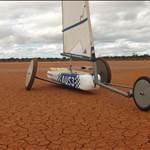
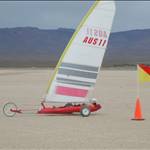
This is the design of the mainsail in the 29er Class yacht.
My interest is the way the sail covers the gooseneck fitting and downhaul system (if used).
My question would it work?
Would it be any better than the current sail design?
Is it legal under class 5 rules (as it would be included in the overall area of the sail)
I am making the assumption it would be OK in class 6.
any comments?

I think it looks good, cant see it improving performance other that reducing a little drag and providing more sail area. Just looking up a landyacht design I saw with similar...
Oh, it was a different boom/sail setup to the one shown above. If its variations in sail design your after it may be woth a look, its here:

fascinating set up. max pockt width for cl5 120mm laid flat . it has some very BLOKART looking elements in it in regard to the creation of a 'sailvang' but what I find really interesting is the brace that bends the mast using the boom as a lever
Would mast bend be attributed with sheeting in or the 'setting' of the 'boom brace'?
Only ask as I dont see many pulleys present to allow for the required leverage.
Concerning sail design; I've seen sails have to be very strong to last well and continue operating efficiently. Is the strength (especially for landyachts) primarily required to withstand wind pressure or the force applied to the sail to initiate mast bend?
I thinkit would have to push outwards like a ram. Maybe t has a powerblock(?) inside that pushes 2 tubes apart. with that set up you would reduce th lifting of the boom and be able to concentrate on the traveller for sail trim.
We did hve sheeting travellers on CL 5 years ago but they dissapeared when yachts changed to midboom sheeting .
landyacht sails do tend to have heavier construction for their size, but not as heavy as sailboards.. A traditional CL 5 set up has little pre stress but is very heavily tensioned when fully sheeted.
This is different in a BLOKART sail where the sail gets pretensioned due to the softer mast and fuller cut of the sail.
That was a nice setup , the boom would have had internal pulleys, have a look just before he gets in, he pulls the sheet rope about 500mm and the boom is only pulled in a much smaller amount maybe 50-80mm.
One of the "Sabre" yachts in adelaide had a box boom made from Al. tube approx 150mmx70mm with sharp corners, (i still have a scar under my chin from it ) it had an internal sheeting but it did limit how far the boom would swing out. I think this was because it was end sheeting, it might have worked with center sheeting like the standart.
Landyacht sails are normally made a little stonger than water yacht sails for the same size because of the apparent wind strength they are going to sail in.
It would be interesting to see some experimentation done in larger sock type sails, with all the interesting sailboard designs and materials around ,I'm sure the potential for leaps of performance has got to be there .
since it cant happen in class 5,with 240mm maxpockets, a loosely ruled MINI class would be ideal for the experimenters to play with ,without breaking the budget

Thanks for the info fellas.
Im sure fun would still be had if experimenters did their thing even without class allowances. You know those people who are happy just to know they did it better
Yeah.. some of the wizz bang sailboard sails out there have some great design stuff in them.
Thats why i would hate do go down a "strict" design path like the Nalsa mini yachts have done.
Class 6 allows radical sail design
I found this diagram of a sail, i know its a sailboard sail but some of the information is also suitable for landyachts.
The anatomy of a SAIL:
We have taken the liberty of using a North Sails Drive as an example of a beginner / free ride sail.

HEAD (Some sails may have adjustable heads)
Masts come in stock sizes - 400cm; 430cm; 460cm etc. However, your mast may not necessarily fit the sail properly because it is a touch too long. This is where an adjustable head comes into play. Many sails below 6.0m are available with an adjustable head strap which allows the sail to fit exactly on the mast. These adjustable head straps are either made of a webbing or a molded plastic cap or both.
BATTENS
Battens give rigidity and shape to the sail. All the main body battens are tapered so that they bend more at the luff end, thus pushing the fullness towards the front of the sail.
LUFF
This is the ‘front’ of the sail; the first part that the airflow encounters. The Luff Sleeve is the sleeve where the mast fits..
BOOM CUT-OUT
The area cut out of the luff sleeve to allow the boom to be clamped to the mast.
TACK
The very bottom of the sail, nearest the mast - usually the point at which the tack cringle (eyelet or pulley system for the downhaul fitting) is located. There may be a tack handle to assist pulling the sail onto the mast.
DOWNHAUL
This is the main method of tensioning the sail, and is most important for securing the bottom of the sail to the mast foot once it has been sleeved onto the mast. Modern sails have either a steel eyelet or pulley system, to allow the downhaul rope to feed several times between the pulleys on the mast foot and the pulleys either on the sail or built onto the hook put through the eyelet.
FOOT
The bottom edge of the sail, between the tack and the clew.
FOOT BATTEN
All sails have at least one batten that goes from the luff to the foot, rather than to the leech. As the foot batten is often orientated at a different angle to the other sail battens, it is often made easier to remove, and will always have a different batten tensioning system, so there are no protruding edges to stick into the deck of the board or the feet!
CLEW
The ‘back corner’ of the sail which is also the fixing point for the back end of the boom. The fixing is almost invariably an eyelet, through which rope from the back end of the boom can be passed.
BATTEN TENSIONERS
Setting and keeping the right tension in the battens is very important, so a lot of ingenuity has been employed in coming up with functional systems. Some brands and older sails still use straps and buckles, but these can slip, which is why most brands use allen key screw-fasteners. Unlike the strap and buckle system which must be adjusted and tightened every time you rig the sail, the allen-key system allows you to tighten the battens only when necessary.
LEECH
The back, or ‘trailing’ edge of the sail, between the clew and the head which effects the sail’s range of use (how little or how much wind a sail can take before getting under-powered or over-powered).

At last people are looking at the thoughts behind class 6.
An asymetric or even a 4 wheeler yacht will fit within the rules if you wanted (right now).
mind you measuring the contact spot of the might be tricky quickly at a championship. (I still prefer to the outside of the wheels)
You would also need to consider that wing masts generate HUGE down force and the chassis may need to be stronger (but that is what development is all about)
But yes class 6 is a great play platform for almost anything.. its just a pitty its taken more than 20 years others to see that.


I dont know why but the yachts both water and land that have any sort of wing mast have generated a lot more down force than the same yacht with a standard mast.
The "Sabre" land yachts that added an aluminium wing section mast of approx 150-200mm had to have the yacht beefed up to cope with the rig, mind you the wing sail rig was much smaller than the original sail that came standard.
Bill Finch would be the person with the answers as he has built a couple of landyachts with wing masts / sails.
Oohaaah, wooow, awwee.
OK I want one!
I have a drawing for a rigid wing sail that is made in two parts to enable the wing to increase the camber. Its rather crude compared to the wings I have designed and also made. The main problem of a full wing-sail is the weight aloft. This can be reduced but at the cost of strength and stiffness which are the principal design parameters. Now I think if I made the wing with the same basic construction as I did the four meter sailplane, I think it just might work..............
Kody
I built a 3m no flap wing to fit a CL 5 at the time Billwas building VINDIS original wing You wouldnt have raced withit as it had no acceleration , but when it hit its "slot' I thought I was going to get hurt
fortunately after the yacht got airborne and droppeddown hard it bent the internal frame of the wing and the whole show rolled to a stop
maybe a 2m 2stage wing is a possibility on a good smooth surface
A quick note on wingmasts I've used...
On wingmasts we've used in the past, a number of factors contribute to them causing more downforce at the mast step.
First up was that the mast rotated on a pin at the base, generating a distinct point load. At the same time, the masts were usually rigid and the depth of the shape was more controlled by the mast rotation, not by flexing the mast.
Also aerodynamically, a wing mast will try to rotate as speed rises, so greater sheeting forces are required. As the rigid mast loads up against the front stay, (due to sheeting loads) the forces have only one place to go; through the mast step! Note here that a rigid wing like Vindicator is not trying to set a shape in a sail, so loading is totally different & sheeting loads are a fraction of a wing mast.
High speed with (relatively) modern sail design & yacht design in class V, & more lately Paul's mini, shows me there is huge scope to go beyond wing masts.
For what it's worth - I was able to match a '70's friendship yacht at 110 kph + down the length of Ivanpah on the practice day at the worlds in 2002 with the class V you see in my avatar (yes thats right.. wheelbarrow wheels!)
But the french class V's were faster (Like Vic's new yacht)
Just a further note on that and I do not profess any expertise here.
A wing type mast/sail/foil, by definition is a rigid thing and the only adjustments it has is it's "angle of attack" to the wind (sheeting??) and "rake".
If the wing has multiple parts as on a modern aircraft (flaps, elevators etc), it's overall shape could be changed to suit tacks and conditions and thereby be more efficient. Also it could be set up with adjustable rake as in the F-111 swing wing aircraft concept.
Now that we have our ultimately efficient wing sail that weighs 2 ton, we will need a cyclone or a jet engine to get it moving.
The advent of mylar, kevlar, carbon fibre, other high tech materials and the methodology of their application has seen a huge leap in the performance of yachts and more particularly windsurfers.
Can anybody tell me why we in landyachting are not using this technology??
Is it because those, in the organisation that cannot be named (for fear of abusive phone calls and threats of legal action), are still basking in the afterglow of the last century?? Cheers Cisco
Your right Cisco very little has been done on wing sails/ Masts in Australia in the past. A few have played but normally on big yachts.
There is a bit on wing rigs on the net so have a look. I will try and find some links to have a look at when i get some time in the next few days.
But I would have to agree the mini yacht might be a good platform for trial of various rigs.