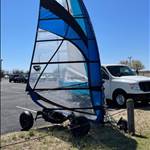
As I turn around making small sails for my Mini, I will dump here some findings and ideas. I don't know if I will go the complete to doing the sails... Let's see.
Why:
Land yacht sails is a niche market. Masts are not as standardized as for windsurf sails. So LY sails have to be considered as one-off variations on a theme. Not many sailmakers. Sails at the end can be expensive. There not a significant second hand market in my country. And second had sails may not fit my mast. For hobbyist, there is a rationale for DIY.
Two different path (at least):
There is good success in tinkering on windsurf sails, with 2 different approaches:
- use the sail as is by adapting the rig: straight mast + cuni + high boom,
- reusing the materials, be recutting the sail to fit the geometry and operation of classic LY.
Primary driver for windsurf sails is the downhaul to bend the mast <=> lot of tension on the mast panel
Primary driver for LY sails is the mainsheet and leach tension to bend the mast <=> lot of tension in the leach.
I will design a LY sail, where main control is the mainsheet. Recutting the Windsurf sail, just reusing the materials.
Masts:
Classic are Alu masts. However there is good success with Windsurf masts. Here SDM low carbon masts are cheap, especially in common length like 430-460. People turn to RDM masts with much higher Carbon percentage (80%, 90-100%). So large second hand market for 430-460 C30 masts. They are as stiff as C80 or C100. They are just heavier (not a problem in LY) as not as fast (return slower to initial position after gust). Sailworks has good success with their Mini Skeeter sails on a Carbon mast (quite long = 520cm).
So here, it is more easy to find a carbon mast, than to find suitable alu in needed variant and diameters. Windsurf masts are quite consistent. So what you design could be used more easily by somebody else on the other side of the planet.
Seems that they only need a internal reinforcement tube on 75-100 cm. No external reinforcement needed.
The longer the mast, the stiffer they are. IMCS increases with lentgh. I'm on the light side. I will prefer a small mast on a longer extension, for more tolerance to gusts.
Shape of LY sails - retro- engineering will next chapter.
Land Yacht sail design:
Basics about windsurf sail design can be found in www.ezzy.com/rig-support/ezzy-basic-sail-design-theory/. The important is to have in mind that the shape of the sail comes from a combination of Excess luff curve and of Panel shaping (seam shape).
I browsed several threads, measured my sail, and tried to do the same on pictures of sails from others. You can measure the camber and twist of the sail on pictures, with free tools like www.uksailmakers.com/accumeasure.
There are pictures of nice land LY sails on R&J sails facebook: www.facebook.com/search/top?q=r.%26%20j.%20sails
I looked at the shape of the sail without mast, doinf as done on pictures of R&J sails: pull the sail at the 3 corners. It should exhibit the "sail mould" and twist deriving from the panel shaping.
Our sails are quite flat, with 2-3% at about 33% and 6-8? twist. Values with different pictures of different sails give consistent values.
This is consistent with what I have read here:
- sails with little seam shape,
- luff curve is critical, as it does the major pasrt of the sail volume,
- rear part of the sail is flat,
- many sails have a very limited number of panels: a luff panel, a middle triangle, reinforced leach to convey the leach tension (X-Ply on Blokart sails, which make sense.
There a freeware to design sails: Enter the expected shape of the sail => get shape of the cloth panels to sew together. This is www.sailcut.com/
I played with a LY sail model with 3% camber at about 33% and 10? twist. This needs so little panel shaping ! This needs max 0.3mm seam shape (from 0 to 0.3mm in some places). And on the luff curve, it is a curve with max -1.6mm au 63% of the height !
As a conclusion. This is very near from flat panels and a luff curve adjusted to the mast curve ! Have maybe to add some Excess luff curve in the bottom (maybe), and done.
In below threads, 20mm is used max in the middle of the luff panel. This seems almost a lot compared to the above. But seems proven in use:
www.seabreeze.com.au/forums/Land-Yacht-Sailing/Sail-making/46m-Sail?page=1
www.seabreeze.com.au/forums/Land-Yacht-Sailing/Sail-making/tall-skinny-class-5-homebaked-sail/
Credits to Landyacht and BenBoulder :-)
From Windsurf sail to Land Yach sail:
- have to modify the luff curve, as not operating in same conditions as during windsurf. Especially much less downhaul,
- have to cut the bottom to fit the LY boom,
- try to keep the Head and Clew, and their reinforcements,
- try to recycle as much cloth, and stuff like battens, batten sleeves, full pocket,
- may need to build a specific "mast panel".
Looking at R&J sails and Sailworks mini skeeter sails, I think that a 25% mast panel should be OK. This minimizes a bit the new stuff compared to the recycled ones.
In LY sails, the loads seem to be driven by the clew and or the boom. This looks illustrated by the radial cut from Frog sails, Libre sails, some seagull sails... This is very LY specific. It won't be possible to achieve when refurbishing windsurf sails.
not sure but were the WS sails, just being recut to suit the bend of a standard LY ally mast. If you are going to use a standard W S mast then would you need to recut the luff curve. Would'nt the WS sail be ok for the mast,and only need the base altering ie straight to accept standard LY boom You could adjust the cut to suit the reduction in size,
.I've used small 3.5 WS with open top sails on masts rated for 5.3s and although a bit too stiff still worked reasonably well,lot harder to downhaul but still set ok.Couldn't afford four of five masts in the early days,until I recieved sponsership from local retailer then had a mast for each sail 3.5 to 10.5 formulae . (seems like a lifetime away now) Well I supose 35 years ago is a life time for some.
I see you have a Plume,think they are centre sheeted(Or maybe not) If they are then would you need to consider that into your calculations. There is a marked difference if the pressure on the sail from rear and centre sheeting. (I'm at present in long term expirement into the performace of both sheeting point's it's amazing the different feel they give)
Very interesting read up ,keep at it will be interesting to see the outcome'
Select to expand quotekennatt said..
not sure but were the WS sails, just being recut to suit the bend of a standard LY ally mast. If you are going to use a standard W S mast then would you need to recut the luff curve. Would'nt the WS sail be ok for the mast,and only need the base altering ie straight to accept standard LY boom You could adjust the cut to suit the reduction in size,
.I've used small 3.5 WS with open top sails on masts rated for 5.3s and although a bit too stiff still worked reasonably well,lot harder to downhaul but still set ok.Couldn't afford four of five masts in the early days,until I recieved sponsership from local retailer then had a mast for each sail 3.5 to 10.5 formulae . (seems like a lifetime away now) Well I supose 35 years ago is a life time for some.
I see you have a Plume,think they are centre sheeted(Or maybe not) If they are then would you need to consider that into your calculations. There is a marked difference if the pressure on the sail from rear and centre sheeting. (I'm at present in long term expirement into the performace of both sheeting point's it's amazing the different feel they give)
Very interesting read up ,keep at it will be interesting to see the outcome'
My Plumekart is not "center sheeting" (www.plumekart.com).
Practicing LY, I discover aspects that I had not noticed initially, as never done (seen) like that in sail boats. Example: as the tack is not attached to the mast with a Gooseneck, then the seeting point mosex the tack fore and aft, modifying the bottom shape of the sail quite a lot... Definitively, native LY sails are not set as windsurfer (WS) ones.
Condition for reusability / recutting, from what I understand, is to find WS sails:
- with little seam shape (flat mould, around 2%-3% draft),
- with "High" aspect ratio (high/width). I think that sails fom end of the 1990s, early 2000 have higher aspect ratio than today, which should be a good feature.
This forum feedback, is that it works ! Good !
About how to make a sail, the basic process is well decribed in sailrepair.co.uk/making-a-sail/
I'm lucky to have access to the Sailing club sturdy sewing machine, with adequate needle, thread... It is doing zig-zag only, but it will do the job.
I now need to buy:
- double sided tape (6 to 10mm large ?), a lot, to prepare before stiching (example for preparing the mast sleeve stiching),
- Roll Insigna adhesive tape (50mm large), to go below batten sleeves + reinforements
- Roll Insigna adhesive tape (10-20mm large). every where that you sew xply or monofilm it must be reinforce with insignia tape or have a layer of cloth glued on each side,
- Roll Dacron (50mm large), to finish/einforce the edges of the sail, for batten sleeves,
- 40mm polyesther strap,
- 20mm polyesther stap,
- would be good to find some Dacron, to have the possibility to make reinforement patches, mast panel...
Still a concern is the batten/spline to draw the luff curve. Idelally it would be about 4.5m long, be flexible and have a constant flex. Hiko propose to look at light aluminium extrusion . Have to check.
And to centrate information in one thread, to unstich the WS sail, Hiko advices a very sharp filleting knife used between the layers of cloth.
JMF
How much do those Plumekarts go for and are they readily available or build to order?
(how much do those Plumekarts go for and are they readily available or build to order?)
Plume website states no longer making that yacht.
many landyacht sailors use a goosneck,its a matter of personal choice,There are pros and cons, rear sheeting has less effort on the hands but forces the sail forwards,this can push the front of the boom to one side of the mast.Ok if its on the downwind side of the mast can give extra fullness in the sail and aid lower power,but if it ends up on the windward side it changes the lower shape of the sail. To control this you need to force the sail (by hand) to the correct side just prior to tacking opr gybing . Once you turn there's no way you can switch the boom there's too much pressure on it. Fitting a goosneck removes this situation and holds the boom central. It can be achieved by where you place the front pully so that as the rear pushes the boom forwards the front pullys counter that and hold the boom central to the mast.
With centre sheeting moving the pullys about gives you the option of forcing the boom forward,pulling it backwards or straight down, Minis generally are not suited to centre sheeting since the pilot is not far enough behind the centre of the sail,There is a lot of pressure on centre sheeting hence tripple pully systems.
I have tried goosneck/no goosneck...centre sheeting/end sheeting and am still undecided as to which is better.I prefer neutral centre sheeting without goosneck so that I can reach up to the end of the boom and force and hold it forwards on the downwind side of the mast, to increase the fullness of the sail,when I release the boom it goes back to central.
I also use uncut windsurf sails but since they are fully downhauled they stay central to the mast, so sheeting has no forwards or backwards effect.
When you get your cut sails built up I think you may need to rig them and by playing with the pullys , see where the boom wants to go when sheeted in,then make a goosneck if you need to ,Don't think you will be able to use centre sheeting on your plumekart.
Good luck.
Select to expand quotertz said..
How much do those Plumekarts go for and are they readily available or build to order?
I bought it through that website: www.plumekart.com/ . The young guy plays the salesman role, but does not looks to me really proficient about details of the design and usage. The designer, Pierre Cornuwell is.
The catalogue price is around 3200? I think. Early in the year, they proposed reduce prices, so I paid about 2300?. My understanding is that they have a few built. I'm very happy with the chassis. Not somuch with the sail mast combination. There seems to be a flaw somewhere.
Yes, those minis are not designed for centered sheeting. Even the competition models from that designer have a similar pulleys arrangement. By the way, I think that finally I should have taken a competition model. Pictures here: www.facebook.com/PlumeCharavoile/photos/?ref=page_internal
As I have an "unconventional" mast, I was looking for a mean to derive the different luff curves proposed in the sailmaking threads to a diffenrent mast. I followed some path from www.seabreeze.com.au/forums/Land-Yacht-Sailing/Sail-making/Sail-design-study to calculate the difference between the mast curve and the luff curve. The idea is that maybe this "difference" curve makes sense an adjustment ratio curve. Intenstion is to apply such curve to a new mast.
From wikipedia, the term spline comes from the flexible spline devices used by shipbuilders and draftsmen to draw smooth shapes. So you can draw what is done with battens on the floor.
Python language has package for spline interpolations and to draw the things. I imagine that CGZDF in his thread proceeded like that.
So I considered a Constant Curve mast : 64% at 25% height, 100% at 50% height, 76% at 75% height.
Luff curves enteres are the 2008 Paul Day curve that comes with LLM, and Ben Boulder Luff Curve.
I get below pictures:


I had taken few measures on my 7.0 windsurf foiling sail (power at bottom + flat top + little pretwist + designed for CC windsurf mast). It gives the curves below. I like them:


Hi,
Small update.
I have recut a very old 3.2m2 and tried it. Not super nice to my eyes, but works quite well. I have to improve my sewing skills, but all this heads in the good direction.
I studied better the landyacht specificities, and the above curves in previous posts don't in fine make so much sense. The windsurf sails are controlled by the dowhaul. The main load path is along the mast. On a Mini, this is quite different: the main load path is from the end of the boom to the top of the mast, along the leech (with a weaker one along the mast).
In my understanding, this implies that the luff curve should simply match the mast curve. The "strategies" related to negative luff curve for pre-twist don't apply here with the load path along the leech (would only work with load path near the mast).
So my next sail will fit the mast curve.
Also, I have old "tippy" windsurf sails. The newer "square top" sails have better aeodynamics and gust behaviour. So the recut shall achieve a square top. This is extra work, but should be worth the effort.
Last, I had some information that "flat panels" (no seam shaping) is working very well. So having only extra luff curve is a not a bad way to go.
I now have to "make it".
JMF
Hi there, its been awhile since I've been on the forum.JMF1 you may need to factor in the wind speed over the sail on WS v LY sails, a WS sail is 'nominally set' for a windspeed +/- a variation on the water. for example 15 knots +/- 5 knots this actually is a VERY small window of windspeed the sail needs to cope with.
A LY may be sailing in 15 knots of wind +/- 5 knots then you need to add apparent windspeed to that, a Mini LY may do 3-4 times the actual windspeed so a sail needs a workable window of shape from 15knots - 45/50 knots of wind almost hurricane force. And to think I about it the rig / sail needs to adjust from a low wind speed to a high wind speed with minimal adjustments from the pilot while sailing.
I stopped using windsurf sails for that very reason gizmo,The wind in my sailing venue is predominantly off shore over highish dunes.WS sails just don;t work . Fine ,and powerful when wind is constant,Probably better than LY sails.but once the wind starts to gust the LY sails have a far wider wind range to cope with the rise and drop .