I have taken a question from another thread and going to give it a place of its own...Select to expand quotewokelliott said...
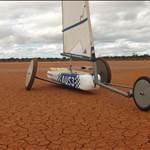
A question on mast rake. I notice that all the L/yachts have mast rake almost to an extreme angle whereas water based yachts have near vertical masts except that some Cats do have some rake.
Is it to position centre of pressure rearward or does it provide helpful wind flow? An old colleague and experienced sailor friend has suggested that in the case of Cats it can help lift the bows to avoid a nose dive. I would think that is not a problem with the land yachts as a more vertical mast placed rearward would achieve the same thing.
Increasing the mat rake does 2 things, it move the CE further back and also lowers the CE. (CE=Centre of Effort)
An upright mast / sail gives better lift, this is shown around in other things like high performance gliders, High performance hang gliders etc... but they actually have a very fine 'best' angle, by raking it back it give a more forgiving sail.
Swing wing aircraft do exist and use use best of both principles, the F1-11 used by the military was / is designed as a swing wing bomber that opens the wings up at lower speeds to create greater lift but at speed the wings move back to have a more stable air craft at speed.
Many years go the class5 rules just limited the mast length with maximum mast tip height from the ground, people then found they could get around the rule by raking the mast back, (this class5 rule now measures mast length + height from the ground to the mast base)
The Manta design yacht uses a VERY raked mast making the yacht a very forgiving and easy yacht to sail.
There are many good books written on aero and hydrodynamics of sailing by C. A. Marchaj that are worth reading.
en.wikipedia.org/wiki/Czes%C5%82aw_Marchaj
Hi Gismo, thanks for the reply. The reason for my post was mainly that I can see the CE is so far back that the rear wheels are taking all the side thrust and hence we have all the comments about sliding sideaways etc. (Perhaps good heart stopping fun but defeating the purpose)
Actually only one wheel (leeward one) is working hard in contact with the ground as the windward one is tending to lift due to wind pressure. The front wheel is doing practically nothing because of low weight on it and as it is far forward of the SG it tends to do little about sharing side thrust and does nothing other than to steer and coast along for the ride! My previous comment about the forward lifting effect of a raked mast would also take load sharing off the front wheel.....So one poor little rear wheel has to do all the hard work as well as carry all my meat and body liquids! 
If the CE was more forward by re-positioning the mast forward or to decrease the rake, would that not be of benefit to balancing the craft as regards CE or are the current rake and mast positions found to be optimum??
I bow to the experience of builders and sailors at any time but the comments about sliding or rear breakaway are too frequent.
Yesterday I set my other sail up with the sailboard boom and it did set the sail ok but the boom/mast clamp causes the mast to rotate in the mast post and I think it will eventually damage or saw off the mast at the base. One benefit is that the sailboard boom tensioning system takes a lot of stress off the mast base. Today I'll purchase some suitable Ali tube and shape a slow curved conventional boom to follow below the sail foot. After my last effort to re-shape the sail by a re-cut I'm looking for another method to set up a standard w/surfer sail.
Hava good weekend..wok
By moving the CE forward either by mast rake or mast positioning yes will put more force toward the front wheel.... BUT this then tends to drag the front wheel to leeward (down wind) and unbalances the yacht causing extra drag (making a slower yacht).
Land yacht design is trying to 'balance' things and there will be no perfect set up on ALL sailing situations, so many things change from yacht to yacht one of the main factors is the pilot weight. On bigger yachts where the pilot weight % is smaller it therefore has less of an effect.
re the mast swiveling,a couple of years back peter greaves came to the lake with a LLM that workrd well with a windsurfer boom. on the base of the mast he had fitted a machined plastic cone ,so the base rotated nicely in the mast pipe
Good thinking Paul. Wouldn't be too hard for me to do the same, that would also eliminate wear from the luff sock having to slide on the mast. I had thought of making the boom swivel on the mast but your suggestion is better...wok