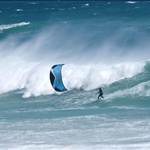
How much of low end differential can be expected with the 10 and 12m REOs when rider is really good at milking the lowend of the kite. I weigh 78kg and ride 6'1 SS Tyrant strapless which is a fast board so apparent wind potential is not hindered by the board.
Thanks!
Hi omg,
The 12m has a knot or two bottom end advantage over the 10m. I doesn't fly like a 12m at all and like all the other sizes, is quick for it's size. I hate saying it flies like a 10m because that comment is becoming so cliche these days, but it does.
Me being ~90 kilos on a 6' WAM as a quad was able to work upwind in very light winds. I'm not going to give a definite figure as I couldn't really tell with any confidence the exact wind speed due to the wind direction and setup. But it was really light and I was having a ball.
They were conditions I wouldn't ordinarily kitesurf in waves as I was of the opinion that 12's don't work in light wind in surf due to low apparent wind speed when going down the line, but I had a great time and really was able to ride down the line with confidence and do what I wanted.
The 12 is very good!
DM
hi guys,
and thank you for the feedback!
I just rode 2 hours with 10m REO and it was good:
in onshore wind & wave conditions which we have pretty much always (today as well) the wave riding was better than my current setup (Spleene SPX 10.5m2). For example, the kite had smooth power when turning and all in all the power was there when needed. Just like you have commented, the wave riding quality is really there. Regarding the turning speed, I wouldn't say it's really fast, SPX is really fast turning kite, but REO is quick enough.
HOWEVER, a big PROBLEM for me was that there were about 5 times, when the kite somewhat nosedived which my current SPX never ever did! Nosediving happened when the kite was above me between 11 and 1 o'clock and on the edge of wind window. This was when I was doing strapless freestyle (jumping front or back 360 & grabbing the board) and not managing to get the board back on. Therefore I fell in to water with the kite above me and my weight pulled the kite's front lines too much shooting the kite forward and then it went over the window's edge resulting nosedive. And I was pulling the bar in to keep the pressure on the backlines but that's all I can do to avoid nosediving. I know some of this is due to my skills, but I want to practise strapless freestyle jumping so this is a really turn off for me with REOs.
Anyone can comment on this one?
Hi omg,
Most any kite will luff if you don't redirect it forward when landing a jump. I would put it down to technique.
You should have the kite back in either 10.30 - 11 o'clock if going to Port or between 1.00 - 1.30 if going to starboard at time of landing.
If you are doing strapless front or back rolls, although I'm sure you think you have plenty of pressure on the bar to keep it pulled in, I can guarantee you have the bar out as you use the other hand to concentrate and grab the nose rail of the board.
We used to see this phenomenon constantly with people doing freestyle in the days of board offs, it's extremely difficult to hold power on, on modern high de-power kites.
I'm guessing you are powered as you start the trick but as soon as you initiate the roll and remove your front hand from the bar to grab rail, the back hand will let the power go resulting in inadequate time to complete the rotation and the kite being between 1 and 11 and sheeted out as your body falling pulls the kite well forward of neutral.
If you watch Mitu doing strapless rolls he loops the kite for landing giving him forward speed and a touch more lift and height towards the latter part of the trick and keeps the kite in the right position for a smooth sail away finish.
I suggest grabbing a video camera and video yourself trying the tricks so you can see exactly what you are doing wrong.
Just a theory that would explain what's going on, as I believe you are the first one to find fault with the Reo.
Cheers,
DM
I have found that higher performance kites will hindenburg (nose dive) if you don't redirect them correctly. A kite like the switchblade for instance will catch itself even if your stuff up the timing.
It all comes down to technique really and how much you want to progress your skills
thanks, however, I have to argue that Spleene SPX is flying more to the edge than the REO and SPX also jumps better, so on the paper REO should cope better but it's the opposite?
Regarding the technique, that's right, I am not redirecting the kite enough, however, I am keeping the back line pressure on but perhaps not enough.
I am a bit bummed right now, as I was almost certain the REO was the one for me =/ Waveriding wise, it has really good qualities, but I the stability would be better.
Oh and I almost forgot; I was floating on my back in the water today in stable & constant 9ms (19 knots) wind and I tested this: first I sheet in a bit and then I sheet out, and the kite nosedives. I thought this wouldn't have happened but it did. Try if you don't believe me...
Still a bit depressed about this "stability" issue.
Some kites will hindenburg more than others. The simple test is to fly the kite at 12 fully sheeted in. Let the bar go and run downwind. Some kites will nosedive very easily, but are usually older model hybrids. Looking at the shape of the canopy I would be very suprised that the reo would do this.
The worst kites I have ever flown were all 2006-2008 models of various brands. One hyrid with a tensioned 5th line would try to nosedive as it was going through the power zone and then punch back to life. Another brand would land on the riders head after a crash due to poor technique and of course there was the 11 strut 2007 hybrid with red bridles that fixed everything.
thanks once again on the feedback.
On lying back on the water: there is no current and no waves in place where I tried it (small island blocking waves without any current). Pls try to do this, sheet in and out thing while on the water to see how your kites behave. This 10m2 is brand new, first fly was by me.
Also, like I said, the Spleene SPX sits further forward than REO. Thing is, when wave riding, I want to throw strapless grabbed airs (at least practise them) and if I know that there is quite high probability if nosedive, then this puts me off from training these things. I highly wonder if you are able to run towards the REO when first sheeting in and then sheeting out without the kite nosediving.
Like I wrote, it's a shame I am having this, since otherwise I would be sold to this kite.
Perplexed and confused, this is definitely not my experience with the Reo, I'll try to grab one on friday and recreate your experience.
Only other thing it could be is if your frontlines are too long and as Dave said you sheet in and run towards kite while sheeting out, we tested and flew the 6, 8 & 10 in both light and nuking winds and they flew perfectly, we did however fly them on brand new 2011 contact bars (4 line equal length) to eliminate any issues with older bars with stretched lines and flew them on the light settings.
thanks for the feedback. However, the bar is brand new 2011 as well so it shouldn't be the bar nor lines. Damn, now this is even more problematic, I mean since you have different experience on the kite's behaviour.
Thing is that I had Bandit Dos 10m and otherwise it was really good, but when waveriding, if there was a hint of slack lines, the kite would just fall. Then I made a promise to myself that I never buy a kite with any stability issues...
ok don't take this as advice as i haven't flown the reo yet. more of an observation.
But its been explained to me the the last 25% of the bar out allmost completly depoweres the reo. Is this correct?.... if it is i understand that the disadvantage of huge aoa adjustment would be the chance of hindenburging with the bar out at the edge of teh window.
The advantage would be shutting off when riding the waves. So does the disadvantage outweigh the advantage?
I guess you can't have your cake and eat it too?
One of the local guys who has a reo was out in 10-18 knots of wholy wind the other day and also complained of the 12m reo falling out of the sky...
perhaps a change of technique is required.
I was down the river this morning on my 10m Reo and Sector and I decided to try what omg suggested. Ie stand still, kite at 12 sheet in and sheet out. I actually just let the bar go and sure enough the kite nosedived.
Wind was ~13kn, 2011 Ozone bar and I have checked the line lengths recently.
BTW flying a fast 10m kite on a Sector 60 is damn good fun.
Originally the kites had slightly shorter rear leader lines. The kites were slower but more stable. For the production models they were lengthened slightly to speed up the kite, improve down-the-line wave riding performance, improve depower, increase windrange and reduce need to adjust depower for unhooked wave riding.
To adjust the kite for flat water and increased stability for jumps perhaps try using the adjustment knots to effectively shorten rear lines.
To refine your technique in jumps, are you redirecting the kite forward for landings? This can be hard one handed especially when you're holding a surfboard in the other. Kiteloops might be an option if you send the kite just past 12o'clock to jump, keep the kite high momentarily, then as you reach the highest point of the jump, continue to turn the kite into a downward loop. With the right timing it will nurse you down, come out redirected forward and you won't have to move your hand on the bar- land well off the wind with a surfboard. This isn't really necessary with these kites but might give you a fun way to adjust your technique without compromising the wave riding performance of the kites.
Hope this helps 
I saw this thread a few days ago and had a chuckle. Seems kiting technology is slowly, slowly catching up to things that fly, like for example a hang glider or a paraglider, which a kite may possibly follow in design. When the REO came out, I noticed several components in the design that separated it from most other kites. Not wanting to sound like a wanker, there are design features that may attribute to the lift co-efficient being different from your normal kite. I will sign off now.
I had another look at the canopy shape. One of the best wavekites in its day was the 07' 9m fuel. The reo is a highly refined hybrid version of that style of kite. If you want to learn to do do grabs, etc.., I dont think this kite is for you, get a catalyst instead if you like ozone, better float in jumps, less rip when you use your kite.
Its called the reo, not the freestyle, Ive heard that is the calalyst. Due to the shape I would love to downloop it down the line. Jusus, I tried to learn handlepasses on a Rebel....???

Select to expand quoteJusus, I tried to learn handlepasses on a Rebel....???
Ouch!!
Select to expand quoteeppo said...
Jusus, I tried to learn handlepasses on a Rebel....???
Ouch!!
Yep 2007 Rebels, very forgiving but when learning handlepasses, throwing in an occasional kiteloop or downloop does not help your progression.

Hey guys, sorry in Fiji and having epic Namotu 20kts and 6/8', 4/6' surf 2 days in a row. BWSwasn't bull****tin...this place is the best I've kited.

I have still only had a few sessions on the reo and I gota say I absolutely love it in surf but still don't know how they will go with a twintip. As for the kite overflying they do seem to race to the edge very quick with no power when you let the bar right out which allows you to go into a wave faster without the worry of the kite then pulling you off the face. the kites don't seem to overfly with the slightest pressure on the bar but if you just let the bar go then they do fall from the edge of the window.
Maybe if you tend to do that you could add an adjustable stopper and lose that last inch or two of depower but for me when dropping into a wave on my toe side It helps me go into a wave without the kite wanting to pull me off it.