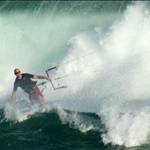
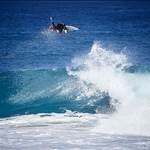
Been riding twintips for a few years now, trying to diversify into surf riding.
So I can ride upwind, ride toeside, gybe (half of the time and it ain't pretty), but I'm struggling with power. I always thought you could ride surfboards in light wind, but i seem to struggle to move along.
Today, about 16knots on my 10m. Plenty of power for the twintip but i was really struggling to stay moving with the surfboard. Also, my back ankle seems to be getting hammered with chop coming off the inside rail.
Am I doing something wrong?
Also, should i be using the rail or the fins to point upwind?
Or could it be that my $50 quokka special surboard isn't cutting the mustard. I noticed that my two and a half fins aren't parallel with each other, they seem to ''toe in'' a fair bit.
Any advice?
try moving your feet way forward of where you would normally put them, if you have your weight near the back of the board it will stall.
also don't edge too much, use the fins and the huge surface area of the board to plane rather than the rails.
it doesn't matter what condition your surfboard is in you should be able to get going earlier than on your twintip.
Hi Matty,
The board will count for some of the problem, maybe too much rocker tends to make them go slow and really bog down. If you have a narrow gunny tail this will also rob you of good light wind performance as well as excessive toe in on the fins.
I have a great surfboard to paddle, but it sux behind a kite.
Why not come up and demo a couple of surfboards to find out if it is the board or your technique.
Cheers,
KH
your probably hopeless. take your shorts off from over your wetty and you should get less drag
hi mate
i think the concept of surfboard = need for much smaller kite is bogus myself
maybe if on a sup or something that supports your weight fully but not for your average surfboard
sure, rocker, width and thickness are relevent to the boards performance but going from a 14m kite in 16kn to a 10m just aint going to happen imho
regards
i would disagree im 86kg and kited yesty in 16knts on a surfboard and 9m nomad no problems!
Having same probs myself- Yesterday I had my 5th session on my FreeStylefish on my (low grunt) 10m, and felt like a noob again, walking up the beach all the time, with the difference of having to carry unweildy fat board under my arm 
In those winds on the twinny I would have been getting upwind, with moderate effort.
Just wondering about taking out the foot straps and going strap free to try out different foot positions, but reckon I will lose the board going over the first bit of chop!
Feels like back to square one as a kiter- frustrated but determined to figure it out.
Tips appreciated 
Big side fins with a lot of toe-in slow the board dramatically. Try smaller side fins.
Hey Knickers, get rid of the straps and learn to ride in the flat first. Once you can ride up wind and gibe, you're ready for the chop and waves.
Learning strapless in flat is much easier than you can imagine.
NOTES: Basic idea here is that you ride as you were riding a surfboard, letting the kite create your speed. Lean back against the power of the kite, pushing the edge of the board into the water. When you decide to turn around, start with the kite low, power it hard so it pivots to change direction rather than going over top. If you bring the kite too high in the window it will pull you off the board. As you round the turn, slide your harness around so the kite is now almost behind you (to the left in this case) and go into the turn at full power. As soon as you enter the turn, push the bar out to burn off power, make the turn and finish riding toe-side, powering up the kite as you exit the turn.
Here's my 2 cents worth...
Foot position is important, particularly the back foot. For riding waves, the back foot should be roughly in the middle of the three fins. For riding upwind (or any time you're not on a wave), your back foot should be around the leading edge of the side fin, near the rail. (Some variation for conditions, board design, or personal preference - the wider the tail of the baord, the less relevant this is)
If you're riding with straps, have a look where the back strap is. Most people would have it in wave riding position, so it works to ride around normally with your foot out of the back strap and just in front of it (or have your toe in the strap but your heel as far forward as you can get). Some will have the strap in upwind position, and some deck grip behind the strap for riding waves.
Riding without straps is great, but be prepared for a learning curve getting out through non-trivial surf. Most people initially loose a fair bit of upwind slowing down for waves, or looking for the easy way though. It's worth the learning effort though.
Another trick (as you can see from the vid above) is to take a standard piece of deckpad made for your back foot, flip it around and put it where your front foot goes. The heel block is used to push your front foot against when going over waves so you don't lose the board.
Another important pointer--when you're going out trying to get over the waves, don't head straight over the wave -- as the wave approaches, slow down then just as the wave hits, power the kite up slightly, do an ollie and allow the board to float over the whitewater, travelling slightly back toward the beach. As the wave subsides, power the kite up further and head out and over the wave again. If you try to go straight over the wave, you'll just get pulled off the board, so let the whitewater go under you, keeping the board just on the surface of the foam as you float along the wave.
Nice downwinder,
A question on wave riding with a surfboard,
When your dropping into a wave and going down the line, such that your going off the wind and not pointing up into the wind, how to you stop over running your kite? Are you madly S ing the kite to keep it powered up while your trying to go down the line or just slowing the board down so as not to pick up speed from the wave?