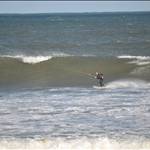
I have always ridden on flat water, but have a beach within a short driving distance from home that has much more reliable wind. Yesterday I decided it was a good time to attempt riding in some dodgy shorebreak.
After being tumbled trying to keep hold of my board twice after 2 consecutive waves dumped on top of me, I decided it was time to call it quits. It wasn't the best conditions and I also decided I wasn't powered enough.
I have a few questions and of course open to any tips you guys have...
Until you are more experienced should you attempt to body drag out past where they are breaking? I have no issues with getting up and riding quickly on flat water but things are markedly different in the surf.
Are there any conditions to look out for that will make learning less painful? Or is it just a case of harden the **** up and just do it till you are good?
Not many other kiters in the area otherwise id ask their advise, as it was I was the only one out, had some mates watching out for me though...
thanks,
surf noob.
Get on the board ASAP.
Keep the kite in the air at all costs.
Power is the key.
The more powered up you are, the easier it is to negotiate white water and near breaking waves - or gently boost over them.
Obviously, start in smaller waves, with good kite power, and work your way up to more challenging conditions. It is a lot less forgiving than flat water if you put the kite down and get worked.
underpowered conditions and big close out waves are not a good combo.
style on!
Andy
mmm, underpowered in surf is just not fun...
Go back to the old "sit down in the shallows to put the board on" method and wait for a nice looking break in the swell...
when approaching a broken wave start moving your kite towards 12 o'clock lift the nose of your board as you hit the whitewater. you should just ride straight over it. Obviously bigger waves are harder to negotiate than smaller ones but the principle remains the same. Practice makes perfect. But it's really not that hard. As others have stated, riding in the waves underpowered is undesireable, even dangerous if the surf is big. If you are riding a twin tip you want to stay powered up, not so neccesary if riding a surfboard.
Kiting in waves is amazing fun when done right, but there is a much greater element of danger which should not be underestimated. Untill you gain experience stick to small surf, and never go out in surf that you wouldn't swim/surf in.
if the waves to big just turn and run or go around it, wait for a break an just cruise out
and yes...power is everything
and dont kite through the flaged areas,go out 100m
you will soon work it out.
Hey Braaad..
I find navigating surf is all about reading the water. Most beach breaks have a 'peaky' section where it's particular gnarly, and then it's easier left & right of this.
If you start off in the less agressive part to get your skills down. Watch how the waves work .. when you're heading out and you're faced with a pitching lip, you can often head left or right to catch a section which isn't so bad. On particularly big days, you might find yourself heading downwind, parallel to the wave, until it breaks, then head out over the froth.
If it is is frothing & foaming, either jump over it, or do a weight shift with your feet to to pop onto/over it ..
If you get in trouble, I'd agree with the other #1 priority is keep the kite flying.. you can always find your board, even if it means dragging to the beach to find out where it went! Having your board, but a downed kite ain't half as much fun! 
And... like the others say, if it looks 'impassable', you can always gybe, stay in one piece, and have another go...
Here's my local beach break: 
You don't mention why you got tumbled. We could offer more advice if we know what problem you are having.
A few things:
- Ease off the edge just before you hit the white whater. If you are edging hard you will slide out and get munched, or do a really lame swinging air (and crash) as the wave passes. Concentrate more on standing upright and getting the nose up so you can ride up and over.
- If the wave is about to break you can dive head and body through the wave in a sort of kite boarding duck dive manouver (with the board on your feet). You will have to do this if you are trying to body drag out through the waves.
- Always ride down wind and get some speed and power happening. No power means no kiting. If the beach is long enough you can have a heap of fun blasting along and doing little carves off the face until you can see a clear spot to edge out. You combine this with racing the lumps of white water and steep faces. Also bend your knees ass you go up and over a face so you don't go into orbit (see edging above).
- Of course, if there's enough wind and your skills are up to it you can always jump over. There's nothing worse than crashing into the face of the wave behind. 
 .
.
Make sure you start out in a spot where the rip is not too strong, and if anything you want it running upwind to give you more power.
Flipside is getting you board back gets a bit trickier if you lose it...
Ok, to get through the heavy shore break you have 2 options. 1 ride fast and just ride over the waves where they don't send you flying. Just go fast and wait for the waves to have a break in berween sets. Take your fins out and put bindings on your board if you want more control. With out fins your board can easily ride over the beach. This let's you wait on the beach away from swash. Boots stop you losing your board in the waves.
2 get a surfboard and ride about having a ball getting owned in the waves. (be warned you do look like some random getting rag dolled as in the same way as some small chicktrying to hold back a massive dog on a leash does) with the aid of the kite you can easily get out of the way of the waves. If you take this option do not try to switch foot over shallow rocks as the explanation of how you got the cuts doesn't sound as good as getting washed over a reef after riding a double head barrel in 30 knots. Falling off turning also makes you look like a total noob in front of everyone
Boots in the surf is fun until you get held down and find you cant kick your legs. Depends on the size obviously.
Some good pointers above! 
IN MY PERFECT WORLD, HERE'S WHAT SHOULD HAPPEN:
I'd have checked the sets / timing when setting up.
I still wait at the water's edge with my kite in the air to time the sets.
Then quick on and out. The first lumps of whitewater much like tips above - point towards the foam and nose up and raise the kite (like a jump) and drop the kite into the power zone after to keep up your speed. You need some momentum to get you over the next wave, but not too fast as to lose control - this improves with time!!
Spot your exit zone (not breaking) through the waves downwind - and speed towards it!
If none available, I frequently turn around and ride back / upwind towards the beach for another go - just like waiting for a set to pass.
If I fall off in the impact zone, I'd normally body drag back in and try to spot the board - usually comes in quick with the breaking waves and just slightly downwind.
(If it's the last set wave, then you may be able to body drag directly to your board but keep an eye out for more dumpers - difficult when body dragging!)
Hope this helps!

if the waves are dumping on ya before you get up and riding, then i'm assuming that you have waded out into deeper water to start off with?
The go (in my opinion) is to start off as close to the beach as you can, that way you'll get up and going in the flat frothy stuff before you have to tackle a wave, and you'll be nicely powered when you do, so it's easy to boost over it. Any more than knee deep and you're making it hard for yourself.
^^ Practice hitting the water running and just jumping onto your board then sliding your feet into the straps (if you have em!)
And add: Don't try to punch through 6ft whitewater (from the Martin Vari Q+A)
If you are on a twin tip, just as you approach the white water, put kite at about 11 o'clock, turn board hard upwind, lift the nose slightly, and you will pop and climb up and over easily. make sure your lines stay solid so you have enough power to get over the next one. If you get through or over the first one but land without power, you probably wont have the power to get over the next one and it becomes a snowball effect.