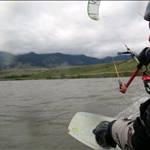
another session called short coz of lightning.........but can it really be that dangerous??... has anybody actually been zapped??... could dyneema actually hold a current or would it just burn too quick??... even if you got zapped.... would there be any affect considering im already wet?if so.... theen how come the fish dont get fried when lightnng earths? give me your views, im interested!!
good questions, I just got off the water last weekend , the storm seemed far away but a huge bolt jumped straight over our heads to a smaller white slightly greyish cloud with an instant crack. still packing up in a wet wetsuit I thought being wet am I at more danger of conduction, than if I took the wetsuit off quickly . The rain had not come at this stage. when people get hit by lightning are they normally wet or dry? I should have jumped straight into the car being the safest place.
That being said salt water is conductive but fresh is not. So if the kite, lines ,bar were wet from salt water I would say possibly enough power would kill you before the lines burnt thru. If everything was dry the dyneema would not conduct at all.
a windsurfing mast being carbon would also conduct well. But remember to that it has happened before where lighting has hit water and several people have been knocked over and zapped even killed on beaches.
also interested in other opinions
yeah, really keen to hear what people think.strangely enough, i got outta the water today when the lightning came, and sort shelter with my clothes & gear (no car) .... whilst chilling and waiting i was leaning against a stainless steel public BBQ. a big bolt came down not too far away, and at the same time i got a big zap from the BBQ. NO ****!!i was sitting there in thinking..... maybe the water would have actually been a safer place??I WANT THE FACTS FROM ANYBODY WHO CAN GET IT......will i get zapped if riding or will it just earth out??
i was kiting a few years ago on the Gold Coast and there was a lightning coming down the coastbeing a beginner thenand still learning id already crashed the kite in the water. the kite, lines, bar and myself were all wet. not thinking i re launched and ran up the beach on the wet sand as it was low tide.every second or third step my whole body would leave the ground (no higher than a foot) and just before i hit the sand i would feel a static shock through my feet.the wet kite and lines flying through the air were building up static and discharging through me
but it was only when i left the ground completely and came back to down that i would feel it if the kite was dry i dont think this would be a problem but im not going to test it to find out
The way I see it is if your out on the water with your kite up, you are now the highest point in your vicinity. Electricity will take the path of least resistance so any high point is now a target. Wet or dry kite, the lightning bolt has travelled kms though air so another 25 mtrs of kite line won't make any difference,
is it worth the risk?
Ragzilla, as airsail said lightning will take the path of less resistance.
I saw a thunderstorm come accross a golf course once with a wall of driving rain.
I was collecting golf balls in the river with friends. We all got out thinking this could be dangerous, so we all got out.
We all looked over at Hole 9 as a group of elderly women huddled underneath a tree. It was not wet and no rain was there yet.
Then BANG a huge thunderbolt hit the tree ran through it and zapped the group of 5 golfers. Only one of them had a golf club in their hands.
Stupidly we all ran over (with our wet wetsuits on) while one of our mates ran to the club house.
One lady had serious burn marks on her left arm, the other ladys all had sore joints and one had heart problems.
I have seen thunder hit the water at phillip island while surfing as well so being in the water is not safer either we all got shocked.
I would say it is dangerous to be out during thunderstorms.
While I don't know of any cases in kiting, I would not risk it if you can avoid it. It maybe unlikely to get hit on land, your chances of getting hit are majorly increased on the water with a kite in the air. There is plenty of electrical potential (voltage) in a thunderstorm to hit you and your kite - dry or wet. Wet would increase the likelihood more as you and your kite are electrically a lower path of resistance than if everything was dry and lower resistance than the vicinity next to you being the highest object in the sky. Stating the obvious it is not fun to be hit.
I used to do mountaineering in France where thunder-storms would often build up near the end of the day. If you were stuck on the mountain it was terrifying and I heard of quite a few cases of people getting hit with major bodily damage. I met one guy whose belly area was burnt. He ended up with major scar tissue, lost his navel and plenty of pain. Being out on the water your risks might be similar as in the mountain scenario.
From another thread:Select to expand quote
Dl33ta said..
My yacht suffered a direct hit 80 miles SE of Mackay, annihilated everything on top of the mast, sent a tongue of flame out of the USB port on my 3G modem, and blew all the electrical fittings off the diesel engine. The 3G antenna on top of the mast turned into floating bits of molten copper that drifted down on to the deck and melted into the deck paint. Pretty much one of the most terrifying and awesome things I've ever experienced in my life. Whenever I see any cloud that looks suss I'm off the beach and out of there asap.
However a yacht's mast is made of metal. An internet search reveals a Mythbusters episode:Select to expand quote
The live or die test
For the final test, they built a Ben Franklin dummy with a torso and hands of ballistics gel and a skeleton of PVC pipe. They visited the PGE lightning strike test facility (previously seen in the showering during a thunderstorm myth). A heart monitor was rigged up to check whether or not 6mA of current crossed the heart (fatal).
Their initial setup stuck the kite right next to the generator as it slowly built up to the test charge of 480,000 volts. This was a bit too tough on their initial setup as the the kite string caught on fire before the full charge was reached. They changed things up so that the kite could be raised up to the generator when the fulll charge was ready.
With a wet kite string, there was a nice spark from the generator, to the kite, down the string, onto the key, and into the dummy Ben's finger. The heart monitor showed a lethal charge to Ben's heart. A real lightning bolt has a lot more charge, so it would be even less likely to survive.
busted (the first two parts of Franklin's experiment are plausible -- flying a kite in a thunderstorm and having a charge travel down the string -- but it's unlikely that Franklin would have been able to touch the key)
Appreciate everybody's input.
but my theory is.....
if im in the water..... Wouldn't it just earth over me?
how come fish don't get fried when lightning hits water??
you realise I'm a self confessed ****wit, and I'm probably going to put this to the test!!
Fish don't die as the lightening can rapidly dissipate when it hits the ocean as the current has more room to spread out than when passing through a small cable or human body above the water. The lightening will earth through you but has to pass many volts through a small cross-section.
Ragz - the internet is complete with all the information you need on the matter. Just look it up. You don't need your own theories - people have theorised before, and experienced lightening while using water crafts.
If you can't find anything about kiting specifically, search for sailing or windsurfing. There are a couple of good stories in this thread:
www.seabreeze.com.au/forums/Windsurfing/General/Windsurfing-in-a-Thunderstorm/
Select to expand quoteBletti said..
Fish don't die as the lightening can rapidly dissipate when it hits the ocean as the current has more room to spread out than when passing through a small cable or human body above the water. The lightening will earth through you but has to pass many volts through a small cross-section.
Personally, I think that lightning could be the last of your problems if you continue kiting during a storm. Some thunderstorms can generate very powerful wind gusts, known as micro-bursts. The mean wind can increase from say 20 knots, to possibly 60-80 knots within seconds. A great example of this was the videos of the storms hitting Victoria and NSW, in the last couple of days. To make things worse, sometimes the seabreeze type winds can drop off very quickly, as the storm front approaches. This may result in your kite falling out of the sky, with the approaching gust front heading towards you, and then trying to relaunch. Moral of my story is to not fly in stormy weather, land ASAP when you see a storm approaching, secure kite and take cover!
More people die each year from lightening strikes than shark attacks. This is just a plain fact.
(but hey more people are killed by photo frames and cupboard doors than shark attacks)
.... that last one made me think, I'm guessing that includes photo frames used by angry spouses?
My 2 cents.
Nobody knows how NATURAL lightnings work. They just have theories and can't explain 99% of them (uncontrolled environments aka normal lightning).
The laws we learn in school are wrong (not wrong but don't fully explain the phenomenon) and they explain (the best) static discharge.
We did some paper calculations in the university taking air humidity, pressure, temperature, cubic space, type of soil and its static and conductivity properties, voltage and amperage of lightning, even airflow (wind) and magnetic field properties above the lightning "strike". What have we concluded... 99,999999 % lightnings are acting DRUNK and don't know where to hit and by our known theories, it is impossible to even hit the ground.... But they do.
We even added some percentage of particles (which would be unsafe to breath) to increase air conductivity and trippled the lightning strenght and still, numbers were weird (not possible).
There are couple of theories with cosmic rays which explain it very well but we are still missing at least 3 more potential factors to fully "predict".
Basically, billions cosmic rays falling true atmosphere every millisecond and some of them have weird paths (lightning paths) due to gravity, atmosphere characteristics, etc... , and they leave less resistance (in every aspect) behind them for a really short period of time (nanoseconds) and small percentage of that particles have massive potential charge (measured in eV - electron volts) opening path for anything (in this case charge).
Most of them are proven in simulators but we don't have that much computing power to simulate even 1 square cm.
There is no rule where will it hit and stories about "don't stay under a tree" are actually "not" true. Yes, they hit trees often but they hit water, beach soil and some types of mountain rock (not peaks, random part of a mountain) more often than trees.
In early 90's we discovered (by accident), with every lightning hitting the ground, there is another pointing in space at the same spot, even 50 times larger. So we actually don't know SQUAT about them or how they behave.
So, nobody can tell u what is safe. :\
Ragz I don't think you will ever get a definitely answer due the the randomness of nature, you will just have to make your own judgement and weight up your risks.
But for me I have seen a man hit and killed by lightning standing at the edge of the water on the beach. With his family sitting in the car waiting for him, having argued for him not to swim but he had driven across the city for a swim and was going in at all costs.
So I put up with calling it a day earlier than I'd like.
Hi there Seabreezers!
Thought this would be a good thread to break the ice, as I have been a “looker” for quite some time.
Ragz you ask a bunch of questions in your first post and I would say yes to all of them.
Coastflyer summed it up nicely, the lightning is just a part of it. (A guy got hit today while surfing in Byron, hopefully he’s ok but it sounds pretty serious)
We’ve all been forced out of the water by storms and how much you push your luck is an individual choice but if you push your luck too often your luck might run out.
A wise old saying in the aviation industry goes something like this- if you never fly into a storm then you will never have a problem in a storm.
Make what you will of that but a lot of people have died in air crashes caused by storms and I don’t see much difference to flying a kite or an aeroplane in these conditions, the end result may not be good for your health.
Just use some common sense and get out of there with a safe margin before the storm hits.
Safe kiting folks. 
Surfer was struck 200m from my house. It was one of those bolts that everyone thinks it struck beside them. He is in a bad way. You r kidding yourself if you think it's ok to kite safely with the danger of lightning, let alone a storm front. The static discharge you can get when landing sometimes proves to you that it's possible to get zapped. There are a few ways you can struck. I forget the names, but basically its direct strike, vicinity ground 'splash', and striking an object near you. ie..a kite
www.abc.net.au/news/2015-11-08/man-struck-by-lightning-at-byron-bay/6922172