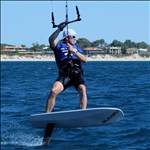
As a water addict who swings both ways (poley and teabagger), I am a lot better at windsurfing than kiting. Given my skill level with kiting is still very limited I decided to windsurf yesterday given the impending cold front.
A description of the afternoons conditions...the wind was on shore and hovering at around the 17knt mark. On the water were four poleys (including myself) and six kiters. The wind conditions were as below:

Now at the time the day was sunny and all very pleasant, however sitting on the horizon and fast approaching was the cold front with dirty black clouds.
Hopefully the graph is clear enough(unfortunately the times and days have been clipped from the image), however if you look at the last third of the top graph you can see where the wind jacks up.
When the front hit the winds went from 17knts and gusted to well over 35knts. Given I was on my windurfer I was able to ride out the worst of the wind (albeit with a 6m sail) by sheeting out and holding a hard rail. As a last resort I know that I can always jump into the water and hold onto the mast if things become pear-shaped.
What did however impress me the most and is the basis of my question is that during the worst 5 minutes of the front, 3 kiters held in and kept sailing with us during this time. These guys were using 9m kites and I know that I would have been brown shorting myself if I was on a kite at this time.
The front at this stage had decided to hold in and within the next half hour all kites had left the water.
Would love to know what the process is for riding out a storm when you are on a kite and are completely over-powered ie. how can you sheet out enough and hold a rail when the wind has more than doubled in strength?
punch out to your safety , let the front dissapate and then reconnect and launch and keep going
Depends on the size if the kite... What dusts said is the best idea, especially if you're close to shore or there's crap downwind.
I'm curious -- if you're over powered on the sailboard and you let the sail depower and sit parallel to the wind, does it still pull at all?
The first and safest thing is land the kite before the squall!...
Assuming for some reason you can't or don't want to do this the most important thing you should have done at the start of the session is to do is select the correct kite. On that day I would select my 8m kite. I can go upwind in 20 knots and know I can hold 40 knots gusts fully depowered.
There's not many instances when you can't see a squall approaching. Depower the kite before it hits. Then keep the kite low and concentrate on digging a hard edge and churning slowly upwind. You can hold wads of power if you control your board speed.
If you get into an overpowered death run you can run down wind to kill some of the kite power, do a butt check, pull the safety. A more advanced technique is to send it for a jump. Hold the kite behind you and it slows and stops you. That's my preferred technique for getting your speed back in control. But don't try that if your still learning.
If the wind gets too powerful that you can no longer churn slowly upwind controllably. Stop, sink into the water put the kite low, you can even stick a wing tip into the water. Ride it out.
Failing that pull the safety.
Try to avoid coming to the beach and landing your kite during the squall. Land before hand or ride it out. If you have to land during the squall and there is no one to catch your kite. Ride into the beach and pull the safety before you get to the beach. the kite will drop into the water and loose most of its power.
Another good piece of advice is this. Keep an eye on the good guys at the beach. If they all of a sudden land their kites before an approaching squall.... so should you.
NEVER WALK UP THE BEACH WITH THE KITE ABOVE YOU DURING A SQUALL!! ALLWAYS HAVE IT LOW WITH YOU HAND ON THE SAFETY.
While kiting, If you see a squall approaching head as far away from land as possible ( if you cant safely kland you kite safely before it arrives)
As per plumment's advise, did heaps of storms last season down at melville.
(Pretty much same as what the windsurfers where during when its got really bad....)
1.Move kite as close to edge of wind window as possible, just above or touching the water.
2. Drop off your board!! and ride out the squall and use yourself as a water anchor,
there will be some pull but the water resistance will prevent any speed build up.
kite almost off the water, Depower, sheet out and edge like hell.
Head out to see not into shore.
Last thing I want to do is to jump when seriously overpowered though.
Yeh buddy I was out and saw that squal coming..hit exactly the same time down your way so must have been a large frontal. I had just packed up when it hit and yeh it was a good 35 to 40 knots, but two kiters still out. One rode it out in a similar fashion described, one punched out completely, although this particular person doesn't believe in safety leashes so he just let the whole kite go...but hey at least he wasn't injured I suppose.
Days like today are harder to judge, the fronts intermittent and chances are you could get caught out now and then. I drop my kite low..I don't depower a great deal, just enough (I don't want my kite jumping back and forth in and out the edge of the window) and dig heelside and ass in water and let it slowly drag you along, keeping ya board at 90 degrees to the pull (like before a water start). Either way it's not a pleasant experience.
If you do punch out, as soon as you do, grab that secondary release on your harness and be ready to let the whole damn thing go if it even slightly looks like its gonna go into a death spiral. That seems to kill or seriously injure too many crew.
Select to expand quoteKamikuza said..
Depends on the size if the kite... What dusts said is the best idea, especially if you're close to shore or there's crap downwind.
I'm curious -- if you're over powered on the sailboard and you let the sail depower and sit parallel to the wind, does it still pull at all?
Yeh, letting the clew hand (leach end) right out lets a lot the wind go past. It's not an ideal thing to do with regards to control of your board but it saves being catapaulted or causing an injury. If the water is clean then it is always possible to just go warp speed, the issue is that the water is rarely like this during these gusts.
Maybe my focus was not entirely on these kiters on the water but it appeared like they were sitting their kites fairly high (around 10-11 or 1-2 oclock depending on direction) and were still motoring along but not with the same level of control.
I suppose it is not a bad point of discussion given the up-coming winter months and keeping this season as safe as possible for all.
Eppo, as you mentioned some time ago, pre-frontal wind is always more predictable and less gusty. The good thing with sailing down here is that there is plenty of time to see fronts and to get your gear down before the big ones hit. The only issue is going out on those days when the front is in and the wind is fairly constant but those rainy squalls come through every half hour or so.
Hey Shi those, all the comments are right about kite placement and punching out ifyou need you need to during squalls but you got to remember that data is from beacon 3 which outside the harbour which always commonly gets atleast 10 knots more than pelican point, I was the 12m yellow and black torch, I don't think we got over 25 at all during that squall, as you pointed out most kept riding the whole time
That spot is one of the best spots to ride those conditions for obvious reasons, throw the kite gear in next time, If you don't have small enough gear pm me, still ditch the pole I've got a few small kites you can lend
Select to expand quotePlummet said..
The first and safest thing is land the kite before the squall!...
....
That is true in principle, just don't time it wrong. The absolute worst thing you can do is try to land *during* a squall. Have you ever seen guys trying to land a kite in 35 knots? It's carnage.
Possibly the most important thing is to not panic. Most squalls blow through in 10 minutes. If it takes 2 minutes to get scared and 5 minutes trying to land on the beach then you only had to last another 3 minutes before the wind backed off.
If you're out on the water then the best thing to do is to ride as far out to sea as you can. Get far away from anything hard that is going to hurt you (or that you are going to hurt. Rocks, buildings, breakwaters, markers and sign posts(, people, houses, roads). Make sure you have several hundred metres of clear water downwind of you.
Keep the kite low and slow and you can continue to cruise around and ride as slowly as possible. Don't allow any speed to build up. You should have pulled in the trimmer as far as possible and the bar pushed all the way out.
If it is getting hairy then sit in the water with your board on your feet and your kite sitting on the water. It's not a bad idea to let go of the bar so that it is at full depower. Just dab the end of the bar to keep the kite down on the water.
You have two options at this point. If you have a lot of distance downwind then allow yourself to move slowly downwind with the kite. That will depower the kite a little. Alternatively you can dig your board in and edge to try and maintain your position. That causes pressure in the kite lines which causes power. If the kite surges towards the edge of the window then that's a good thing. If it starts bucking around that is bad.
If it gets really hairy then you can release the kite to the safety leash. Be really sure your fingers and no part of your body is in a position to get tangled. If you do then the hook knife is your only way out. Do not be afraid to use it and use it quickly.
If all else fails then release the kite completely. If you're on a big deserted ocean beach then this is usually the best option of all. Once the tension is released from the lines the kite will have no power at all. It will most likely just sit nose down on the water and get nicely swamped in the shore break. If there's anything for the bar to catch on (rocks or weed) or people/houses downwind then the kite can become an uncontrolled danger. This is not really an option.
Select to expand quoteNickT said..
kite almost off the water, Depower, sheet out and edge like hell.
Head out to see not into shore.
Last thing I want to do is to jump when seriously overpowered though.
just what I would do,
PS the other thing is the old windsurfing rule. Rig your sail/kite for the gusts and the board for the lulls. It can be pure joy to ride around comfortably underpowered in the lulls with a 6-7m kite and a fast surfboard, then hook into it when the squalls blow through.
Select to expand quoteNickT said..
Last thing I want to do is to jump when seriously overpowered though.
And that's fair enough.
That's why I said its an advanced technique.
If your doing a overpowered death run its an option if you are comfortable with jumping and have enough down wind room.
You don't load and pop like you would jumping normally. hell you cant anyway, by the time your in a death run yourve lost control of your edge.
You simply send it bar out back behind you. Up you will go, typically it's not stupidly high because you haven't loaded and poped, Its more of a long low downwind glide. hold the kite back to slow you down and redirect normally and land at a lot slower speed.
I have used this technique hundreds of times. Its actually the most controllable technique for slowing down when over powered while still retaining control of your kite/board.
Select to expand quotelostatsea said..
Hey Shi those, all the comments are right about kite placement and punching out ifyou need you need to during squalls but you got to remember that data is from beacon 3 which outside the harbour which always commonly gets atleast 10 knots more than pelican point, I was the 12m yellow and black torch, I don't think we got over 25 at all during that squall, as you pointed out most kept riding the whole time
That spot is one of the best spots to ride those conditions for obvious reasons, throw the kite gear in next time, If you don't have small enough gear pm me, still ditch the pole I've got a few small kites you can lend
G'day lostatsea, good to see you out there giv'in it the big one. As a newb kiter I was impressed. Was that a 12m?? Man and I thought the 9m were doing well when the front hit.
As for the wind strength, maybe my wind predictions are out of whack and true the beacons can show stonger wind, but when my board was tail walking across the chop and giving that it was a westerly (closer to the inner harbour) I giving I'm thinking the squalls were well over 30knts.
Thanks for the offer, I will pm as it is always good to know other people I can kite with other myself (which has been the norm). By the way, looked like those guys out by the Cut were smashing it.
Yeah mate the pure c kites don't look as big cos they are not as open, there was another 12m out just before the squall, the black and blue airush, he saw the clouds closing in and made the call to change down to the red and black Vegas, before the front I was mostly just mowing the lawn waiting for a bit more wind out the front then went around the corner in the river mouth, it stays glass regardless the wind, I love the cut it is epic in winter, i had the cut to myself this morning it was a lot cleaner than yesterday but the wind was fairly gusty
... just to add to good info given here ...
Done this a few times now and worked for me:
... slowly bring the kite down and drop on water at the edge of the wind window completely depowered and heading away from danger.
... keep your hands on the bar for control, keep kite flying downwards back onto the water where it's safer, you can also feather the power if needed.
... keep your board on your feet and in front of you as a water plough, using the power of the legs and the surface area of board will keep the kite at the edge, the more pull the harder you plough the board through the water.
... ride out the storm and don't attempt to land unless someone is going to grab the kite.
... if still too powerful, punch out and if still being pulled get out of Dodge and let it all go!
Good luck and have fun man,
Robbie 
Select to expand quotePlummet said..NickT said..
Last thing I want to do is to jump when seriously overpowered though.
And that's fair enough.
That's why I said its an advanced technique.
If your doing a overpowered death run its an option if you are comfortable with jumping and have enough down wind room.
You don't load and pop like you would jumping normally. hell you cant anyway, by the time your in a death run yourve lost control of your edge.
You simply send it bar out back behind you. Up you will go, typically it's not stupidly high because you haven't loaded and poped, Its more of a long low downwind glide. hold the kite back to slow you down and redirect normally and land at a lot slower speed.
I have used this technique hundreds of times. Its actually the most controllable technique for slowing down when over powered while still retaining control of your kite/board.
I'll leave you to it, just risking a kite falling out if the sky followed by a backbreaking hot launch IMO
I call seriously overpowered when you jump and you need to sheet out to come down. So jumping it out is the last thing I'm thinking about if I'm too lit.
One thing about this sport is to hopefully prevent a bad situation by learning from others, and if you find yourself in a bad situation, just maybe you will remember what to do, to save yourself.
This article outlines some kitemares and possible solutions to prevent.
www.kitemare.com/kitemare-lessons-learned/
Thanks Shi. That might explain why the ex-sailboarders here just park their kites overhead, thinking they'll be fine...
We had a really good day last week - during the session, I was feeling happily over-powered on my 7m (!) but before I launched it, thinking I was erring on the side of caution, a wee fellow launched his 8m. I grabbed the back of his harness as he went sliding past, his kite at the zenith and fully "depowered" and then walked him back up the beach, hovering a few feet off the ground the whole way, so he could land it and put his 6m up.
Good times!
Select to expand quoteeppo said..
One rode it out in a similar fashion described, one punched out completely, although this particular person doesn't believe in safety leashes so he just let the whole kite go...but hey at least he wasn't injured I suppose.
Nope,
I didn't let the whole kite go ... ^^^
I had full control of the rig with a firm grip of the grab-loop on my flag-line.
Not using a 'safety' leash doesn't equate to a runaway kite when I pull the trigger.
Runaway kites happen when folks don't sand-down their kites properly on the beach,,,
or when cheap-arse death-leashes snap unexpectantly.
lol.
All good advice above. Squalls are nasty little buggers at times...actually all the time.
The last few squalls I've been in, I've found I've had to dig in so hard, and pull the kite round so much, I'm going up wind against my will... to the point I either have to wait for a lull to travel downwind, or end up sitting on my ar$e in the water, feet out, with the kite around 12 and let it pull me slowly down wind...
All those weeks, months, okay, years, trying to go upwind effectively, and now I long for the ability to go down wind!
Thanks everyone for the great advice!Select to expand quoteSaltySinus said..The last few squalls I've been in, I've found I've had to dig in so hard, and pull the kite round so much, I'm going up wind against my will... to the point I either have to wait for a lull to travel downwind, or end up sitting on my ar$e in the water, feet out, with the kite around 12 and let it pull me slowly down wind...
That's exactly what I do SaltySinus! Plus when I get overpowered and can't slow down by digging in I let kite slowly go higher and 'skim' with board over the water. This bleeds the power until I'm in control again. Dropping into the water and keeping kite at 12 gives time to rest too...