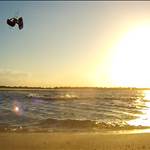
Keen to have a crack at night kiting this weekend. Lad from work wants to come down and take shots with his new rig.
I know nothing about cameras and he's not sure on the best settings to use for night action shots.
Anyone got an pointers for us?
With the wind angle and location of the sand bars we will be able to kite up to about 2m away from the camera.
Cheers in advance.

ISO settings, F stop and a very bright flash. No doubt some fancy lightroom work going on in that shot. A slightly slower shutter speed will help but too slow and the motion will blue.
This shot is most likely done in 2 steps depending on the lighting at the time. So a slow shutter speed to get the moody exposure of the sky and setting. A second shot with a big flash...merge the two together and you have a nice action shot.
Technically a very difficult photo to take Underoath with a fast moving object, black wetsuit and bright colours on the board and all at night. All that combined will totally confuse the auto focus and exposure settings. He'll have to go manual and just experiment with the settings as he goes. Hopefully he has a decent flash on the hot shoe too?
I'd suggest he gets down there in the late afternoon and start experimenting with position and focus before it gets dark, then worry about the flash and exposure settings after dark.
Let us know how you get on.
Good lighting as you dont want your iso too high. Have your shutter speed around the 300 mark roughly.
G'day underoath, I havn't tried kites but I've photoed some other stuff at night and the basic guidelines I went with are:
1. There is always going to be a conflict between either too slow shutterspeed or too high Iso, if in doubt always go higher with Iso (rather a grainy image than a blurry image.
2. Standard camera mounted flashes are only any good too a extreme range of 20m and run out of battery very fast, they will still flash but after something like 20 shots there is usually a massive (not obvious to your eyes) difference in light output so always have spare batteries (rechargables if you want to save money).
3. You will most likely have to wear at least a white shirt for the auto focus to pick you up fast enough while moving so manual focus and having a pre set launch spot/distance is a good idea.
4. Try offset lighting (camera and light source offset at an angle) like if you can use car head lights from the beach.
5. Low light means big apertures but generally the lenses that come with cameras don't have them, every shutterbug needs at least one fixed focal length lens (usually a f1.8 50mm) they are relatively cheap and great for sharpness. If I was doing this (dark subject 5-10m away moving) and had a endless budget on my own gear I would use a f1.4 18mm lens.
6. Lastly tell your mate to read up on a thing called painting with light, its not needed for kiteboarding shots but if he can get his head around actually producing a image with his own gear using it then he would have learned basically everything he needs to know about low light photography and the settings on his new camera.
I hope this helps its pretty subjective so other people may say differently but at the end of the day photography is like kiteboarding you can read as much as you want but time on the water solves everything.
Technically that's a dusk **** rather than a night shot.
Under expose your ambient (natural light) and correctly expose your flash.. easy . Flashes don't actually need to be bigger/brighter etc just a standard one will do . You are only a few metered away as you said..
I'd recommend your mate mucks about the night before with the camera in the same light to get his exposure techniques right . Getting a cheap camera to fire in those situations will be your hardest task with this type of stuff as it won't be able to focus.. maybe bring a light / torch etc so the camera has a better chance to track you. It'll also make your water look cool .
I have sent my mate to this page for him to have a read up.
Cheers everyone. Much appreciated. 
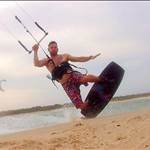
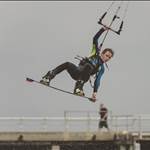
Everything that has been said above plus this:- Make sure the rider is wearing bright or white clothing and loud graphics on the board (just like in the pic). It gives the white balance something to grab onto and reduce shadows.
Your mata aould ba batter off looking at guidwd on the nternet for action dhots and low light.
These were just taken on My Sony A6000 using the inbuilt flash and on automatic. Obviously that can be improved but there pretty good for what they are if you ask me. 


I purchased a bunch of glow in the dark sticks. Going to attach them to the pigtails.
Hopefully can get some "tracing" effects going on with a looping kite.
Keep in mind it will probably 14 knots on a 13m... so im not getting too excited.
you can buy tiny little led lights that are magnets and can put them all over your kite. stunt kiters been doing this for decades
Don't forget to put some glowsticks onto your board to find it if (when) it falls off.
Manual focus. Pre focus on where the rider will be, auto focus at night is a pain.
Moderate ISO. 400 - 800 depending on how bright your flash is.
Moderate aperture if your flash allows for it, f5.6 to 8ish. Gives you a bigger focus window.
Fast shutter speed. The flash will probably only sync to around 200.
Time the shot and make it count. Flash probably won't cycle that fast so time you're shot.
Shoot RAW, gives you lots of post processing options.
Have fun with it and experiment.
Hopefully doing the same thing tonight. Settings I will be using Iso 1600, f2.8 or f4 depending on lens choice overexposing the highlights by 1 stop, this will allow me to drop the exposure in post processing to hide the noise in the darkest shadows and bring the color back to the highlights. Using a external speedlite at full power using high speed sync and set at 200mm for a concentrated light source i'm hoping to get a suitable shot.
Only trying to catch the color at sunset so there will still be enough ambient light for focus tracking. Depending on lighting ISO may not need to go that high as it gets darker Iso will be your only option. Flash should stop all motion blur if subject is close enough.
There are lots of cool sunset pics on instagram some of the pros are using multiple flash heads up to 6 allowing for further throw of light.
Also now available are LUME CUBES google these they are water proof and can be mounted to board and strings etc. Just investigating there value currently it appears they are very reliable for video and operating as a slave for photography may be sketchy?
Look forward to your results.
Disappointing sunset no colour no clouds. Was a fun night taking these shots settings were ISO 800, f2.8, 1/800sec. Flash at full power .
Love the look of the previous shots where there is some colour and clouds in the sky.
Till next time
Cheers
EB


A couple of keepers for the other night.
Wind was sub 10 knots and incoming tide made it challenging. But fun nether the less.
My fav photo was the last one of Pincushion Island, (That's the Moon)


Balancing a flash with ambient light is fairly easy to do. for best results get the flash off camera..
I do recommend reading www.strobist.com which is a great site for information on using speed lights off camera.
I have just built a waterproof housing for my flash, which also mounts to my gopro line mount. https://www.instagram.com/larsdanielterkelsen/?hl=en
this guy is the master at it... he has started using these www.lumecube.com/ and mounting them in the kite and on the board