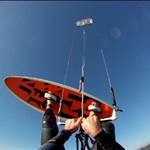
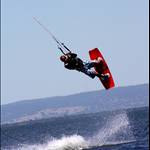
Lately I have been haveing a crack at boosting big time - flying a 10 m Bandit 3 in around 20 knots yesterday and in the surf so had some awesome ramps.
I've been kiteing for a bit over 3 years and am currently riding a 5'8" Kipuna .
Some of the jumps were - um very big !! ie seems that at the top of the jump I was looking srtaight at the bridle of the kite nearest me - lots of altitude for me and some hang time !!
My question is - apart from looping the kite ( Ok I'm 51 so not a young buck!) what is the best plan to make every landing a survivable one ??
Yesterday I landed hard on my left ribs and dont want to do that again - jumped left hand forward and got big height off the wave lip - and hit the apex of the jump and generlly I pull on the front hand to redirect to kite forward and land down wind.. still didnt work out to plan me thinks !!
So I guess I'm trying to find out what I should have done differently in the air to land the jump ? Once you go big there is alot of time to think about the kite -but my mind is always well WTF - now what next!!!!!
I'd love to hear how you guys that jump high fly the kite to make the landings - well just happen!!
Cheers Lambie
On big jumps the smoothest landings I find are actually done with a downloop before you land. At 51 you just need to give them a go timing is not that difficult. For learning to boost big, keep the wave out of the equation as it can send you into some strange angles.
Sounds like you pulled to early with the extra height and came down too hot
You dont necessarily need to loop, but you do need to turn the kite down hard before you land.
Most beginners land jumps and zoom under the kite and it goes slack and crashes.
They correct this by trying to land on an edge, or by not landing pointing directly downwind.
Instead, land pointing in the same direction you are travelling but by turning the kite down just before you land it will drift with you and you wont underrun it.
Moving from this to a downloop is simply pulling the kite a bit harder.
what they said and
no matter how high you get off the water do not send the kite to land until you are the same hight off the water on the way down. different kites require different timing but it should be the same each time for each kite.
If you are up too long(is that possible?) and have too much time to think and do not want to loop just wiggle the bar back and forth to keep the kite moving slightly so there is tension when you do pull the front hand to land. just timing and practice how far off the water you need to be to pull the front hand. start with double head high and see how it goes...
Jumping off wave ramps are awesome! but if you time the ramp wrong then if leads to interesting jumps.
Some more tips. More board speed. Go faster. you can stall mid air if you hit a lip to slow and that can lead to a the kite loosing power. more speed means more wind over the kite and more power for a soft landing.
One of my personaly favourites is to let the bar out. come down fast. (letting the bar out speeds the kite up giving more aparent wind). then bar in and hard redirect hard just before landing. when timed well it gives you at nice bit of lift just before landing and a super soft landing.
As others have mentioned a downloop on the decent os a great way to slow the decent or if not comfortable with that follow plummets advice regarding sheeting in hard just before landing ( about 2-3 m from the water this will give you a little lift just before touchdown.
Yep, loop it! Gives that little uplift, better then swooping kite as that only speeds you up, in fact giving you a harder landing
Every now & then ill do a big Jump, not loop it, stuff up my landing and think to myself why didn't I just loop it!

Plus one on the moving of the kite if you dont want to downloop just yet.
Say heading out to sea, send to your left, pull in, near the summit, move to the left again slightly, then right as you descend, followed by what plummett and the others were saying about a redirect...every kite has its own timing.
Me I'm a bit of a pussy when it comes to insane height, and follow the above..only on meduim days do I downloop just in case i get it wrong. I need to work on that!
The kite I use lands so soft anyhow with a huge horizontal float near the surface of the water just by redirecting. But say the VX i Used to use, it demanded a down loop or else...so depends on the kite you are using.
Another thing to consider, when you jump, keep your shoulders intially pointing in the direction of travel, rather than follow the kite up on its ascent...reduces the over rotation potential of the body in flight, where you can lose your orientation.
like this...
I went down to Sandy Point this past weekend which had a great 25 kn E most of the weekend.
My girlfriend got out the camera and shot this footage.
Thanks for tips guys, Plummet I ususally hold the bar in so i guess I should try your suggestion of sheeting out in the decent then I sheet back in just before touch down. Eppo - I couldnt get my head around your response re sending the kite left then realised the west coast difference LOL - over here on the east coast when heading out to sea we send the kite back to the right ( the sun setting over the ocean is also just weird!!) HaydenD - yeah Sandy point's a nice spot and your vid is great but your girlfriend chopped off the kite in all of the jumps so kite movement is kind of obscured.
I do downloop carve transitions now so the question is how much faster is the landing speed when looping the kite in a big jump (thats the bit that scares me!!) again thanks for the comments so far - BTW no one over this way (Gippsland that is) is looping kites so I havent got anyone to follow!!
Okay turn it around and head back to shore and it works...lol..sorry should have read where ya kiting.
So you can do a downloop carve gybe thingy...well...that's it to start from.
Try this...Going out to sea, do a jump...not huge and you know you can transition by after the kite goes left for the original jump, move to the right across the window and back left (I'm on your side of the country here) and land going the other way...
well instead...as you bring the kite right, keep it going right and hard...forward (front hand) loop it.
Once you got this, then practise down and forward looping it with small jumps heading in the same direction. Get bigger until you are down or forward looping high enough to get this kite all the way around.
That's how I learnt anyhow.
The kite technique for control and float on really big jumps varies a bit depending on the wind strength and kite size, you can either use "flat loops" (where the plane of the loop is closer to horizontal than vertical), or just use the "wiggle" as others have mentioned, to keep the kite lines tensioned and the kite roughly over your head.
For bigger kites (12m-10m) you probably want to use the wiggle. Check this video of Mark Shinn on a 12m crossbow in 20-25knots to get an idea of the technique:
Downloops and not going particularly big this day
A lot colder here in Scotland than what you pussies get out there 
^^^^ Great footage John!!!
What sort of camera mount are you using?
Been using my camera on a helmet mount but found it is too shaky....
I binned the GoPro HD2 for a Contour Roam 2 without the case on one of there sticky mounts. A much better camera for kiting IMO.
Full review here: kiteboarder.co.uk/kitesurfing/controur-roam2-camera-review-55339
Oi - Scotland - nice but that looks too effing cold !!!! again as with most vids that show people jumping you really cant see what happens with the kite - but its one of the better ones!! As for the vid of the "he throws a downloop at the end of nearly every big jump, especially near 2.10 and 3.30." - yes that is some good guidance - I just need to pull the pin it seems!!
I think I might start a new thread about the value of impact vests - ie do they work to stop bruised or broken ribs - or are they just to protect the ego! LOL