How can I calculate the air pressure in a submerged (in water) object with air trapped in it? For example when you push an inverted glass into a sink full of water, as you push the glass deeper the pressure of the air trapped inside it increases. How can I calculate this pressure increase for different depths, volumes, shapes etc?
Thanks.
The pressure is related to the weight of the water column above the glass. Shape of the glass has no effect.
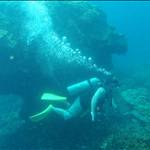
From diving, they say roughly 10m down is 1 "atmosphere" extra pressure. So, if air pressure is roughly 100 kPa at sea level, then at around 10m underwater, pressure will be roughly 200 kPa. At 20m down the, pressure should be around 300 kPa. These are round numbers, do a search for more exact figures.
If the "glass" is actually a fully closed capsule (e.g. bottle with airtight lid on), then air pressure within it will remain the same as it was filled at, unless it gets crushed inwards by the increase in external pressure.
Try some experiments.
- Next time on a plane, half drink a bottle of water at the airport, seal it, and open it at cruising altitude. (should get a bit of a "pfft" as you open it, and maybe a little spray of water if you shake it before opening).
- When at cruising altitude, finish drinking said bottle of water, and seal it. Watch what happens as you come in to land. (flimsy plastic bottles crush inwards).
- Take your empty plastic bottle and go free diving as deep as you can with it (it will mostly likely crush inwards).
Science is fun. Or maybe I'm easily entertained.
If the vessel has an opening or is perfectly flexible pressure (Pa) = depth (m) x 9.81 x density (1000 for fresh water, ~1025-1030 for sea water)
As the others said if the container is flexible or open ended then its only the depth that really matters - unless you get specific between salt water and fresh water.
Online calculator, choose your depth and units of measurement.
www.calctool.org/CALC/other/games/depth_press
Select to expand quotennnbrewery said..
Science is fun. Or maybe I'm easily entertained.
Science is definitely fun.
Select to expand quotennnbrewery said..
Try some experiments.
- Next time on a plane, half drink a bottle of water at the airport, seal it, and open it at cruising altitude. (should get a bit of a "pfft" as you open it, and maybe a little spray of water if you shake it before opening).
- When at cruising altitude, finish drinking said bottle of water, and seal it. Watch what happens as you come in to land. (flimsy plastic bottles crush inwards).
- Take your empty plastic bottle and go free diving as deep as you can with it (it will mostly likely crush inwards).
Science is fun. Or maybe I'm easily entertained.
You have explained it very well. Thank you. Unfortunately, the experiment you suggested may not be feasible nowadays. The airlines won't let you take fluids on board, I believe. Terrorism related.
Select to expand quote...
You have explained it very well. Thank you. Unfortunately, the experiment you suggested may not be feasible nowadays. The airlines won't let you take fluids on board, I believe. Terrorism related.
Liquids are still allowed on Aus domestic flights, it is only international flights that don't allow them over a certain size (100ml iirc)
Select to expand quoteJupiter said..nnnbrewery said..
Try some experiments.
- Next time on a plane, half drink a bottle of water at the airport, seal it, and open it at cruising altitude. (should get a bit of a "pfft" as you open it, and maybe a little spray of water if you shake it before opening).
- When at cruising altitude, finish drinking said bottle of water, and seal it. Watch what happens as you come in to land. (flimsy plastic bottles crush inwards).
- Take your empty plastic bottle and go free diving as deep as you can with it (it will mostly likely crush inwards).
Science is fun. Or maybe I'm easily entertained.
You have explained it very well. Thank you. Unfortunately, the experiment you suggested may not be feasible nowadays. The airlines won't let you take fluids on board, I believe. Terrorism related.
You can still buy water bottles past the security gates, and take them on the plane.