iSonic Speed Specials by Bjorn and Carlos

Speed surfers have always been the elusive ones in windsurfing. Traditionally staying away from regular spots, they were always looking for those contradicting conditions: Flat, glassy waters with nuclear winds. And when they weren't on the water, they hid in the basement, looking to shape the perfect speed needle. It wasn't a very social sport, and setting up reliable measurement equipment cost a fortune. And so the speedsurfer steadily disappeared from the windsurfing scene.
With the arrival of affordable GPS kits, speedsurfing has made a comeback. The appeal is to steadily increase your personal records, and compare those with anyone online.
Internet allows you to see who is faster than you on your favourite speedstrip, and once you send them an e-mail, they might even tell you how they tuned their material for that one run that annihilated your personal record.
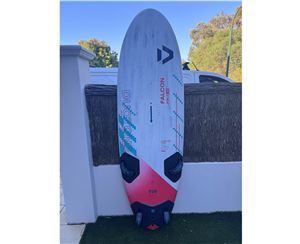
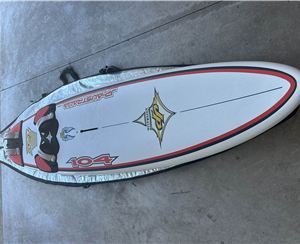
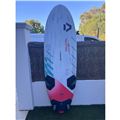
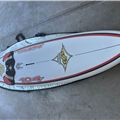
Since late 2008, Starboard has been involved with their own line of speedboards, carrying some DNA from the iSonic series, but strictly engineered for speed. Hence the name iSonic Speed Specials. To take our design to the next level, we recruited multiple world champion Bjorn Dunkerbeck and legendary shaper Carlos Sosa, who shaped their very first board together back in 1986. Here's what Bjorn, Carlos and Remi Vila, head of R&D have to say about speed:

Bjorn:
"I think the main ingredient in going fast is tuning. Fins, boards and rigs should all be optimized for each other, and to truly learn what goes best together under what conditions is an exact science. To learn, you need a lot of experience, which is why you see many older, experienced guys in slalom racing who are able to outperform the rest of the field because they know their equipment so well.
When you translate that concept to speedsurfing, experience weighs in at least twice as much. Just owning all the fastest equipment isn't going to let you be the fastest: knowing how to tune it and feeling comfortable with that specific setup takes a lot of time and practice. To give you an idea, we've been testing the 2011 iSonic Speed Specials for the last 18 months. "

Carlos:
"The guys on the strip who are quickest always have an eye out for the exact water and wind conditions. Flat water will allow you to put your board at a flatter angle, giving you more speed. The best angle will reduce drag, but going over that angle will slow you down again. But every type of water has a different optimum angle; water with little or no movement will have a smaller angle, whereas chop demands a nose that points up a little more, thereby increasing the angle again. Keeping the board as still as possible is also an art, because any sudden movement will cost you. Now the W54 is very easy to sail, and will perform ideally with a 7.0 but works well under a 6.2 as well. But if you are lucky enough to hit a spot with a smooth strip, 7.8 is the way to go.
Bjorn:
Last year I tested the W44 in Namibia, and one of my first runs got me to 44.77 knots. That's what smooth water will do for you. 47.8 on the 500 meter was my personal best at that spot, with the best control I've ever had on any speed board.

Carlos:
"Compare a guy like Bjorn to a part of an equation; there's the board, the fin, the rig and the rider. As a fourth element, he shouldn't only care that his rig and board are set up just right, there is stance as well. Think about harness lines, their positioning and length, the boom height and mast track position. Only when all of those elements are regulated extremely well, a rider can adopt a stance that will break personal records."

Bjorn:
"I'm a tall guy, but regardless of height, I always advise people to put their boom a little higher, since a high boom with long harness lines will let you leverage your rig to the fullest. This becomes most apparent with the W54. A great contest board when it is flat, and it allows you to use 7.8 down to 6.2. It's easy, has great control and is very, very fast.
The W49 is good from 7.0 to 5.6. A little faster and just as easy with the same levels of control. The W44 is the most fun to ride but it will need the wind. Use it with sails 6.2 and down to 5.1. Try them out and windsurf faster than ever. Enjoy your speed sailing."
Remi Vila, Starboard's R&D manager:
I've been told that in motorsports, the track runs that don't feel fast at all, usually are. This is a universal truth that is easily translated to windsurfing as well. Being on the edge of control will release all that adrenaline and makes you feel excited, but all the excitement will not translate to a higher personal record. When everything is tuned just right, high speed windsurfing will feel considerably less wild, and in those settled, secure positions you will find that acceleration is most constant.
Now the new W58 iSonic Speed Special is one of my proudest achievements to date; a no-paint finish and minimal pads make sure weight is kept to a minimum, and they still look the part. Deep deck concave for the W44, W49 and W54 is a design clue taken directly from the normal iSonic and closes the gap between the board and sail. This is a speed-specific design at its best, and I invite you to try them out. Enjoy your speed sailing!"
Click here to go to the iSonic Speed Specials
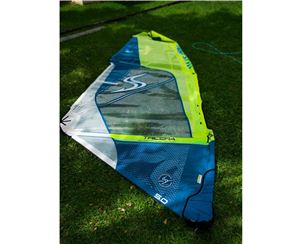
 redland bay, QLD