Eco friendly Stand up paddle boards, do they really exist?


Could this be the new carbon fibre?
The manufacturing history of composite surfboards and more recently, stand up paddle boards has always been a story filled with toxic plastics and resins. Toxic chemicals have left surfboard shapers looking aged and suffering respiratory problems after a life inside shaping rooms cloudy with foam dust and epoxy resin. These plastic and composite based products don't break down in landfill (which is where all these products end); and the factories in Thailand are pumping out huge amounts of CFC's into the atmosphere. It's all beginning to change however, and several stand up paddling companies are starting to push more environmentally friendly products.
The most popular eco friendly way of marketing a stand up paddle board is by shipping it in a board bag. Many companies do it, most notably Naish and Coreban who have been doing it this way from the start. Naish even go as far as saying "The Eco Boardbag reduces packaging by 85%." That's not too bad, but most of these SUP boards come from the same factory in Thailand which still insist on packing bubble wrap around the outside of the board bag for extra protection. Boards need to be protected in transit, so this added measure seems a fair call for customers, and are now trying some far more substantial methods to reduce their environmental impact.
The base materials used in the construction of stand up paddle boards are by far the most damaging to the environment. Foam, Epoxy, composite cloths like carbon and kevlar etc, all consist of synthetic materials. By minimising their use, and replacing them with natural materials the SUP companies can not only make a sustainable product, they can in some cases produce products that are superior to previously used technology. One such product is composite cloth made from Flax; used in the same way as carbon fiber, this natural flax fiber is woven the same way as carbon, laminated the same way with epoxy resin (we'll get to that later) and when cured, is producing very similar strength properties and weights to carbon.
Even the resin used in laminating the composite cloths can be made from sustainable ingredients. Bio resins are now becoming popular with many of the surfboard manufactures, and although not totally natural in their makeup, they're largely made from sustainable oils like pine oil and non-grade vegetable oil. Customers can buy this resin, take it to their custom surfboard or SUP shaper as ask them to use it in their next board for that extra, quilt free feeling.
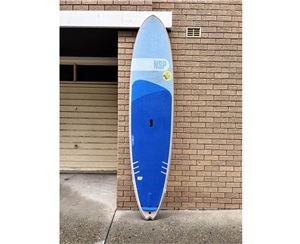
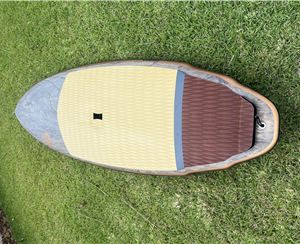
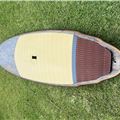
Currently using these materials are somewhat cost prohibitive, but once this stuff becomes more mainstream, you can expect to see less black boards, and more greeny brown ones! Speaking of brown boards, the wood used in many kiteboards and SUP boards called Paulownia attracting a lot of attention as a sustainable solution to the global deforestation problem. This light, very strong wood can be used in place of balsa, and best of all, it doesn't absorb water if the outer layer is damaged. Bamboo is another sustainable wood used in a similar way. Companies are using a thin layer over the deck and sometimes base of a board like a sandwich, to improve strength and resist heel dings and paddle chips. All of these 'wood look' boards use this method in place of a carbon or kevlar skin, plus it looks great and in most cases costs less for the customer.
Paddles are also getting the eco treatment by a couple of companies and in a few different methods. Choosing a simple wooden blade is a great way to reduce the impact on the environment, although the blades are usually laminated in fiberglass, and the shafts are still carbon - it's better than nothing! All wooden paddles haven't quite yet reached the performance of an all composite one, but the gap is evening up!
Many other sports are taking a step in the eco direction too, for example - there's a company making fishing rods out of carrot fibres, running shoes made from recycled materials with biodegradable soles and Nike's even making their world cup sports jerseys from recycled plastic bottles this year. You could cry that the entire world is jumping on the eco bandwagon right now, and for sure, many companies may be - but you can't argue that it's going to be good for environment in the long run.
With stand up paddling being promoted as an eco friendly sport itself, it seems like an obvious idea to manufacture the equipment using the same principles. By reducing the synthetic materials used, these stand up paddling companies are really stepping in the right direction for the sport. Hopefully over the next few years all of the similar watersports like kiteboarding and surfing follow suit, then we can all enjoy a sustainable future in the sports we love...
 Shellharbour, NSW